

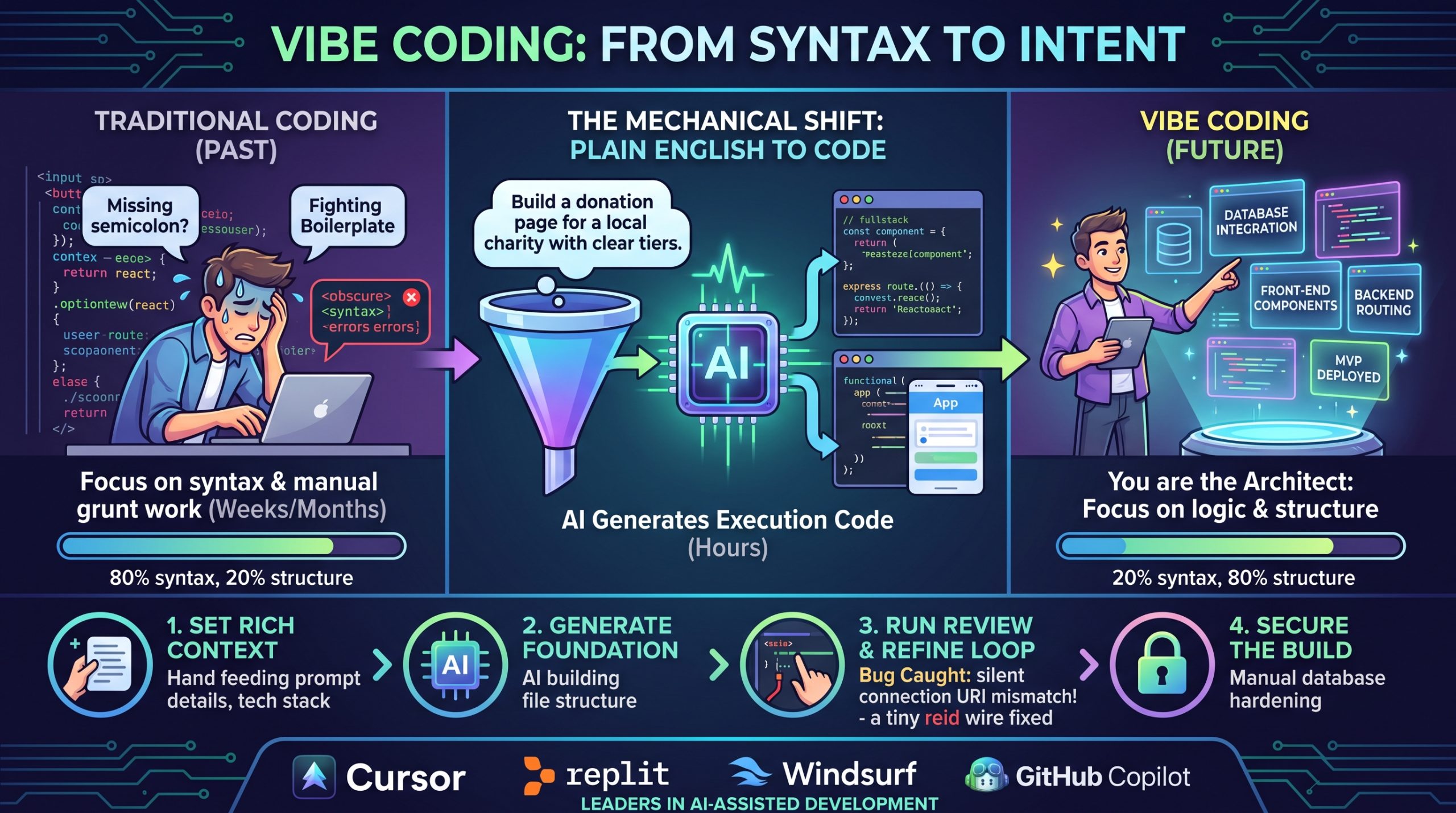
Programming used to mean spending hours hunting down missing semicolons and wrestling with obscure syntax.
Not anymore.
In 2026, plain English is fast becoming the single most powerful programming language on the planet.
Enter vibe coding.
First popularised by AI pioneer Andrej Karpathy in early 2025, vibe coding is straightforward: you describe what you want in natural language, and AI generates the execution code.
No tedious manual keystrokes. No fighting with boilerplate. Just pure, high-level intent.
The result?
The friction between a raw idea and a functional prototype has completely vanished.
Whether you are launching a quick app or validating a full-stack MVP, vibe coding is fundamentally changing software development from the ground up.
Here’s how it works—and why it’s redefining rapid prototyping forever.
The Mechanics of Vibe Coding
How does vibe coding actually work under the hood?
Here’s the deal:
It comes down to a fundamental shift from syntax to intent.
In traditional development, you spend 80% of your time writing repetitive boilerplate code and 20% thinking about structure. Vibe coding flips that ratio on its head.
Instead of typing out functions line by line, you step back and orchestrate the high-level architecture.
In short? You’re no longer just a coder typing in the dark.
You’re the director.
Does this mean AI does 100% of the heavy lifting?
Not even close.
While AI generates the raw execution code, human intuition is still required to drive the logic, run edge-case tests, and catch subtle flaws.
Case in point: Just last month, I was setting up a custom backend database integration. The AI generated syntactically flawless code, but it completely missed a silent connection URI mismatch.
It took human eyes—and a quick manual review—to spot the bug and patch the fix.
That’s the real power of vibe coding. The AI handles the grunt work, while you manage the big-picture vision.
And the modern arsenal making this possible?
Tools like Cursor, Replit, Windsurf, and GitHub Copilot are leading the charge.
Instead of simple autocomplete, these platforms ingest your entire codebase, read your project context, and generate production-ready components in seconds.
Let’s look at how this changes rapid prototyping forever.
How Vibe Coding is Revolutionising Rapid Prototyping
Why Vibe Coding is the Ultimate Prototyping Engine
Building a Minimum Viable Product (MVP) used to be a painful, gruelling grind.
You had to design the UI, wire up the database, configure backend routes, and write hundreds of lines of tedious glue code.
It took weeks. Sometimes months.
Today? That timeline has collapsed down to hours.
With vibe coding, you can spin up a fully functional, full-stack prototype—complete with sleek front-end components and working backend routing—before your coffee even gets cold.
And that changes the game for one simple reason:
Lightning-fast market validation.
In software and startups, speed is everything.
When turning a raw idea into a working product takes a single afternoon, testing market fit becomes radically cheaper and faster.
If an idea flops? You lost a Tuesday instead of six months of your runway.
If it hits? You’re already miles ahead of competitors who are still stuck writing manual boilerplate.
While rapid prototyping is a massive advantage, it is just one piece of the broader ecosystem. To see how these tools fit into your entire workflow, check out our ultimate guide to AI-assisted software development in 2026.
Now, let’s break down the exact step-by-step framework you can use to start vibe coding today.
A Practical Vibe Coding Workflow
Want to know how to actually build software with vibe coding without creating a buggy mess?
Here is the exact 4-step framework modern developers use to get real work done.
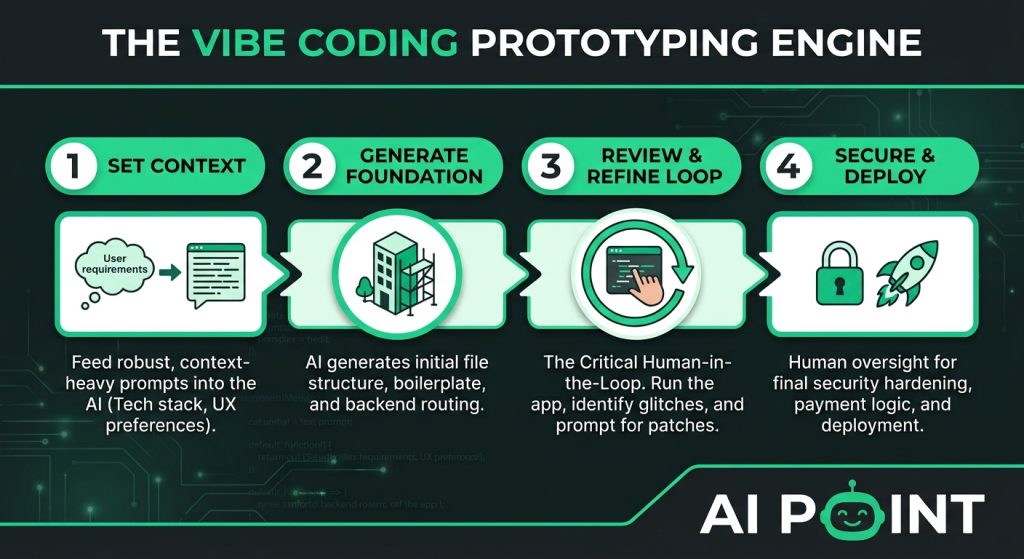
Step #1: Set Rich Context
Forget writing rigid, 50-page technical specs.
Instead, feed your AI tool robust, context-heavy prompts. Give it your exact tech stack, design preferences, and target outcome. The better your context, the cleaner the generated code.
Step #2: Generate the Foundation
Next, let the AI do what it does best: the heavy lifting.
In seconds, it will scaffold your entire file structure, configure backend routing, and lay down functional foundation code for your app.
Step #3: Run the “Review & Refine” Loop
Here’s the truth: vibe coding is NOT about blind trust.
The real magic happens in a rapid feedback loop:
Intent → Generate → Review → Refine.
You run the code, catch the glitches, and guide the AI to patch edge cases until the logic is watertight.
Step #4: Secure the Build
Finally, step in for the final check.
AI gets you 90% of the way there, but human oversight is non-negotiable for critical tasks—like hardening database security, testing manual payment handling, and pushing a clean build to production.
Conclusion
Here’s the bottom line:
Vibe coding isn’t here to replace software developers.
Far from it.
Instead, it’s elevating you from a manual code-writer to a high-level software architect.
By letting AI handle the tedious boilerplate, you get to focus on what actually matters: solving real problems, building great user experiences, and moving at breakneck speed.
Now I’d like to hear from you:
Are you ready to spin up a quick prototype using a vibe coding workflow? Or do you have a favourite AI tool you’re already using to build faster?
Either way, let me know by leaving a quick comment below right now.
