

Most marketers are playing a dangerous game.
They spend thousands of dollars on paid ads, optimize their landing pages down to the pixel, and celebrate a massive spike in sign-ups.
Then, thirty days later, half of those users cancel their subscriptions and walk out the door.
Here is the brutal reality:
Acquisition means absolutely nothing if your churn rate is bleeding you dry.
For SaaS businesses and subscription platforms, retention is the ultimate conversion metric. If your bucket has a massive hole in the bottom, pouring more water into the top isn’t a growth strategy—it’s an expensive exercise in futility.
And yet, most companies handle churn completely backward.
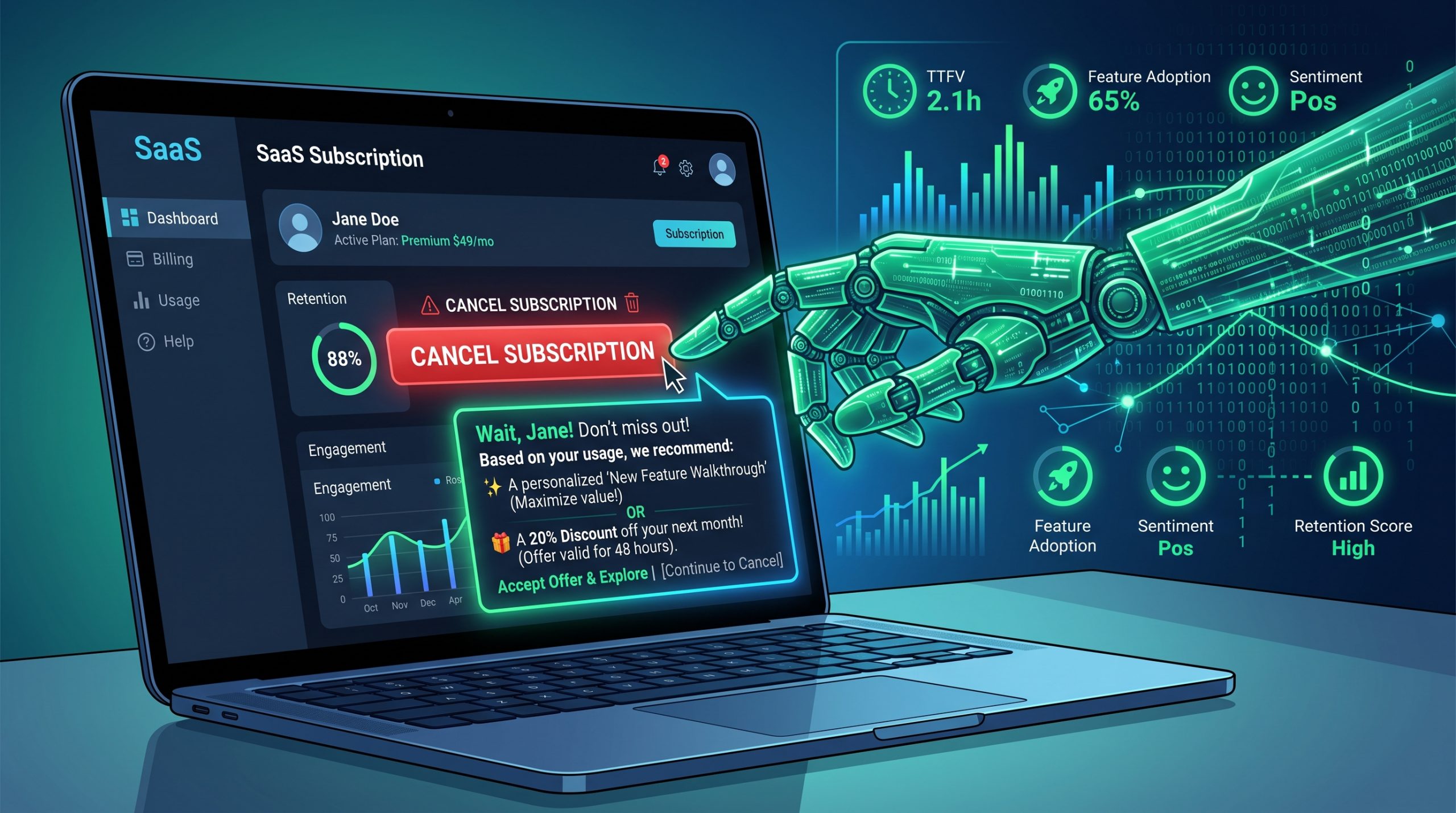
They wait until a user clicks the “Cancel Subscription” button. Then, they send an automated, robotic email offering a desperate 20% discount to stay.
By that point? It is already too late. They are gone.
What if you could stop churn before the user even realizes they are about to leave?
In this guide, I am going to show you how to shift from reactive churn management to proactive, predictive machine learning. We are going to build a churn-forecasting model that predicts user drop-off before it happens.

The Core Telemetry: What Metrics Actually Predict Churn?
Before we talk about machine learning or database architectures, we need to address a massive trap.
Most founders track the wrong metrics.
They look at vanity metrics like daily active logins or total time spent on the platform. They assume that if a user is logging in every day, they must be happy.
Wrong.
A user can log into your software every single day out of pure frustration because they are trying to figure out how to export their data before leaving.
If you want an AI model to accurately predict churn, you have to train it on deep product telemetry.
What metrics actually matter?
-
Time to First Value (TTFV): How many minutes or hours did it take a new sign-up to achieve their very first meaningful win inside your software? If TTFV exceeds your product’s critical threshold, churn probability spikes by 300%.
-
Feature Adoption Depth: Are they exploring core workflows, or are they stuck using just one basic feature?
-
Support Ticket Sentiment: How many times have they contacted support with angry or confused queries?
Most marketers stop optimizing once the user clicks “buy”, but a holistic AI CRO approach recognizes that preventing churn is the most profitable conversion metric of all.
You need to gather this behavioral telemetry continuously so your prediction engine has clean data to chew on.
Database Architecture for Churn Prediction
Now, let’s get into the technical engine room.
Where do you store this massive stream of behavioral data, and how do you get an AI model to analyze it?
You don’t just dump everything into a standard spreadsheet. You need a modern, vector-ready database infrastructure.
Here is the exact architecture we use:
-
PostgreSQL + Supabase: We store all user telemetry and event logs inside a high-performance Postgres database.
-
The pgvector Extension: By enabling the
pgvectorextension, we turn our database into a high-powered vector store. -
Behavioral Vector Mapping: The system converts the behavioral history of your long-term, highly loyal users into a baseline vector. Every single day, it runs a similarity search comparing your new users’ behavioral vectors against that success baseline.
If a new user’s behavioral vector starts drifting away from the “successful user” cluster and begins aligning with the “historical churner” cluster, the database flags them instantly.
You aren’t guessing who is unhappy. Your database is calculating the exact mathematical distance between a happy customer and a lost cause.
Triggering Automated Interventions
Knowing that a user is at risk of churning is useless unless you take immediate action.
Once your database calculates a high “Churn Risk Score” (say, an 85% probability of cancellation within the next seven days), the system shouldn’t wait for a human manager to notice.
It should trigger an automated, multi-channel intervention sequence instantly.
What does that look like in the real world?
-
The In-App Rescue: If the AI notices a user struggling with a specific feature based on their click patterns, it dynamically triggers a targeted, interactive tooltip or a 30-second Loom walkthrough right inside the dashboard.
-
The Customer Success Alert: The system pushes an urgent Slack notification directly to your customer success team: “High churn risk detected for [User Company]. Reason: Zero API integrations completed by Day 3.” The CSM can then reach out with a personal, proactive video message.
-
The Friction Remover: It can automatically unlock a premium feature or grant a free usage extension to help them cross their activation hurdle.
You are fixing the hole in the bucket automatically, systematically, and at scale.
Conclusion
Let’s wrap this up.
Acquisition gets all the glory, but retention pays the bills.
If you want to scale a modern SaaS business, you cannot afford to wait for users to cancel their subscriptions before you try to save them. By that time, your ad spend is wasted.
By tracking the right telemetry, leveraging vector databases like pgvector, and running predictive machine learning models, you can forecast churn weeks before it happens.
Set up your telemetry. Train your model. Stop the leaks in your funnel.
Your bottom line will thank you.
