

Let’s face it.
If you want to grow a brand, capture attention, or build a faceless media channel today, short-form video is where the game is won.
Whether it is TikTok, YouTube Shorts, or Instagram Reels, the algorithm rewards volume, consistency, and speed.
But if you are trying to edit, voice over, and export three short videos a day by hand, you will burn out in a week.
What if you could build a machine that does it all for you?
What if you could spin up a fully automated pipeline that scrapes trending topics, writes scripts, generates synthetic voiceovers, animates digital avatars, and publishes the final MP4—completely on autopilot?
In this guide, you are going to learn how to architect and build a fully automated short-form video generator from scratch.
Let’s dive right in.
Introduction: The Power of Programmatic Volume for Social Media
Social media growth is a numbers game.
The creators and brands winning right now aren’t just making great content—they are publishing at a scale that manual labor can never match.
By leveraging APIs, you can turn content creation into a software engineering problem.
This project is the ultimate practical application of automating media production, bringing together all the distinct AI APIs into one cohesive, headless media loop.
When you combine automated script generation with high-fidelity TTS and avatar rendering, you remove the human bottleneck entirely.
You write the code once, set up a cron job, and let your automated engine feed the social algorithms 24/7.
Designing the End-to-End System Architecture
Before writing a single line of code, you need to map out your architecture.
A fully automated short-form video generator is a pipeline of microservices working in sequence. If one step breaks, the whole chain stops.
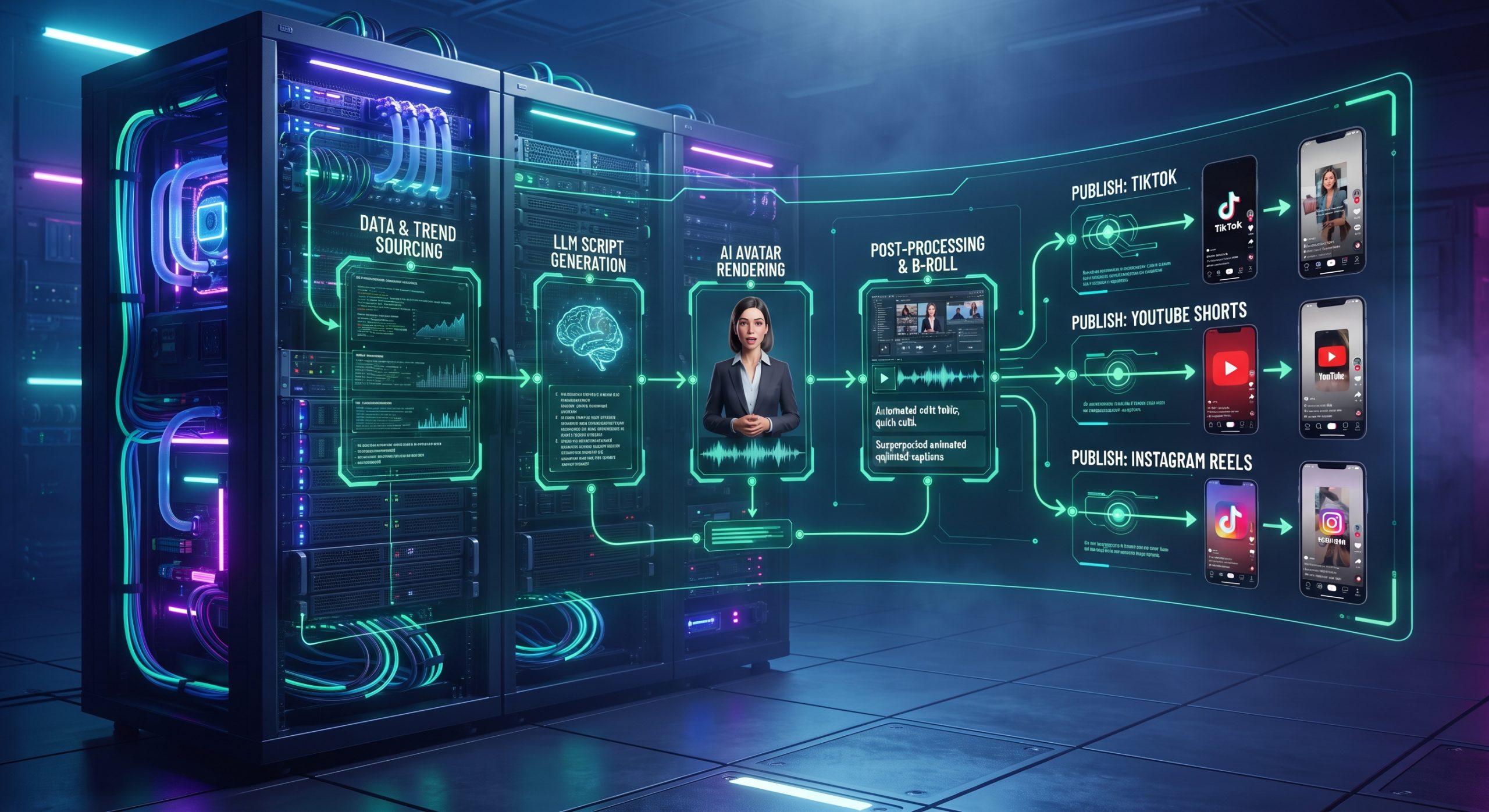
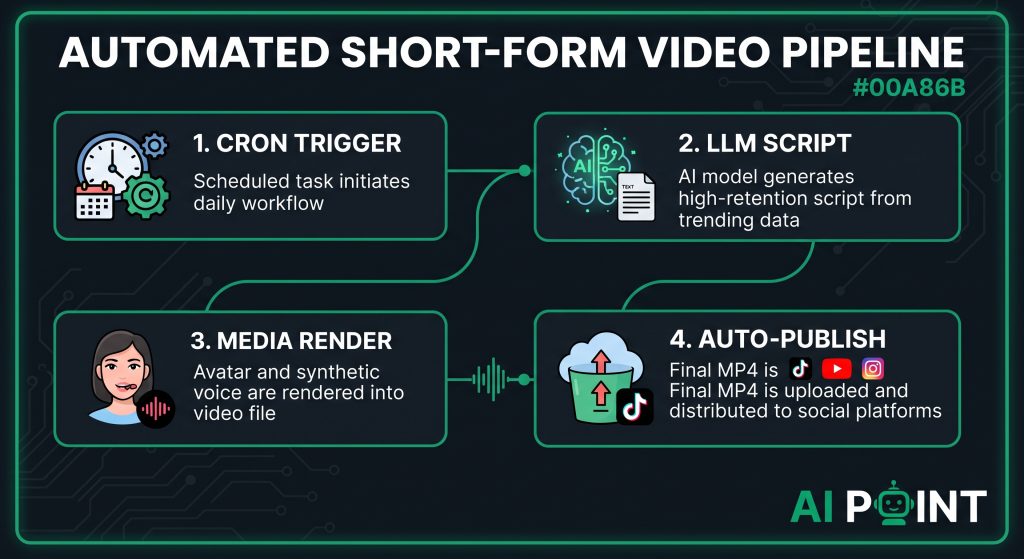
Here is what the end-to-end system flow looks like:
-
The Trigger (CRON Job): A scheduled task runs daily on your server (using Node.js cron or Python Celery) to kick off the video generation cycle.
-
The Data Sourcing Layer: Your script queries a news API, Reddit scraper, or trend database to grab fresh topic data.
-
The LLM Writer: An LLM formats the data into a high-retention 60-second video script optimized with strong hooks.
-
The Media Renderers: The script text is sent to a Text-to-Speech API for audio, which is then fed into an AI video/avatar API (like HeyGen).
-
The Storage & Delivery Layer: Your server receives the webhook, downloads the temporary MP4, uploads it to cloud storage, and queues it for auto-publishing.
Visualizing this pipeline keeps your code modular and easy to debug.
Orchestrating the Pipeline in Python or Node.js
Now comes the fun part: writing the orchestration layer.
Whether you prefer Python for its robust data tools or Node.js for its asynchronous speed, your orchestrator acts as the conductor of the orchestra.
It handles the API hand-offs. It ensures that the audio file is fully generated before the video rendering request is fired off.
Here is a conceptual look at how an orchestrator manages the async state in code:
Python
async def run_video_pipeline(topic):
    # Step 1: Generate the script using an LLM
    script = await generate_script_from_llm(topic)

    # Step 2: Send script to TTS API and get audio URL
    audio_url = await generate_tts_audio(script)

    # Step 3: Trigger the avatar video generation API
    video_id = await trigger_heygen_render(audio_url)

    # Step 4: Save state to database while waiting for webhook
    await db.videos.insert_one({"video_id": video_id, "status": "processing"})
By structuring your code with clean async/await patterns, you prevent race conditions and ensure smooth data flow from text to final render.
Injecting Dynamic B-Roll, Captions, and Visuals
A talking head alone won’t keep retention high on TikTok or YouTube Shorts.
Short-form video thrives on fast pacing, dynamic zoom effects, background B-roll, and bold animated captions.
Once your core avatar video is rendered, your pipeline should pass it through an automated post-processing step:
-
Automated Captions: Use an audio transcription tool (like OpenAI Whisper) to generate timestamped subtitle text, then overlay bold, color-popping captions directly onto the video frames using FFmpeg or a programmatic video library like Remotion.
-
Contextual B-Roll: Programmatically parse the script keywords and pull relevant stock video clips or AI-generated images to splice in during transitions.
-
Audio Balancing: Layer a royalty-free background track underneath your voiceover at a low volume (around -20dB) to instantly elevate the production value.
Automating post-processing turns a plain AI clip into a native-feeling social media video.
Scaling to Multiple Channels and Optimizing Costs
Once your pipeline is generating one video successfully, scaling to ten channels is just a matter of parameter changes.
You can configure your orchestrator to pull from different topic databases—ranging from tech news and historical facts to finance tips—and swap out avatar styles or voice IDs dynamically.
However, keep a close eye on your infrastructure costs:
-
Batch Processing: Don’t run generations randomly throughout the day if you can batch them during off-peak server hours.
-
Error Retries: Implement robust try/catch blocks with exponential backoff so a temporary API timeout doesn’t crash your daily publishing schedule.
-
Storage Cleanup: Set up automated deletion rules in your S3 bucket to clear out raw intermediate assets after the final video has been successfully published to social media.
Scale smartly, keep your API usage optimized, and let your automated machine run.
Conclusion
Building a fully automated short-form video generator changes everything.
You are no longer just a content creator—you are a media developer operating an autonomous publishing engine.
By mapping your system architecture, orchestrating clean API workflows with Node.js or Python, injecting dynamic captions and B-roll, and scaling your outputs, you can dominate social media algorithms with zero manual friction.
The pipeline is built. The code is ready.
It is time to deploy your generator, sit back, and watch your automated content machine come to life.
