


Content marketing has undergone a massive, irreversible shift.
A few years ago, writing a single, comprehensive 2,000-word blog post every week was enough to capture top rankings and drive predictable traffic.
Today? That approach is completely outdated.
Your competitors aren’t sitting around typing articles one by one. They are leveraging automated workflows to publish hundreds of hyper-targeted, fully optimized pages in a matter of hours.
Welcome to the world of Programmatic SEO.
But there is a major catch.
If you hook up an out-of-the-box AI model to a WordPress blog and hit publish on 5,000 unedited pages, Google’s algorithms will spot the pattern and flatten your rankings overnight.
Here is the ultimate truth: Search engines do not penalize automation. They penalize unhelpful, low-quality garbage.
In this guide, you are going to learn how to architect a programmatic pipeline the right way—scaling your output exponentially while staying completely clear of algorithm penalties.
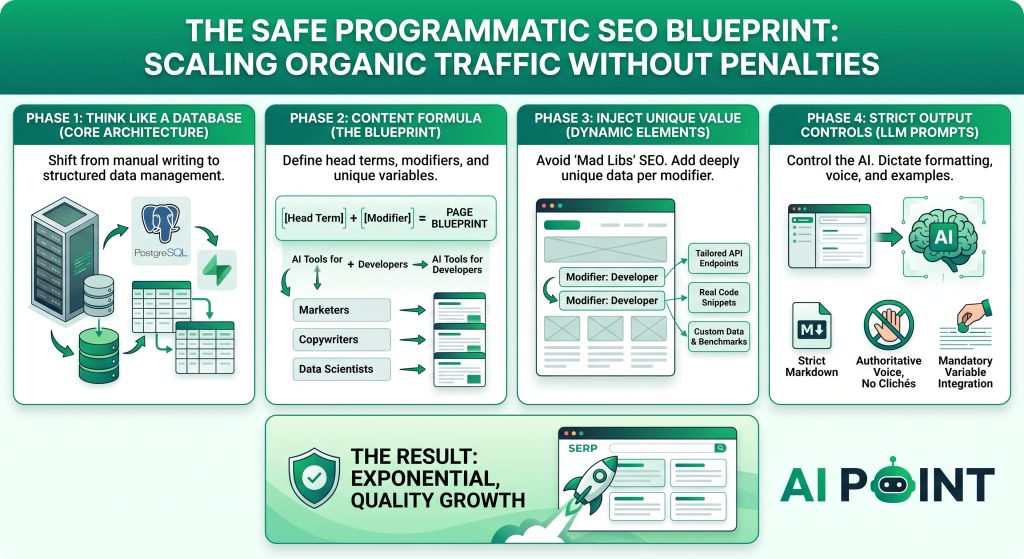
The Core Architecture: Think Like a Database
Most creators completely misunderstand how programmatic SEO works.
They treat a pSEO campaign like a giant text editor where they try to manually plug in synonyms. That is a recipe for disaster.
If you want to scale safely, you need to stop thinking like a writer and start thinking like a database architect.
Successful programmatic strategies begin with structured, relational data—not a blank document. The highest-performing builds rely on robust databases like PostgreSQL, frequently managed through platforms like Supabase.
Why? Because you aren’t actually writing individual articles. You are building dynamic templates that pull exact variables from a structured dataset.
Every solid campaign boils down to a simple formula:
-
The Head Term: Your core subject or main category.
-
The Modifier: The specific variable that changes per page (e.g., location, profession, or tool).
For instance, if your core topic is AI software, your head term might be “AI Tools for [Profession]” and your modifiers could be Developers, Marketers, Copywriters, and Data Scientists.
Combining these creates the blueprint for hundreds of unique pages. However, scaling this introduces a risk: if your templates are too thin or your variables don’t significantly change the intent of the page, search engines flag them as duplicate content.
Getting this architecture right is the foundation of any robust programmatic content and automation strategy, ensuring your site delivers real utility rather than generic fluff.
Injecting Unique Value: Beyond the Mad Libs SEO
The biggest reason sites get penalized during core algorithm updates is simple: they rely on “Mad Libs” SEO.
This happens when a site swaps out a single city name or job title in an otherwise identical template. Google’s quality raters and automated filters despise this because it offers zero extra value to the user.
To survive and thrive, your architecture must inject deeply unique, structured data into every single page.
Instead of just changing text strings, your database rows should feed dynamic elements into your templates, such as:
-
Specific API endpoints or integration requirements unique to that modifier.
-
Real-world code snippets or syntax examples tailored to the user type.
-
Custom data points, statistics, or benchmark metrics relevant to the sub-niche.
When a developer lands on your page, they shouldn’t see the same generic advice a marketer sees. They should see technical depth, precise parameters, and tailored solutions that justify the page’s existence.
If the core meaning and practical utility of the page shift meaningfully with every variable, search engines will reward you with long-tail traffic dominance.
Controlling the Output: Strict Prompt Constraints
Once your database is locked down and your unique variables are mapped, you have to control how your AI engine interprets that data.
If you give an LLM an open-ended prompt, you will get unpredictable results, messy formatting, and the dreaded “AI writing voice”—filled with robotic transition phrases and fluff.
To keep your programmatic engine clean, you must enforce strict prompt constraints.
Your system prompts should dictate formatting rules down to the granular level:
-
Enforce Strict Markdown: Force the API to output clean headers (
H2,H3), bulleted lists, and code blocks without conversational filler at the beginning or end. -
Adopt an Authoritative Voice: Restrict the model from using clichéd introductory fluff like “In today’s fast-paced digital world…”
-
Mandate Example Integration: Require the model to incorporate the specific data variables pulled directly from your database row into the body text naturally.
By locking down your prompt architecture, you ensure that every single page generated looks like it was meticulously hand-crafted by an expert technical writer, even though it was compiled entirely through code.
Conclusion & Next Steps
Building a programmatic publishing machine isn’t about taking shortcuts—it’s about building smarter systems.
By treating your content like a structured database, injecting genuine utility into every variable, and enforcing strict prompt constraints, you can scale your organic reach without triggering search engine penalties.
You now understand the foundational architecture required to build a safe, high-performing programmatic pipeline.
The next step in the journey is moving your data from static tables into a live production environment. In our next guide, we will break down how to connect your database directly to your CMS using webhooks and APIs to automate your publishing workflow completely hands-free.
