

Let’s address the elephant in the room.
Generative AI is insanely fast at writing copy.
You type in a quick prompt, hit enter, and within three seconds, you have a 500-word landing page sitting right in front of you. It feels like pure magic.
Here is the brutal, unfiltered truth:
Most AI-generated copy is absolute conversion poison.
If you just go to ChatGPT, open a blank chat, and type, “Write a high-converting landing page for my SaaS,” you are going to get generic, corporate garbage. It will be full of buzzwords, weak hooks, and zero emotional resonance.
It will sound like every other boring software company on the internet.
And more importantly? It won’t sell a thing.
Just because an AI can string words together doesn’t mean it understands direct-response psychology.
So, how do we fix this? How do we take massive language models and turn them into high-velocity copywriting machines that actually beat human control pages?
In this guide, I am going to show you the exact frameworks, prompt constraints, and testing methodologies we use to separate AI hype from real-world conversion data.
Why “Write a Sales Page” is a Terrible Prompt
To understand how to get good copy out of an LLM, you first need to understand why default AI writing fails.
When you give an AI zero context, it defaults to the median of its training data. And what is the median of internet writing? Average, safe, corporate fluff.
The AI doesn’t know your customers. It doesn’t know their deepest pain points, their midnight frustrations, or their specific objections.
If you want your AI copy to convert, you have to stop treating the LLM like an entry-level copywriter who knows your business. You have to treat it like an elite direct-response strategist—and give it the exact inputs it needs to succeed.
Generating copy is only 10% of the battle; having a rigorous testing framework to evaluate those outputs is the core of any successful AI-assisted CRO strategy.
Let’s look at how to load the AI with the right context so it stops writing garbage and starts generating winners.
Context-Loading: Training the AI on Your Brand
Garbage in, garbage out. It’s the golden rule of computer science, and it applies doubly to AI copywriting.
Before you ask an LLM to write a single headline, you need to feed it a heavy dose of real-world context.
Here is my exact context-loading checklist:
-
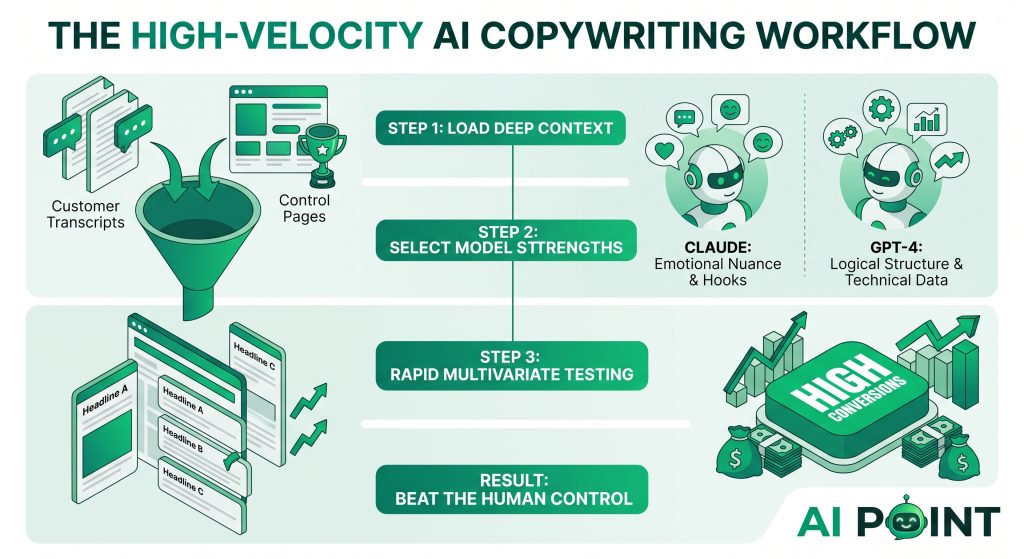
Customer Interviews: Paste in transcripts from real customer support calls or user interviews. Let the AI read the exact words, slang, and phrases your buyers use to describe their problems.
-
The Control Page: Feed the AI your current highest-converting landing page copy. Tell it: “This is our control. Study its tone, sentence length, and structure.”
-
The Competitor Swipe File: Drop in competitor landing pages, but instruct the AI to find their weak spots and explicitly position your product to counter them.
-
Strict Psychological Frameworks: Never let the AI write free-form. Force it to use proven direct-response frameworks like PAS (Problem, Agitation, Solution) or AIDA (Attention, Interest, Desire, Action).
When you lock down your prompt with these strict constraints, the quality of the output changes overnight.
Suddenly, the AI isn’t writing generic corporate fluff. It is writing sharp, punchy, problem-aware copy that hits your buyer right where it hurts.
Analyzing the Data: Claude vs. GPT-4
Now you have your context-loaded prompts. You have generated 50 distinct variations of your value proposition.
Which AI model actually writes the copy that wins multivariate tests?
We ran extensive experiments across multiple SaaS landing pages to compare the performance of OpenAI’s GPT-4 against Anthropic’s Claude.
Here is what the empirical data showed:
Claude is the King of Emotional Nuance. If you are writing top-of-funnel hero headlines, storytelling sections, or emotionally charged problem statements, Claude consistently outperforms GPT-4. It writes with a more human, conversational rhythm. It understands subtle subtext and avoids robotic cliches much better than its competitors.
GPT-4 is the Master of Logical Structure. If you need to write complex feature breakdown tables, technical FAQ sections, or step-by-step logic arguments for pricing tiers, GPT-4 takes the crown. It is fiercely analytical, incredibly precise, and handles bulleted constraints with zero errors.
The takeaway? Don’t pick just one model. Use Claude to hook the reader’s emotions at the top of the page, and use GPT-4 to handle the logical objections further down the funnel.
Setting Up Rapid Multivariate Tests
Once your AI has generated these variations, you cannot just push them live and cross your fingers.
You need a high-velocity testing pipeline.
Instead of waiting three months for a traditional A/B test to reach statistical significance on a single headline, AI copywriting allows you to run true multivariate tests.
You hook your LLM generation pipeline directly into your testing tool. Every week, the system automatically rotates in new AI-generated variations of your subheadings and CTA buttons based on real-time engagement data.
If a variation underperforms after 1,000 impressions, the system kills it, pulls a fresh variation from the model, and keeps the optimization loop spinning 24/7.
You are no longer guessing what copy works. You are letting an automated algorithm find the absolute peak of your conversion curve.
Conclusion
Let’s wrap this up.
AI-generated copy has a bad reputation because most people use it like a toy. They type in lazy prompts and get lazy results.
But when you stop treating AI as a magical content machine and start treating it as a disciplined data processor—loaded with deep customer context and strict psychological frameworks—everything changes.
The AI is the eager intern generating dozens of creative ideas.
But you, backed by rigorous data and testing, are the director making sure only the winners make it to the page.
Master that workflow, and your conversion rates will never look the same.
