

Let’s be honest.
Writing blog posts one by one is a terrible way to scale your SaaS.
Sure, manual content creation works well for building a personal brand. But if you are a solo developer trying to acquire your first 1,000 users, writing one artisanal post a week is way too slow.
You need massive leverage.
Enter Programmatic SEO (pSEO).
For the modern solo developer, pSEO means treating your content creation exactly like a scalable database query.
You aren’t writing articles. You are writing scripts.
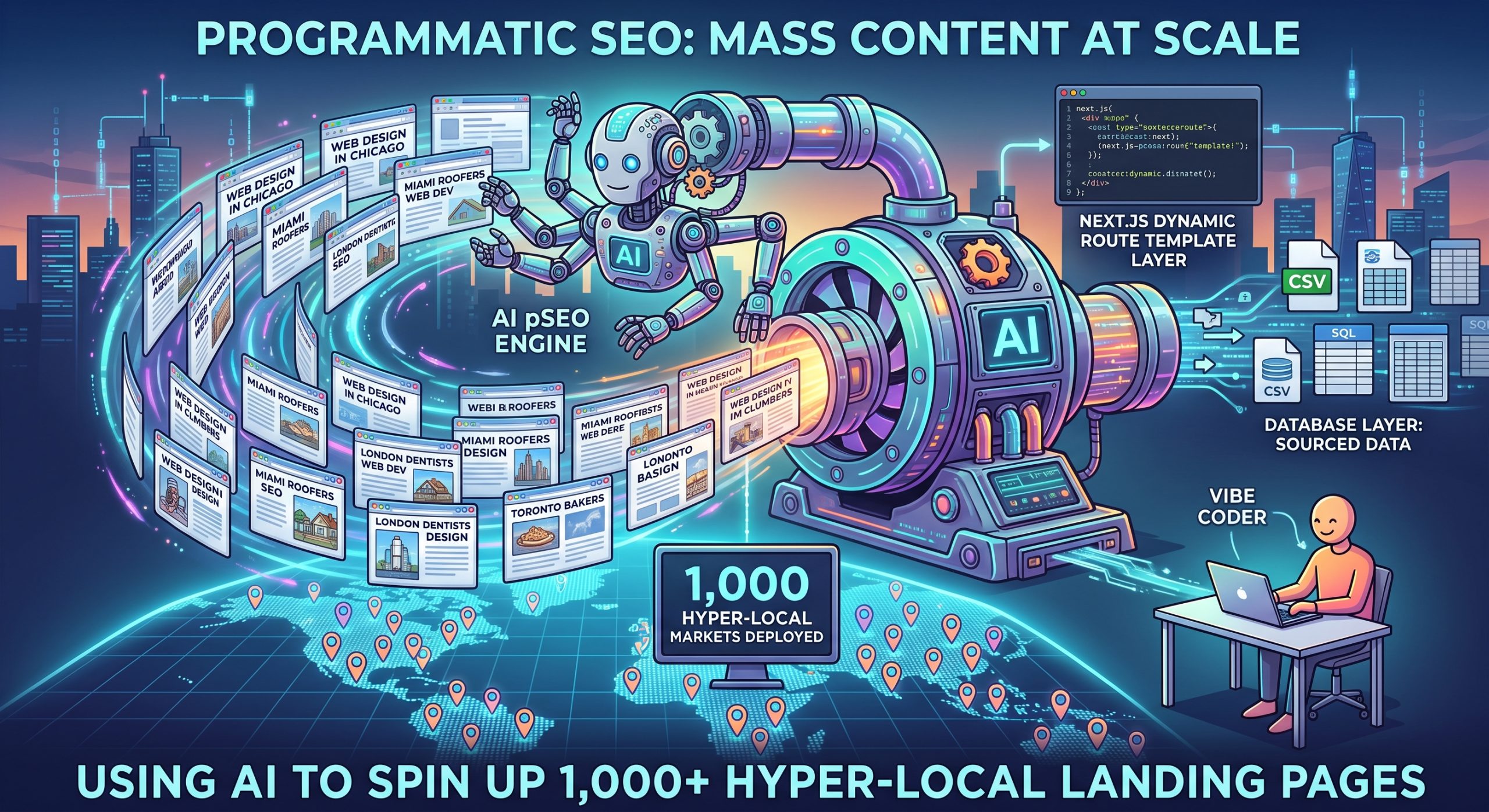
The promise of pSEO is simple but mind-blowing: by writing a single, well-architected script, you can automatically generate and index thousands of hyper-local, high-intent pages on Google.
It is the ultimate shortcut to driving predictable, top-of-funnel traffic.
In this guide, I’m going to show you the exact step-by-step process.
Let’s dive right in.
The Database Layer: Sourcing Your Data
Here is the truth about programmatic SEO.
Most people think the magic is in the AI. They are dead wrong.
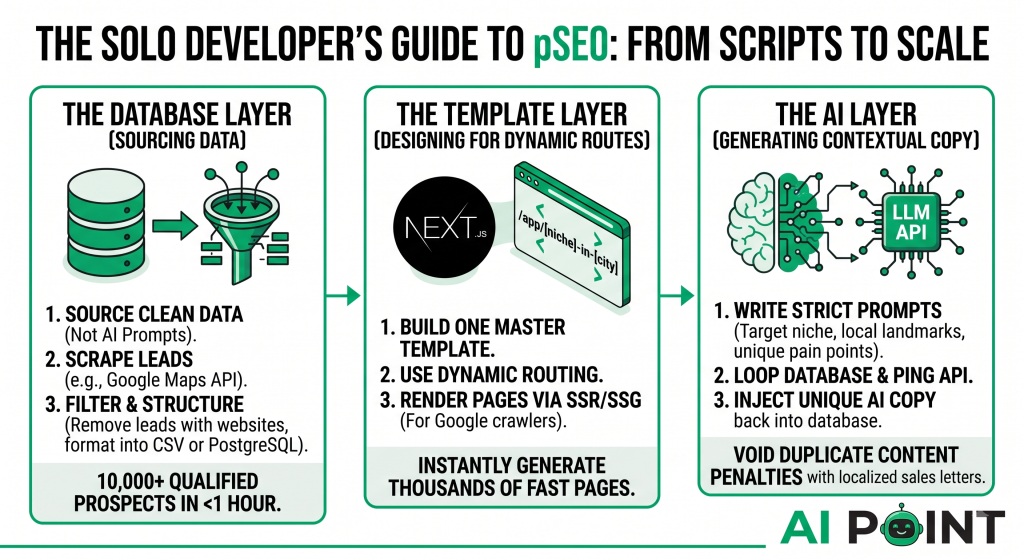
Good programmatic SEO starts with clean data, not fancy AI prompts. If your data is garbage, your landing pages will be garbage. It’s that simple.
You need a massive, highly specific dataset to feed your pages.
Let’s look at a real-world example.
Imagine you are running a digital outreach strategy to source international clients. Specifically, you want to find local brick-and-mortar businesses across the United States, Canada, and the United Kingdom that desperately need a digital presence.
(And to be crystal clear: we are talking about building actual, high-converting websites here, not pitching them random WhatsApp automations).
To do this manually would take years. But you are a vibe coder. You write code.
Instead of Googling prospects one by one, you write a Python script to hit the Google Maps API.
Your script sweeps through hundreds of target cities. It scrapes the data for local businesses—plumbers, roofers, dentists. Then, it runs a simple filter: it completely removes any business that already has a website URL listed in their Google Business Profile.
Boom.
In less than an hour, you now have a raw database of 10,000 highly qualified prospects.
Next, you take that data and clean it up. You format it into a structured CSV file or upload it directly into a PostgreSQL database like Supabase.
Each row in your database now represents a future landing page. You have the city, the niche, and the business name.
This is your foundation. Without this, the rest of the strategy falls apart.
The Template Layer: Designing for Dynamic Routes
So you have your data. What’s next?
You need to build the actual landing page architecture.
This is where modern frameworks like Next.js give you an unfair advantage. Next.js supports dynamic routing out of the box, which is the absolute engine of pSEO.
Instead of manually creating thousands of HTML files, you design one single template.
In Next.js, you set up a dynamic route file. It looks something like this:
/app/web-design-for-[niche]-in-[city]/page.tsx
This bracket notation tells Next.js to dynamically generate a page for every single row in your database.
You design this React component once. You make it look absolutely incredible. You add fast-loading CSS, trust badges, and conversion-optimized CTAs.
When the user visits /web-design-for-plumbers-in-chicago, Next.js pulls the “plumber” and “Chicago” variables directly from the URL. It queries your database, fetches the specific data for that market, and injects it straight into your beautiful React template.
And because Next.js strongly supports server-side rendering (SSR) and static site generation (SSG), Google’s crawlers immediately see a lightning-fast, fully pre-rendered HTML page.
But before you deploy thousands of these routes, you have to be smart.
Spinning up these pages is incredibly effective for driving top-of-funnel traffic. But that traffic is completely useless if your underlying lead capture system isn’t ready.
To ensure you aren’t pouring water into a leaky bucket, check out our complete vibe coder’s guide to zero-to-one user acquisition to see exactly where programmatic SEO fits into the bigger picture.
The AI Layer: Generating Contextual Copy
Now for the final piece of the puzzle.
Back in the day, programmatic SEO was just “find and replace.”
Marketers would take a generic paragraph like: “Are you a [NICHE] in [CITY]? We build the best websites!”
They would just swap out the variables.
Look: Google hates this.
If you launch 1,000 pages with the exact same boilerplate text, you will get hit with a duplicate content penalty faster than you can blink. Your pages will be completely de-indexed.
This is where Artificial Intelligence changes the game.
Instead of simple string replacement, you feed your database rows into an LLM API.
You write a strict, highly detailed prompt that commands the AI to generate unique, contextually relevant copy for every single local market.
Here is an example prompt structure:
“Act as an expert copywriter. Write a 300-word landing page intro for a web design service targeting [NICHE] in [CITY]. Mention a known local landmark or neighborhood in [CITY] to build immediate local trust. Highlight how lacking a website hurts their specific [NICHE] business. Do not use generic filler.”
You run a script that loops through your database, pings the API, and saves the unique AI-generated text back into your Supabase table.
Now, when Next.js renders the page, it isn’t just swapping a keyword. It is loading a 100% unique, human-sounding, localized sales letter.
Google’s crawlers see a massive site with thousands of unique, helpful pages. And they reward you with Page 1 rankings.
Conclusion & Next Steps
You’ve sourced the data. You’ve built the Next.js template. You’ve injected unique AI copy.
The machine is built.
The very last step is to generate a massive XML sitemap containing all 1,000+ of your new dynamic URLs. You can use external tools like next-sitemap to automatically generate this file for your application.
Once generated, you submit that sitemap directly to Google Search Console.
Within a few weeks, Google will start crawling and indexing your localized pages. You will start capturing long-tail search intent that your competitors don’t even know exists.
Bottom line?
Code-driven marketing is the ultimate leverage for the solo founder.
Stop writing articles manually. Start treating your user acquisition like an engineering problem.
Build the database, design the template, leverage AI, and watch the traffic compound.
