

Let’s get right to it.
If your AI agents don’t have access to your private company data, they are practically useless.
Sure, an out-of-the-box LLM can write a generic email or summarize a public Wikipedia page. But if you want an AI agent to answer customer support tickets based on your private refund policy, or analyze your internal financial PDFs, you have a problem.
The model doesn’t know your business.
To fix this, you have to connect your AI to your data.
In the AI development world, there are two heavyweights fighting for the crown of data integration: LangChain and LlamaIndex.
Choosing the wrong framework will cost you weeks of frustrating refactoring. Choosing the right one will make your AI pipelines lightning-fast and incredibly accurate.
In this guide, I am going to break down exactly when to use LangChain, when to use LlamaIndex, and how to build a world-class data pipeline for your agents.
Let’s dive in.
The Role of RAG in Autonomous Workflows
Before we compare the tools, we need to talk about the engine that powers them: RAG.
RAG stands for Retrieval-Augmented Generation.
Here is exactly why RAG is the most important concept in modern AI.
Every AI model has a “context window.” This is essentially its short-term memory. If you try to paste a 10,000-page enterprise database into a single ChatGPT prompt, the model will crash. It simply cannot hold that much information in its head at once.
RAG solves this memory limit.
Instead of forcing the LLM to memorize everything, RAG acts like an incredibly fast librarian.
Here is how the workflow actually operates:
-
You take all of your company data (PDFs, Notion docs, SQL databases) and chop it up into tiny text chunks.
-
You convert those chunks into numbers (vector embeddings) and store them in a Vector Database.
-
When your AI agent receives a question, it searches the Vector Database for the most relevant chunks.
-
The database returns exactly the three or four paragraphs needed to answer the question.
-
The agent reads those specific paragraphs and generates a highly accurate, custom response.
When you are mapping out the core architecture of a multi-agent system, memory is the very first bottleneck you have to solve.
If your agents cannot retrieve accurate context, they will hallucinate. They will make up facts. They will confidently give your customers the wrong information.
To build a bulletproof RAG pipeline, you need a framework. Which brings us to the big debate.
Deep Dive: LangChain for RAG
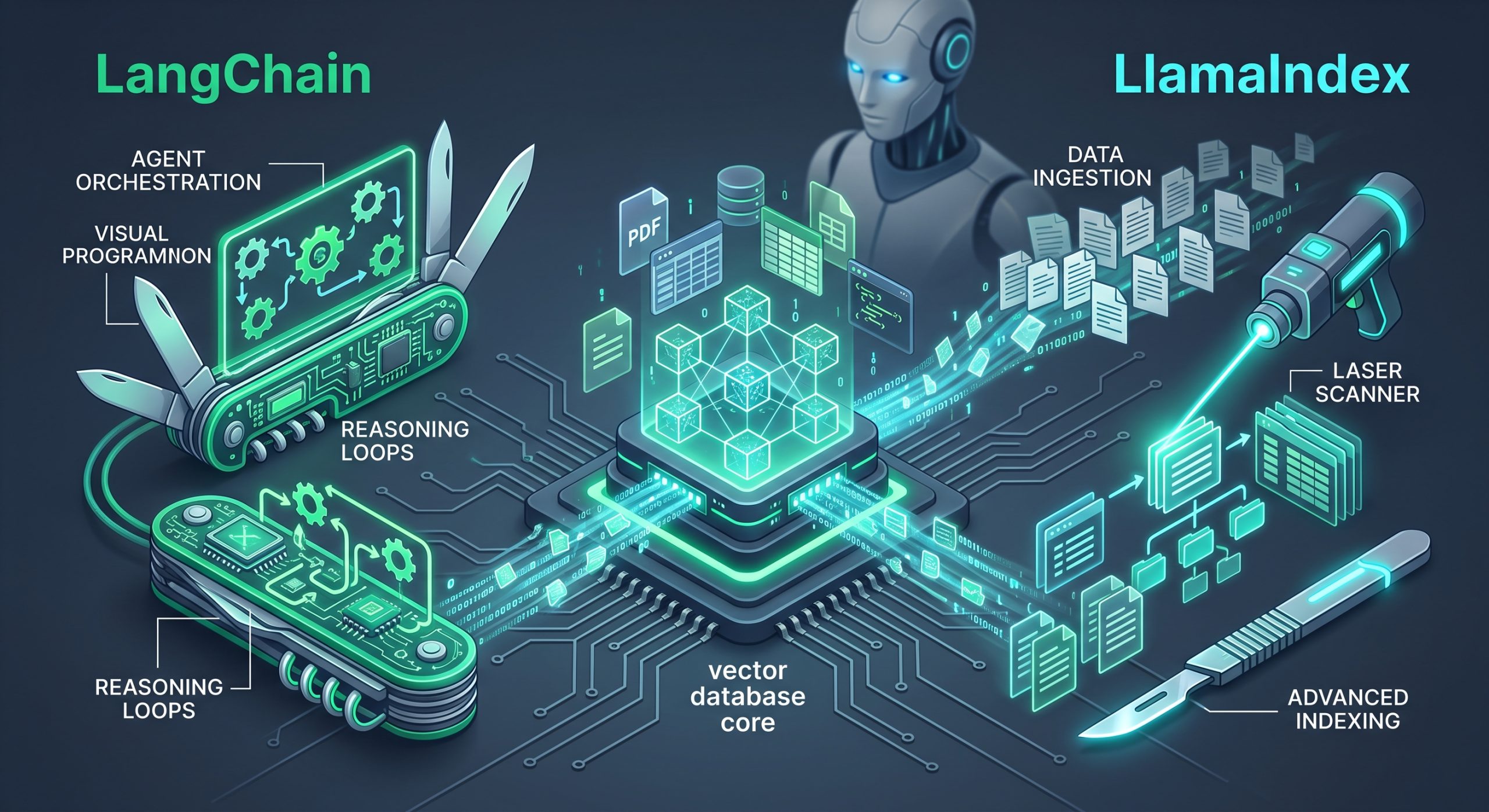
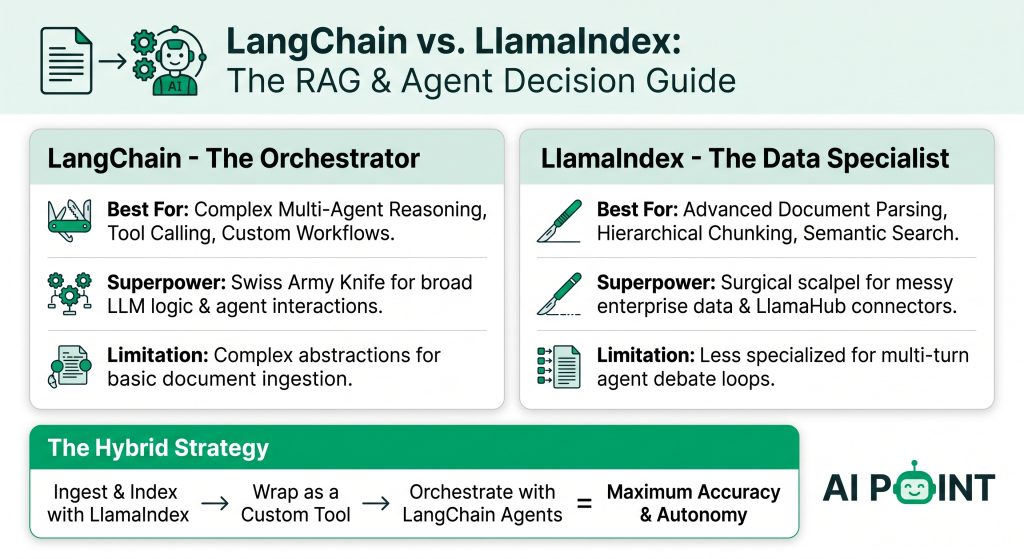
If the AI development world had a Swiss Army Knife, it would be LangChain.
LangChain is a massive, all-encompassing framework designed to do literally everything related to Large Language Models. It handles prompt templating, memory, output parsing, tool calling, and yes, RAG.
The Pros of LangChain
The biggest advantage of LangChain is its sheer flexibility.
Because it is an orchestration framework first, it allows you to build incredibly complex reasoning loops. If you want an agent to read a prompt, decide to query a vector database, read the result, decide it needs more information, and then execute a live Google search—LangChain is built exactly for this.
It also boasts the largest open-source community in the AI space. If you run into a bug, chances are someone on GitHub or StackOverflow has already written a custom workaround for it.
The Cons of LangChain
But there is a catch.
LangChain is notoriously complex. It uses heavy “abstractions,” meaning it hides a lot of the underlying Python code behind its own proprietary logic.
If you just want to build a simple chatbot that reads a single PDF, using LangChain is like using a sledgehammer to crack a peanut. It is overkill. You will find yourself fighting against LangChain’s complex syntax just to execute basic data retrieval.
Furthermore, because LangChain tries to do everything, its RAG capabilities are solid, but not always the most advanced. It handles standard document chunking well, but struggles with highly complex, messy data ingestion right out of the box.
Deep Dive: LlamaIndex for Data Frameworks
Enter LlamaIndex.
If LangChain is the Swiss Army Knife, LlamaIndex is the surgical scalpel.
LlamaIndex was built from day one with a single, obsessive focus: Connecting massive amounts of private data to LLMs efficiently.
The Pros of LlamaIndex
When it comes to data ingestion, LlamaIndex absolutely crushes the competition.
It features a massive library of native data connectors called LlamaHub. Whether your data lives in Salesforce, Slack, MongoDB, raw HTML, or messy, poorly formatted PDFs, LlamaIndex has a pre-built loader that can ingest it cleanly.
But ingestion is only half the battle. LlamaIndex excels at Advanced Indexing.
Standard RAG (which LangChain uses by default) just chops text into equal-sized blocks. This often breaks the context of a sentence in half.
LlamaIndex uses smart parsing. It understands document hierarchies. It knows what a “Heading” is versus a “Paragraph.” It can automatically generate summaries of documents and route queries dynamically. If a user asks a broad question, LlamaIndex can query a document summary. If they ask a hyper-specific question, it queries the raw vector chunks.
This leads to significantly faster, much more accurate RAG pipelines.
The Cons of LlamaIndex
LlamaIndex is a data specialist, not a pure orchestration engine.
While the team has recently introduced agentic features, it is still not as robust as LangChain when it comes to building complex, multi-agent systems with dozens of looping tools. If your primary goal is building autonomous agents that talk to each other, LlamaIndex might feel a bit rigid.
How to Choose the Right Framework for Your Agents
So, which one should you actually use for your AI workflows?
Here is the simple, no-nonsense decision matrix.
You should use LangChain if:
-
You are building a complex, multi-agent workflow where agents need to use a wide variety of tools (web scraping, code execution, API calling).
-
Your RAG pipeline is just one small piece of a much larger, highly interactive system.
-
You need advanced, custom control over the exact reasoning steps of your agents.
You should use LlamaIndex if:
-
Your primary goal is Semantic Search or building a “Chat with your Data” application.
-
You are dealing with massive amounts of highly complex, unstructured data (like legal contracts or dense financial PDFs).
-
You want the absolute highest accuracy for data retrieval without writing custom chunking algorithms from scratch.
The Ultimate Developer Secret: Use Both
Here is the best part. You actually don’t have to choose.
The most advanced AI developers in the world are combining them.
Because LlamaIndex is so good at data retrieval, and LangChain is so good at agent orchestration, you can use them together.
You build your highly optimized vector database and query engine using LlamaIndex. Then, you wrap that LlamaIndex query engine into a “Tool.”
Finally, you hand that Tool over to a LangChain agent.
When your LangChain agent realizes it needs internal company data, it triggers the LlamaIndex tool, gets the perfect, high-accuracy context, and continues its multi-agent workflow seamlessly.
By playing to the strengths of both frameworks, you get the best of both worlds: flawless data retrieval and unstoppable agent autonomy.
