

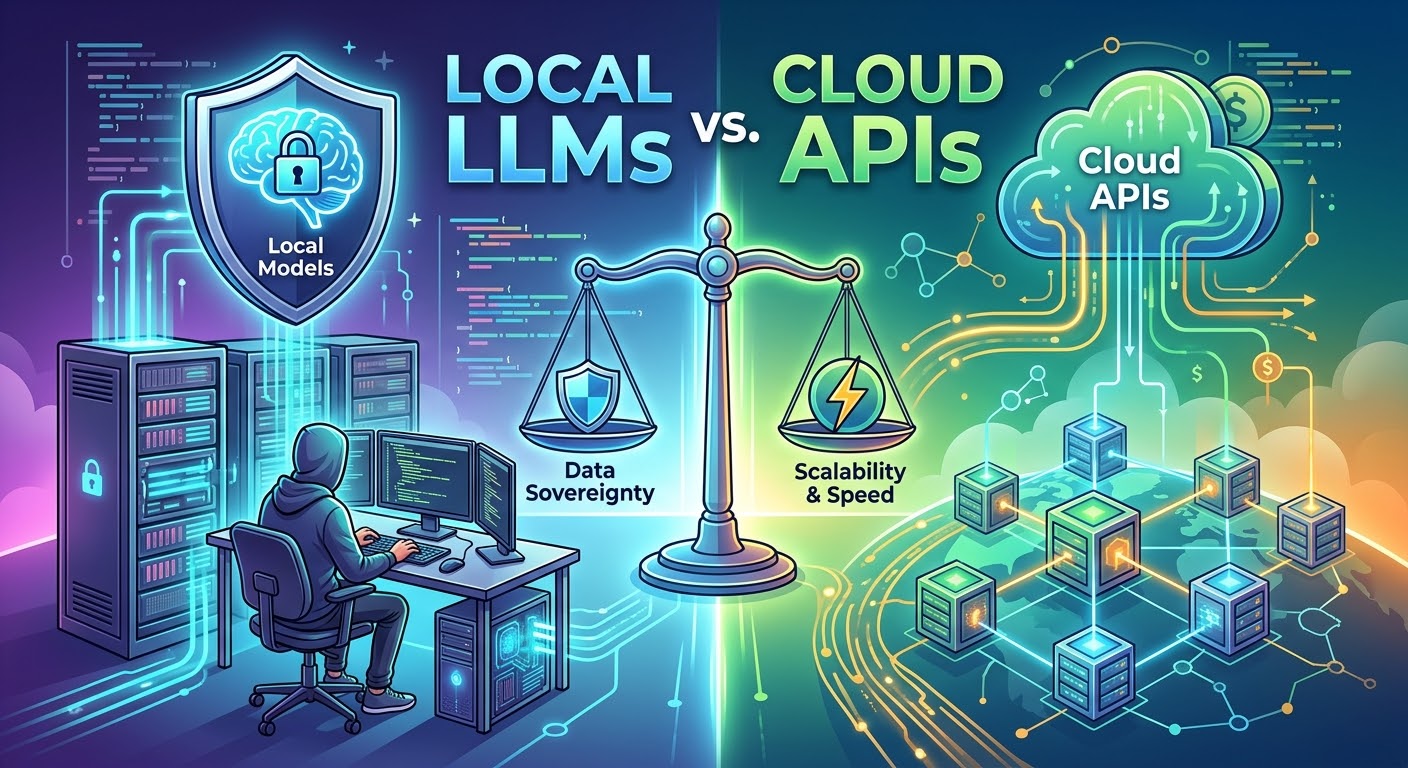
You just launched your new AI app.
Product Hunt loves it. Hacker News is sending you traffic like crazy. You refresh your Stripe dashboard and see your MRR climbing.
Awesome, right?
Then, you check your OpenAI billing dashboard.
You owe them more than you made.
Ouch.
Welcome to the bootstrapper’s dilemma.
When you are building an AI startup from your bedroom, the infrastructure choices you make on day one dictate whether you build a profitable business—or just a very expensive hobby.
Cloud APIs like OpenAI and Anthropic are incredible. They let you ship an MVP in a weekend. But they come with a massive catch: variable costs that scale instantly, strict rate limits, and zero privacy guarantees.
On the flip side?
The open-source rebellion is here. Local LLMs (Large Language Models) like Llama 3 and Mistral are closing the reasoning gap. And they let you lock in your infrastructure costs, own your data, and scale your throughput to the moon.
So, how do you choose?
In this guide, we are going to break down exactly how to scale your AI stack. We’ll look at cost, speed, developer experience, and privacy.
Let’s dive in.
The Current Landscape of AI for Bootstrappers
Before we get into the weeds, let’s look at the playing field.
Right now, the AI ecosystem is split into two distinct camps.
Camp 1: The Cloud Giants
This is OpenAI (GPT-4o), Anthropic (Claude 3.5), and Google (Gemini).
They offer “Model-as-a-Service.”
You don’t worry about GPU clusters, CUDA drivers, or memory management. You just send a JSON payload to a REST API, and magic comes back.
But you pay for that convenience. You pay per token. And when you are bootstrapping a Next.js application, those token costs eat directly into your profit margins.
Camp 2: The Open-Source Rebellion
Enter Meta, Mistral, and an army of open-source contributors.
Models like Llama 3 (8B and 70B) have completely changed the game. They offer state-of-the-art reasoning that you can download directly to your laptop or a rented cloud server.
And the hardware is catching up, too.
You don’t necessarily need a $40,000 Nvidia H100 server anymore. Thanks to quantization (compressing the model size), you can run powerful models on standard Apple Silicon (M-series MacBooks) or cheap cloud GPUs from RunPod or Lambda Labs.
Which brings us to the most important question for any indie hacker.
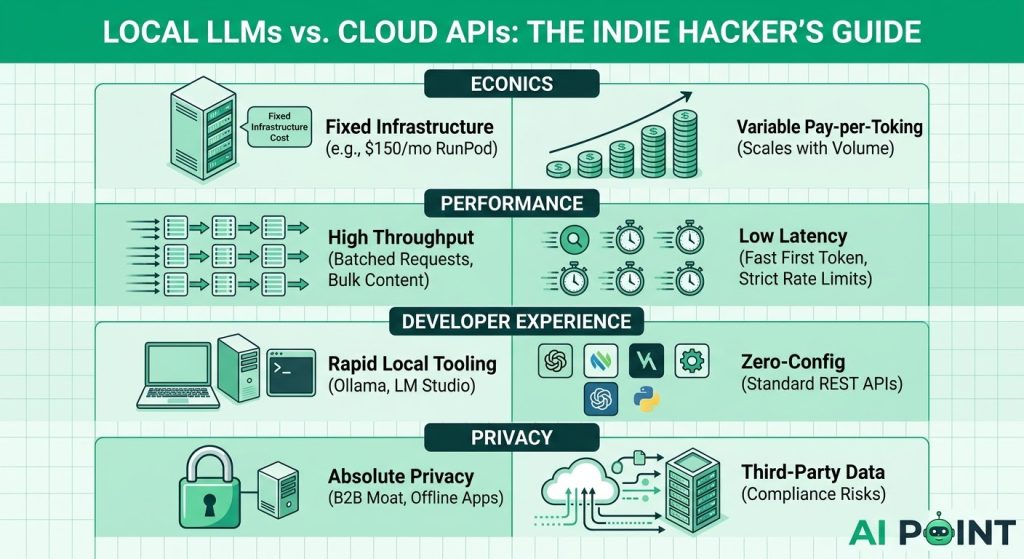
The Economics of AI: Variable Bills vs. Fixed Infrastructure
Let’s talk about money.
When you use a Cloud API, you are falling into The API Trap.
Here is how it works:
APIs charge by the token (roughly chunks of words). If your app gets 10 users, your bill is tiny. If your app goes viral and gets 10,000 users, your bill skyrockets instantly.
The scaling is linear. If you are doing heavy RAG (Retrieval-Augmented Generation)—where you stuff massive documents into the context window before asking the model a question—that scaling can actually become exponential.
Let’s do some quick math.
Imagine you have a feature that summarizes PDF reports.
Each report is 10,000 input tokens.
The output is 1,000 tokens.
If you process 50,000 reports a month on a premium API, you could easily be staring at a $1,000+ monthly bill.
Now, let’s look at the fixed infrastructure model.
Instead of paying per token, you rent a dedicated cloud GPU (like an RTX 4090 or A100) on a service like RunPod.
You pay a flat rate. Maybe $150 to $300 a month.
Whether you process 1 report or 100,000 reports, your server cost remains exactly the same. Your cost per generation plummets as your volume increases.
But finding the exact moment to make this transition is tricky. It depends on your traffic spikes, your token usage, and your server utilization. To find your exact breakeven point, read our cost-benefit analysis on when to switch from OpenAI to local models.
Bottom line?
Cloud APIs are for when you are searching for product-market fit. Local models are for when you need to protect your profit margins.
Performance, Rate Limits, and High-Volume Workloads
Now:
Cost isn’t the only bottleneck. Performance matters just as much.
But when we talk about performance in AI, we have to split it into two categories: Latency vs. Throughput.
Latency is how fast a single user gets a response.
Throughput is how many responses you can generate at the exact same time.
If you are building a real-time chat interface (using something like the Vercel AI SDK), latency is king. You need that first token to stream onto the screen in milliseconds. Cloud APIs are usually heavily optimized for this.
But what if you aren’t building a chatbot?
What if you are building an automated content engine? Or doing programmatic SEO? Or processing thousands of database rows in a PostgreSQL pgvector setup?
That is a high-volume workload.
And if you try to hit an API with 10,000 concurrent requests, you are going to slam face-first into a brick wall:
Error 429: Too Many Requests.
Cloud giants aggressively rate-limit indie hackers on lower pricing tiers. You simply cannot push massive volume through them without complex queueing systems and constant backoffs.
Local models don’t care about rate limits.
With a local model, you control the pipeline. You can use batched requests to push thousands of prompts through the GPU simultaneously. It might take longer for a single response to finish, but your overall throughput will be vastly higher.
In fact, if your product relies on bulk generation, check out our guide on how to run Llama 3 locally for high-volume content generation.
Developer Experience (DX) and Rapid Prototyping
Let’s be real for a second.
The Developer Experience (DX) of Cloud APIs is unbeatable.
You grab an API key, drop it into your .env file, write import openai, and you have world-class AI integrated into your app in under five minutes.
It is the ultimate zero-config dream.
A year ago, trying to run a local model was a nightmare. You had to fight with Python environments, CUDA versions, and broken dependencies just to get a single “Hello World.”
Not anymore.
The local tooling renaissance is in full swing.
Tools like Ollama and LM Studio have made downloading and running a local LLM as easy as running a Docker container. You literally open your terminal and type:
ollama run llama3
Boom. You have a local API running on localhost:11434 that mimics the OpenAI endpoint perfectly.
This means you can build your entire application—from your Tailwind CSS frontend down to your database logic—without spending a single cent on API calls during development. You can use your favorite AI coding assistants, like Cursor or Github Copilot, alongside local runners to iterate endlessly.
To optimize your personal development environment, explore our indie hacker’s guide to setting up Ollama for vibe-coding.
You build locally for free. Then, when you deploy to production, you just swap the local URL for your production API key. It’s seamless.
Privacy as a Moat: Serving the Unserved Markets
Here is a marketing secret most indie hackers ignore:
Privacy is a highly lucrative moat.
If you are building B2C apps (like a travel itinerary generator), nobody cares where the data goes.
But if you are building B2B? It’s a completely different story.
Lawyers, accountants, healthcare professionals, and enterprise corporations are terrified of AI. They have strict compliance laws. They absolutely refuse to paste sensitive client data, financials, or proprietary code into an API that sends it to a server owned by a tech giant.
If your app relies on OpenAI, you are instantly disqualified from securing these high-ticket clients.
This is where local LLMs give you a massive competitive advantage.
Because local models run on your own infrastructure (or directly on the user’s device), the data never leaves the environment.
We are seeing a massive rise in offline-first applications. These are desktop apps (often built in Electron or Tauri) that download a small, quantized model directly to the user’s Apple M3 chip.
No internet required. Zero data retention. Absolute privacy.
You can use this as a core Unique Selling Proposition (USP) against VC-backed competitors who are locked into cloud APIs. For a technical deep dive into this architecture, read our tutorial on building offline-capable apps for sensitive data.
If you can guarantee data privacy, you can charge premium enterprise rates.
The Hybrid Approach: Why Not Both?
Here is the good news.
You don’t actually have to choose just one.
The smartest indie hackers are building Routing Architectures.
They use both.
Here is how a hybrid system works:
You analyze the prompt before you process it.
Is the task highly complex? Does it require deep logical reasoning, coding, or nuanced analysis? Route it to a Cloud API (like GPT-4o).
Is the task simple? Are you just summarizing text, extracting JSON entities, or formatting data? Route it to your self-hosted Llama 3 8B model.
By routing the “dumb” volume tasks to your cheap local infrastructure, you save your expensive API tokens only for the tasks that actually need them.
Plus, having a local model acts as the ultimate fallback mechanism. If Anthropic goes down for three hours (which happens), your app doesn’t crash. It just gracefully degrades to your self-hosted model until the cloud is back up.
Conclusion: Making Your Decision
Let’s wrap this up.
Choosing between Local LLMs and Cloud APIs isn’t about which technology is “better.” It’s about what your specific startup needs right now.
Choose Cloud APIs if you are optimizing for speed-to-market, need the absolute smartest models on earth, and want zero infrastructure headaches.
Choose Local LLMs if you are optimizing for profit margins, generating massive volumes of content, or selling to clients who demand absolute privacy.
Start with APIs to validate your idea. Transition to local models to scale your profitability.
Now I want to turn it over to you:
Are you currently paying for Cloud APIs, or have you already made the jump to self-hosting?
Let me know by leaving a comment below right now.
