


Most marketers treat the FAQ section at the bottom of their landing page like an afterthought.
They throw together four or five basic questions, hide them inside an accordion menu, and call it a day.
That is a massive missed opportunity.
In the era of voice search and conversational AI, your landing page FAQ isn’t just a place to handle customer objections.
It is your most powerful weapon for winning voice assistant retrieval.
When a user asks Siri, Alexa, or Gemini a buying-intent question, the AI doesn’t read the whole sales page. It scans the page for direct, atomic answers.
If your FAQ is structured properly, the AI assistant will read your exact copy aloud to the buyer.
Here is how to structure your landing page FAQs to dominate voice search.
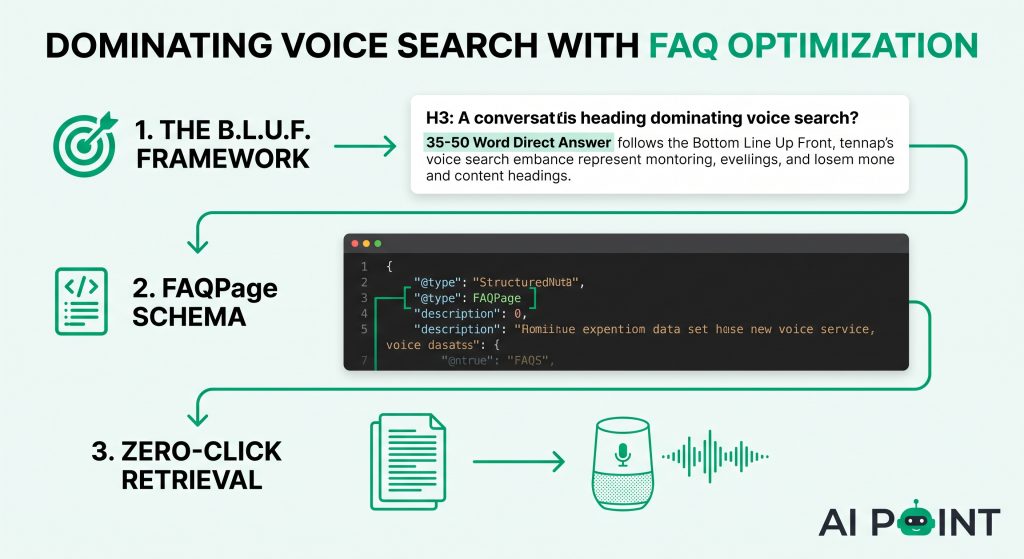
The Zero-Click Conversion Funnel
Look at the anatomy of a voice search query.
When people use voice commands to search, they rarely ask top-of-funnel questions like “what is cloud computing.”
They use voice when their hands are busy, they are on the go, or they want an instant answer to a specific problem:
-
“Does this software integrate with Supabase?”
-
“What is the monthly cancellation policy for this tool?”
-
“How much does a commercial heating repair cost?”
These are high-intent, bottom-of-the-funnel questions.
In traditional search, this user would land on your page, scroll through your hero section, and read your pricing grid.
In voice search, they never see your page.
The voice assistant parses your content, extracts the exact answer, and reads it back to the user in three seconds.
If your competitor provides a cleaner, more direct answer to that commercial question, the voice assistant quotes them.
You lose the customer before they ever visit your website.
Winning the “One True Answer”
When you search on a desktop browser, you get options.
You see ten blue links, a map pack, and maybe a few sponsored ads. You have choices.
Voice search is ruthless. There is only one result.
The AI chooses a single source of truth, delivers the answer, and closes the transaction.
“Voice retrieval is a winner-take-all environment. If you aren’t the primary source, you don’t get second place. You get ignored.”
Because voice assistants only return one result, securing this spot requires strict adherence to the principles outlined in our comprehensive Voice-First Generative Engine Optimization guide.
To become that single source, your landing page FAQs must be built specifically for natural language processing (NLP) models to extract without friction.
The B.L.U.F. Framework for FAQ Design
If you want an LLM or voice assistant to extract your answer, you cannot write long, rambling marketing copy.
You need to use the B.L.U.F. Framework: Bottom Line Up Front.
Here is the three-step formula to structure every single FAQ item on your landing page:
1. Target Natural Spoken Queries as Headings
Do not write generic headings like “Compatibility.”
Write the exact question a human would speak out loud into a phone:
H3: Does this platform support server-side rendering with Next.js?
2. Deliver the Direct Answer in the First Sentence
Do not start with backstory. Do not write filler.
Your first sentence must be a direct, definitive answer between 35 and 50 words. State the core fact immediately.
Example: “Yes, our platform natively supports server-side rendering with Next.js. You can connect your existing repository using our pre-built API routes and deploy dynamic pages without extra configuration.”
3. Provide Context in the Second Paragraph
Once you have delivered the atomic fact for the machine, you can write two or three sentences elaborating on the details for human readers who happen to be scrolling the page.
Feed the machine first. Then serve the human.
Technical Setup: FAQPage Schema is Mandatory
Writing great copy is only half the battle.
You also have to tell search engine crawlers exactly what that copy represents.
If you don’t use structured data, the AI has to guess which parts of your page are questions and which parts are answers.
Never make the machine guess.
You must inject dynamic FAQPage JSON-LD schema into the <head> of your landing page.
Within your schema markup, explicitly declare:
-
The
@typeasFAQPage -
Each
Questionentity matching your exact H3 text -
The
acceptedAnswercontaining the plain-text B.L.U.F. response
When an AI crawler encounters valid FAQPage schema, it doesn’t need to parse messy layout code. It reads the raw JSON object and immediately adds your answers to its retrieval index.
Component-Driven Formatting for LLMs
Voice assistants powered by modern LLMs love structured data formatting.
When answering complex commercial questions—like feature breakdowns, system requirements, or pricing tiers—plain paragraphs can be ambiguous.
Use component-driven UI elements directly inside your FAQ answers:
-
Bulleted lists: Use bullet points to list supported operating systems, included features, or integration partners.
-
HTML tables: Use compact tables when comparing subscription plans or service tiers.
-
Bold entity anchors: Bold specific product names, technical terms, and numeric values so the parser recognizes them instantly.
When an LLM retrieves information to formulate a spoken answer, it evaluates the confidence score of the data.
Clean tables and bulleted lists produce far higher extraction confidence than long, complex sentences.
FAQs are the Ultimate Voice Search Asset
Stop treating your landing page FAQ as a boring checklist at the bottom of your sales funnel.
It is not just customer service copy.
In a voice-first world, your FAQ section is the primary API between your product and the AI assistants your customers use every single day.
Frame your questions around real spoken queries. Lead with short, factual answers. Back it up with strict schema markup and clean formatting.
Do this across your high-value landing pages, and you will transform your bottom-of-funnel content into an automated voice-retrieval engine.
