

Remember when “Prompt Engineer” was hailed as the job of the decade?
That era is already fading.
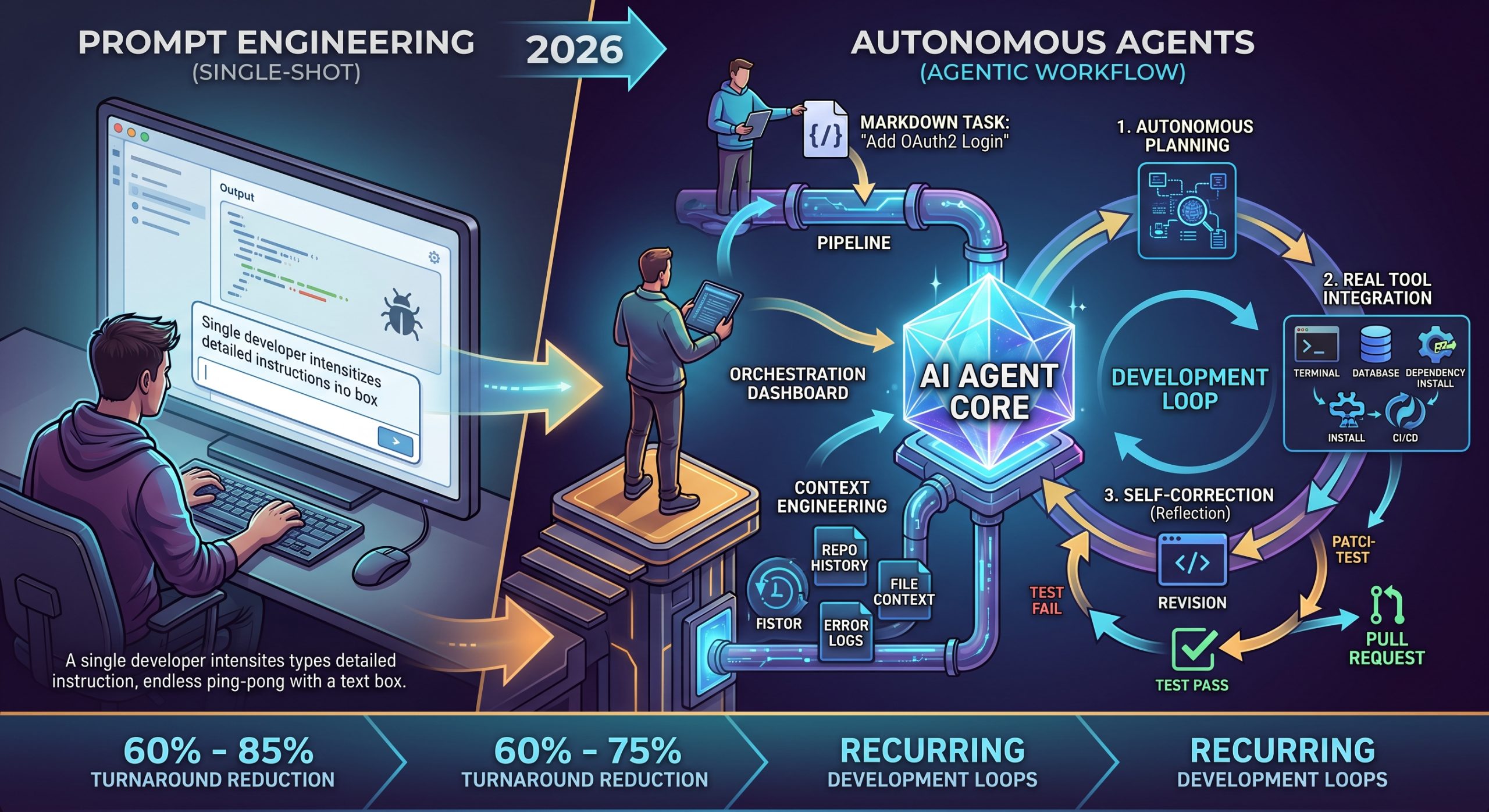
In 2026, writing the perfect, highly tweaked instruction is no longer the secret sauce for building complex software. We’ve officially moved past static, single-shot prompts.
Today, it’s all about agentic AI—autonomous systems that can plan, reason, execute complex workflows, and fix their own bugs without hand-holding.
It’s a massive leap forward for engineering productivity.
While perfecting your prompt architecture was a necessary first step, it is only a fraction of the modern engineering stack. To see the complete picture of where the industry is heading, read The ultimate guide to AI-assisted software development in 2026.
Ready to make the jump from simple prompts to full-blown autonomous agents?
Let’s dive in.
The Bottleneck: Why Prompt Engineering Isn’t Enough Anymore
Let’s be honest.
Single-shot prompting hits a wall fast when building real software.
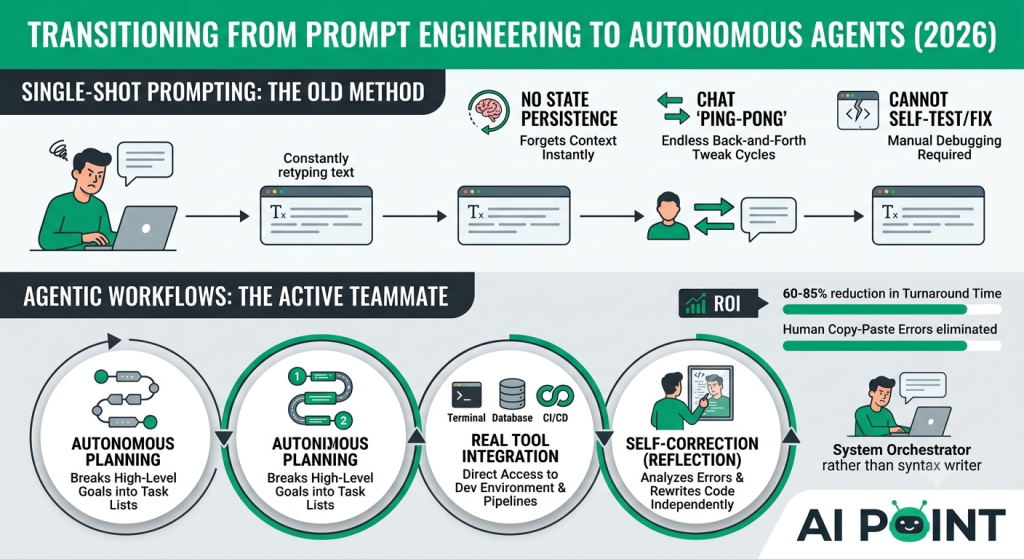
Why? Because complex applications require multi-step reasoning. Traditional prompts lack state persistence—they forget context the moment a chat session resets.
Even worse, when a prompt generates code with a subtle bug, it can’t spontaneously test the output, recognise the error, or figure out what to do next.
You end up playing an endless, frustrating game of ping-pong with a text box.
Here’s the deal:
In 2026, AI models rarely fail because of “bad phrasing.” They fail because of bad context.
Enter context engineering.
Instead of spending hours obsessing over adjectives in a prompt, top engineers now build pipelines that feed the right files, error logs, and repository history into the model at the exact right moment.
The bottom line?
Prompting got us out of the starting blocks. But if you want to build scalable software, relying strictly on single prompts is a massive bottleneck.
Enter Agentic Workflows: From Passive Copilots to Active Teammates
So, what actually separates a standard AI copilot from an autonomous agent?
It boils down to three game-changing capabilities:
- 1. Autonomous Planning & Reasoning: Instead of waiting for step-by-step instructions, an agent breaks down a high-level prompt (like “add OAuth2 login”) into a series of logical, executable sub-tasks.
- 2. Real Tool Integration: Agents don’t just generate text on a screen. They have direct access to your dev environment. They can run terminal commands, query databases, install dependencies, and trigger CI/CD pipelines.
- 3. Self-Correction (Reflection): This is the magic sauce. When an agent runs a command and hits an error, it reads the test log, analyzes what broke, rewrites the code, and tests it again—all without human intervention.
Here’s why this matters:
This autonomous, multi-step orchestration heavily contrasts with the highly iterative, human-driven feedback loops we discussed in our guide on what is vibe coding and how is it changing rapid prototyping?
While vibe coding keeps you in the driver’s seat for rapid design tweaks, agentic workflows hand the wheel over to the AI for complex logic execution.
The result?
Your AI shifts from a passive autocomplete widget into an active, proactive coding teammate.
Real-World Software Development with AI Agents in 2026
What does this actually look like on a Tuesday afternoon?
Imagine a modern 2026 development loop:
Instead of writing code manually, you drop a high-level task into a simple Markdown file within your repository.
Then, your coding agent takes over:
- It scans your entire codebase to map out dependencies.
- It identifies the exact files that need modification.
- It writes the feature code, spins up an isolated sandbox testing environment, and executes unit tests.
- If a test fails, it patches the bug internally until every check passes.
- Finally, it opens a fully documented Pull Request ready for your review.
Now, let’s address the elephant in the room: ROI.
Setting up an agentic workflow takes more upfront effort than typing a quick prompt. No doubt about it.
But for recurring development loops, autonomous agents cut turnaround time by 60% to 85% while eliminating frustrating human copy-paste errors.
It’s not just faster—it’s a completely different way to scale software.
The Developer’s New Role: Orchestration and Supervision
Does this mean software engineers are obsolete?
Not even close.
But your role is undergoing a massive paradigm shift.
You are moving from a syntax writer to a system orchestrator.
Instead of spending eight hours a day writing boilerplate syntax or debugging missing semicolons, you become the manager of an AI workforce.
Your primary job becomes:
- Setting clear architectural goals.
- Auditing security protocols and data flows.
- Serving as the final checkpoint for agent-generated code.
Agents aren’t replacing developers—they are expanding what a single developer can ship.
The developers who win in 2026 won’t be the ones with the fastest typing speeds. They will be the ones who orchestrate agentic teams most effectively.
Conclusion
Here’s the bottom line:
Prompt engineering was the temporary bridge that taught us how to talk to AI. Agentic workflows are the actual engine building the future of software.
Your action item? Map out one repetitive dev task today, assign it to an autonomous agent, and watch the future unfold.
