

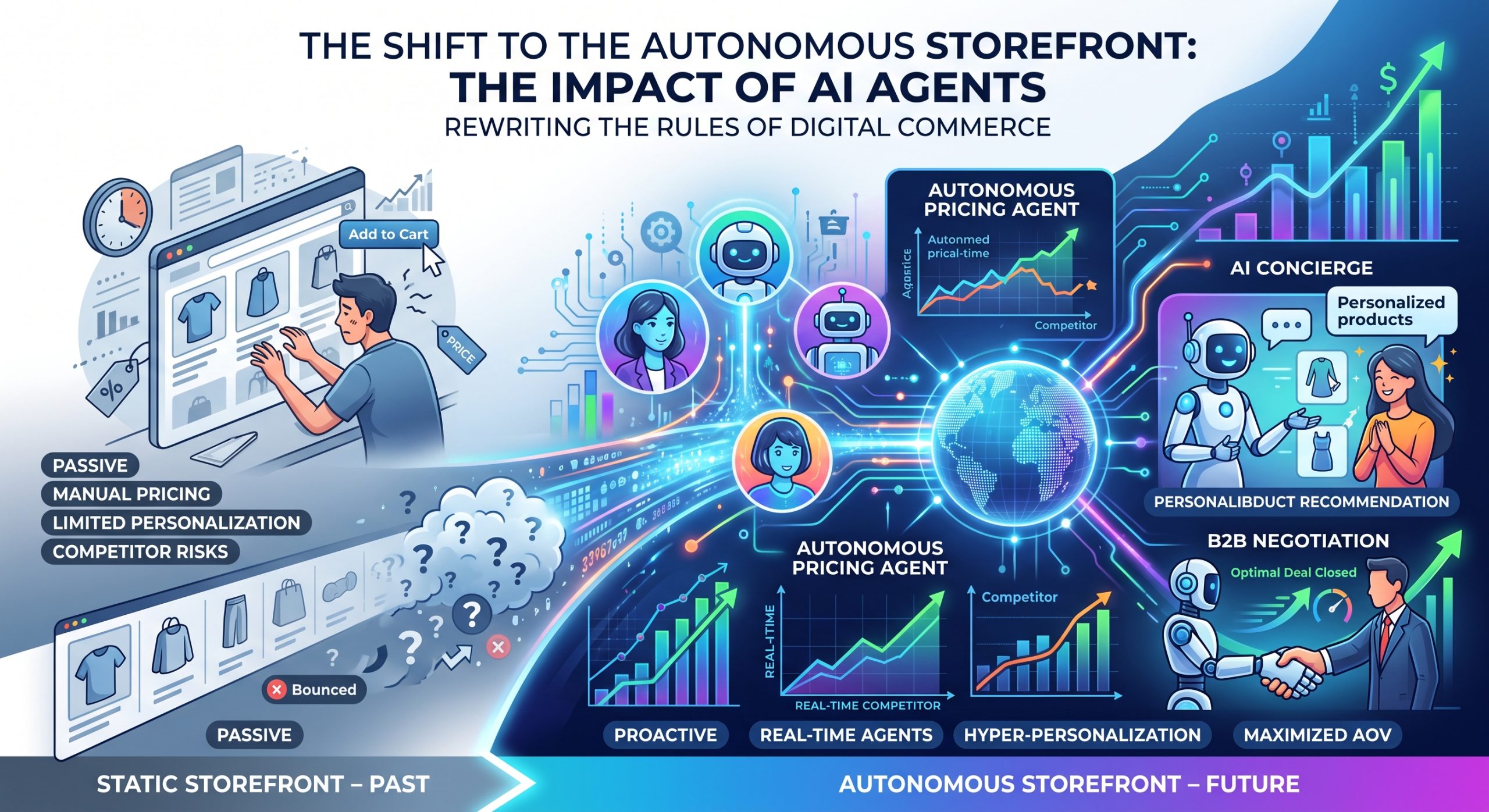
The static online storefront is officially dead.
Think about it. For the last 20 years, e-commerce has worked the exact same way:
You upload a product. You set a price. You drive traffic. And you hope the customer clicks “Add to Cart.”
It is completely passive.
If a customer can’t find what they are looking for? They bounce. If a competitor undercuts your price by a dollar? You lose the sale.
But that is all about to change.
We are entering a new era where your e-commerce store is no longer just a digital catalog. It is becoming a proactive, negotiating, 24/7 sales engine.
Enter: Autonomous AI Agents.
Today, I’m going to show you exactly how AI agents are rewriting the rules of digital commerce. We will look at autonomous pricing, personalized concierge experiences, and how bots are now negotiating B2B wholesale deals.
Let’s dive in.
The Shift to the Autonomous Storefront
Let’s look at how most e-commerce brands handle pricing today.
It involves complex spreadsheets, expensive scraping tools, and a lot of guessing. You might check your competitor’s pricing once a week. Maybe once a day if you have a dedicated team.
But in a hyper-competitive market, checking once a day means you are already too late.
This is where the Autonomous Pricing Agent comes in.
A Pricing Agent doesn’t just track data. It makes executive decisions. It monitors your competitors 24/7.
If a major competitor runs a flash sale at 2:00 AM, your agent notices instantly. But it doesn’t blindly match the price.
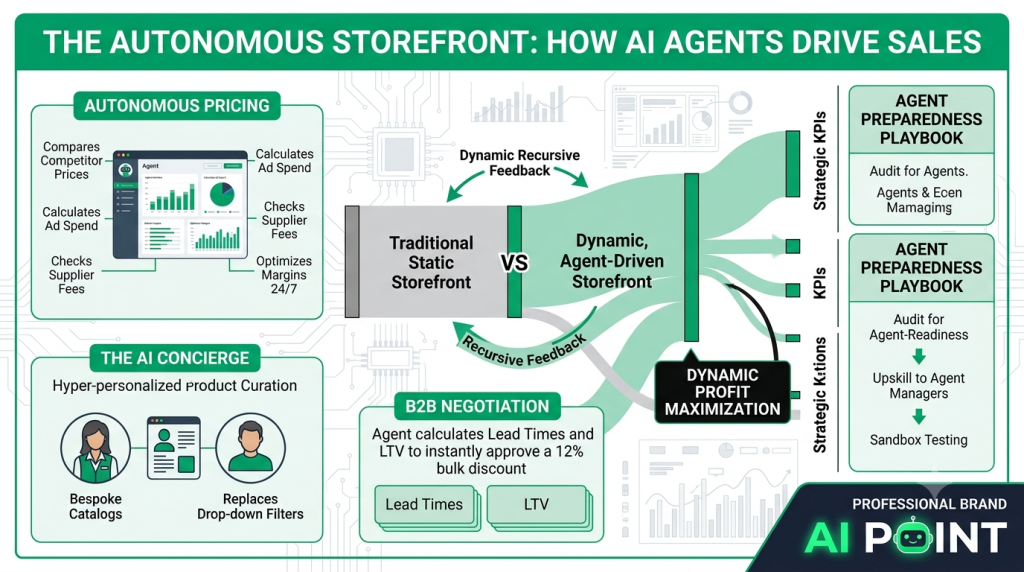
Instead, it calculates your current ad spend, checks your supplier fees, and reviews your inventory levels. If it determines that matching the price will destroy your profit margins, it holds your price steady and automatically adjusts your Google Ads bidding strategy instead.
It does the math, formulates a strategy, and executes it. Instantly.
This level of independence is a prime example of the broader rise of autonomous AI agents in the workplace, fundamentally shifting how retail teams operate.
You no longer have a team manually updating Shopify prices. You have a digital workforce optimizing your margins while you sleep.
Hyper-Personalization: The AI Concierge
Site search is broken. And product filters? They are a massive conversion killer.
Imagine walking into a high-end retail store.
You don’t walk up to a wall of 10,000 items and start mentally filtering by “Size: Medium” and “Color: Blue.” You talk to a sales rep. You tell them what you need, and they bring you exactly what fits your style.
AI agents are bringing this white-glove experience to digital commerce.
We are moving away from the drop-down menu and moving toward the AI Concierge.
Instead of forcing your customer to dig through your website, the Concierge Agent chats with them.
“I’m going to a summer wedding in Italy next month. I need a breathable suit under $500, and I usually wear a 42R.”
In milliseconds, the agent cross-references your inventory, checks sizing availability, and dynamically generates a bespoke landing page specifically for that customer. It doesn’t just show them the suit; it recommends a matching tie and loafers based on what similar customers bought.
The result?
Your Average Order Value (AOV) skyrockets. Conversion rates jump. And the customer feels like they just received a premium, 1-on-1 shopping experience.
Because they did.
Automating B2B Procurement and Negotiation
B2B sales is notoriously slow.
It involves endless email chains, PDF quotes, and “let me check with my manager” delays.
If a buyer wants a custom discount on a bulk order of 5,000 units, a human sales rep has to manually calculate lead times, check warehouse stock, and get approval on the margin. That can take days.
AI agents do this in seconds.
Imagine a procurement buyer interacting with your B2B Agent. The buyer requests a 15% discount on a massive order.
The agent instantly goes to work.
- It checks your ERP system for real-time inventory.
- It analyzes the buyer’s lifetime value (LTV).
- It calculates the factory lead time to replace the stock.
The agent determines that a 15% discount cuts too deep into the margin. So, it counters the buyer in real-time: “I can’t do 15%, but because you’ve been a loyal partner for three years, I can offer a 12% discount and wave the freight shipping fees if we close today.”
The buyer agrees. The agent drafts the invoice, sends the payment link, and updates the warehouse.
Zero human intervention. Zero delays. A closed deal.
Conclusion
The future of e-commerce isn’t about having the prettiest website.
It is about having the smartest infrastructure.
The businesses that adopt autonomous AI agents will out-price, out-serve, and out-sell static competitors at every single turn. They will capture sales that traditional websites simply cannot convert.
The shift is happening right now. The only question is: will your storefront adapt, or will it become a digital relic?
Want to stay ahead of the curve on AI and digital commerce? Make sure to bookmark AI Point and subscribe to our newsletter for the latest agent frameworks and strategies.
