

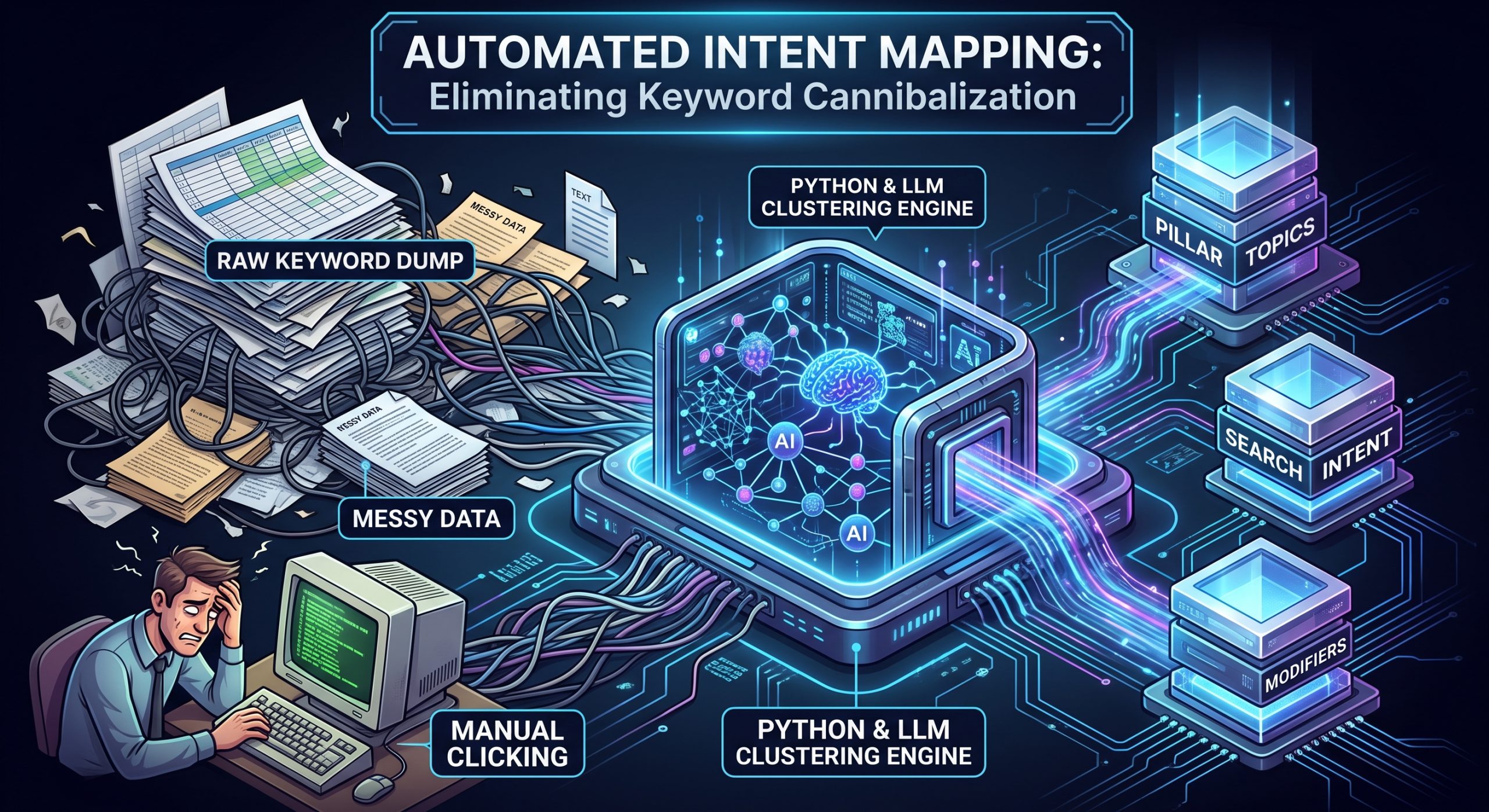
Traditional keyword research is dead.
At least, the manual way of doing it is.
If you are building a programmatic SEO campaign that requires 5,000 to 10,000 unique pages, manually checking search volume, competition, and search intent in tools like Ahrefs or Semrush is a recipe for complete burnout.
Even worse? You will inevitably end up with massive keyword cannibalization.
When multiple pages target near-identical phrases, Google gets confused, and your rankings flatline.
To scale successfully, you need an automated approach. You need to leverage Large Language Models and Python scripts to map search intent programmatically.
In this guide, you’ll discover the exact workflow to scrape, clean, and cluster thousands of keywords into pristine pillar topics without spending weeks in spreadsheets.
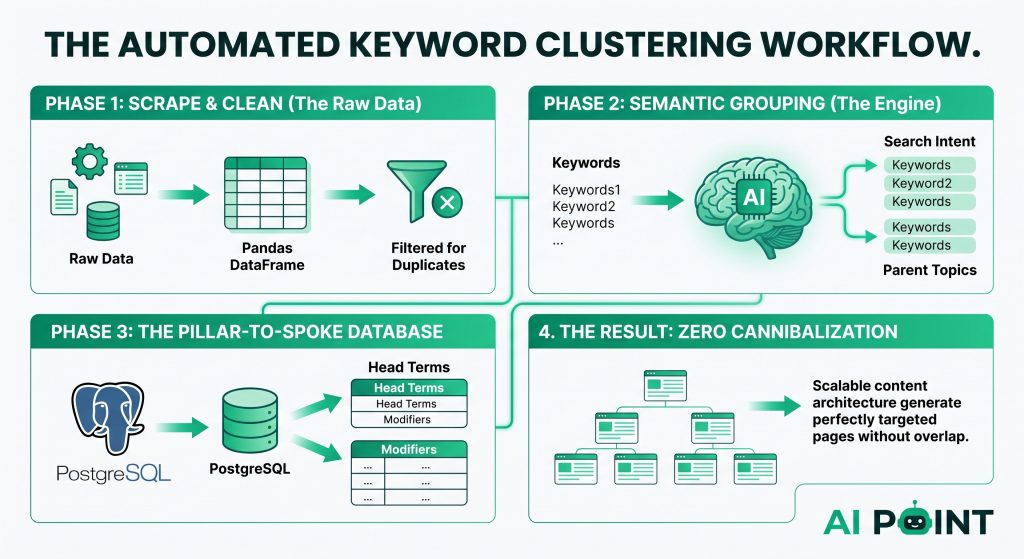
Scraping and Cleaning the Raw Data
Before you can cluster anything, you need a massive, raw list of keywords.
You can pull these raw dumps from Google Search Console, Google Keyword Planner, third-party SEO tools, or automated autocomplete scrapers.
When you export 20,000 keywords from these sources, your dataset is going to be a complete mess. It will contain duplicate strings, trailing spaces, irrelevant modifiers, and messy capitalization.
Here is how you clean your raw data before running it through an AI model:
-
Import into a Pandas DataFrame: Load your raw CSV file into a Python script using the pandas library to handle bulk text manipulation efficiently.
-
Strip Duplicate Strings: Run standard regex replacements and normalization scripts to remove exact duplicates and trailing characters.
-
Filter Low-Value Queries: Drop queries that have zero commercial or informational relevance to your niche before passing them to your API pipeline.
Cleaning your data upfront saves thousands of tokens and ensures your clustering algorithm only processes high-value search terms.
The Semantic Grouping Workflow
Once your keyword dataset is clean, the real magic begins.
If you look at a raw list of thousands of keywords, you will notice dozens of variations that mean the exact same thing to a search engine.
For example:
-
“Best AI coding agent”
-
“Top autonomous AI developers”
-
“Which AI coder is best”
If you build three separate programmatic pages for these terms, you are competing against yourself.
The solution? You pass your raw keyword list through an LLM using a custom Python script. Instead of matching exact keywords, the script instructs the model to analyze semantic embeddings and group keywords based on their true underlying meaning.
Here is what your automated grouping script achieves:
-
Intent Categorization: The LLM automatically categorizes every keyword by Search Intent—whether it is Informational, Navigational, or Transactional.
-
Parent Topic Mapping: It bundles hundreds of long-tail variations under a single parent head term.
-
Elimination of Cannibalization: It ensures that every cluster maps to one definitive page blueprint, which is essential for structuring your programmatic content and automation clusters effectively.
By automating this semantic grouping workflow, you transform an overwhelming spreadsheet of 10,000 messy keywords into a clean, highly structured database of 500 targeted pillar topics.
Building the Pillar-to-Spoke Database
Now that your keywords are neatly grouped by intent and semantic meaning, you need to structure the final output.
You can’t just leave your clusters sitting in a random text file. They need to be stored in a relational database format that your automated publishing pipeline can read instantly.
Here is how you structure your database for production:
-
Export to Clean CSV or SQL: Output your clustered results into a production-ready PostgreSQL table or a clean CSV file where each row represents a distinct parent topic.
-
Assign Head Terms: Designate the highest-volume, highest-centrality keyword in each cluster as the primary Head Term for your template.
-
Attach Modifiers: Map the associated long-tail variations as modifier variables to be injected dynamically into your content generation templates later.
This database becomes the single source of truth for your entire content operation, feeding directly into your API generation scripts without human intervention.
Conclusion & Next Steps
Automated keyword clustering completely changes the economics of search engine optimization.
Instead of spending weeks manually sorting rows in Excel, you can use Python and LLMs to map thousands of search intents in minutes.
By cleaning your data, running semantic grouping workflows, and organizing your clusters into a structured database, you eliminate keyword cannibalization before it even starts.
Now that your market is mapped and your database is primed, the next step is connecting your structured rows to your automation engine. In our next guide, we will break down how to trigger webhooks and push your clustered data through AI APIs straight to your live CMS.
