


Let’s face it:
Scaling an AI-powered application is exciting… until you see the first month’s API invoice.
Your token usage is through the roof. Your margins are shrinking. And your server budget is taking a severe beating.
Most developers try to solve this problem by immediately downgrading their models. They swap out a flagship powerhouse for a tiny, budget-friendly edge model.
The result?
Your API costs drop, but your output quality falls off a cliff. Hallucinations spike, reasoning breaks down, and your users notice immediately.
Fortunately, there’s a much better way.
It’s called prompt compression.
When done right, prompt compression lets you slash your token consumption by up to 70%—without losing a single drop of reasoning power or output precision.
In this guide, I’ll walk you through the exact, step-by-step tactics you can use to streamline your prompts, eliminate token bloat, and protect your margins.
Let’s dive right in.
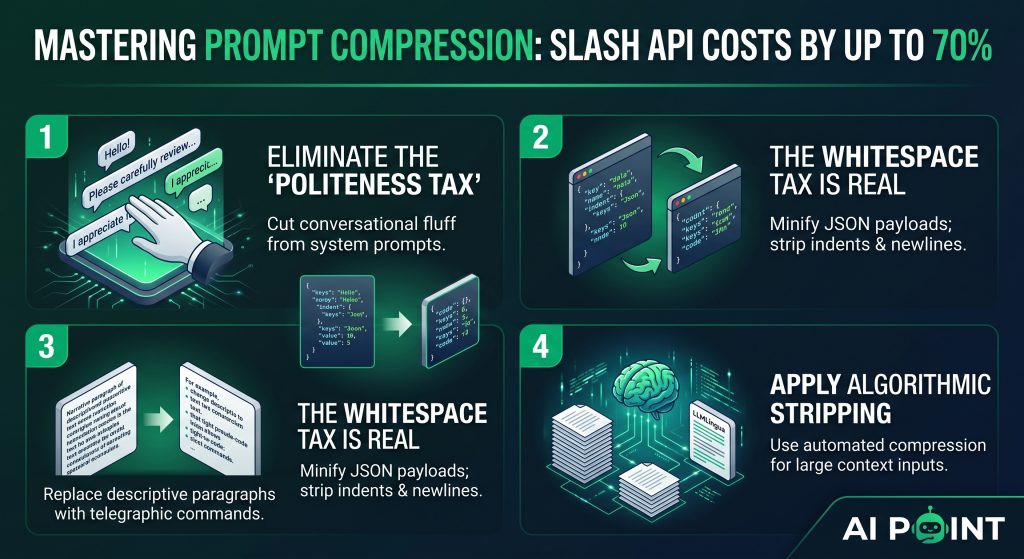
The Hidden Cost of Being Polite
Here is an uncomfortable truth about large language models:
The AI does not care about your manners.
When humans write system instructions, we naturally fall into conversational habits. We add pleasantries, introductory padding, and gentle phrasing.
Take a look at this standard system prompt I see all the time:
“Hello! You are an expert data analysis assistant. Please carefully review the following user data and provide a concise summary. I would really appreciate it if you could format your final answer as a neat list.”
It sounds natural, right?
It’s also an absolute waste of your API credits.
Let’s break down the token toll:
-
“Hello!” = 2 tokens
-
“Please carefully review” = 4 tokens
-
“I would really appreciate it if you could” = 8 tokens
-
“neat list” = 2 tokens
That’s 16 tokens of pure conversational fluff in a single instruction.
If your app handles 100,000 requests a day, that single bloated sentence burns roughly 1.6 million unnecessary input tokens every 24 hours.
Multiply that across your entire prompt library, and you are paying your provider to read polite filler words.
The fix is simple: cut the fluff completely.
The Whitespace Tax in JSON Payloads
Politeness isn’t the only invisible drain on your API budget.
There is another silent credit killer hiding inside almost every production app: the whitespace tax.
When developers inject database records, user profiles, or API responses into a prompt, they usually pass standard, pretty-printed JSON payloads.
Here’s what that looks like in raw text:
JSON
{
  "user_id": 4092,
  "account_tier": "enterprise",
  "is_active": true
}
To a human developer, those clean indents, spaces, and line breaks make the code readable.
To a tokenizer, every double-space indent and trailing newline is counted and billed as an individual token.
If you pass nested JSON payloads with dozens of keys and multi-level indentation, you can easily waste 30% to 40% of your input payload on invisible formatting characters.
The solution? Minify everything before it touches the API.
Strip out newlines, eliminate spacing around colons and commas, and pass a flat string. The LLM parses minified JSON just as accurately as pretty-printed JSON, but you pay a fraction of the cost.
Instruction-Based Constraints
Once you’ve stripped the whitespace, it’s time to rebuild how you write instructions.
The goal here is simple: replace descriptive paragraphs with strict, telegraphic commands.
Think of this as moving from narrative writing to pseudo-code syntax.
Let’s look at a quick before-and-after comparison.
Before (Bloated Prompt):
“You are an automated customer support agent. When a user submits a ticket, your job is to read their complaint, identify the primary issue category, determine the emotional sentiment, and give a score from 1 to 5.”
After (Compressed Prompt):
“Task: Classify support ticket. Output format: [Category, Sentiment, UrgencyScore(1-5)].”
Notice how the compressed version delivers the exact same instructions to the model?
There is zero ambiguity. The model doesn’t have to parse conversational narrative to figure out its objective. In fact, benchmark tests show that concise, bullet-style constraints often yield more consistent structured outputs because there is less semantic noise in the context window.
Mastering this transition is one of the most effective foundational strategies for optimizing LLM costs and token usage.
Algorithmic Token Stripping with LLMLingua
What happens when you need to compress massive inputs—like a 20-page document or a long customer support transcript?
Manual editing and minification won’t cut it. You need an automated system.
This is where algorithmic prompt compression comes in.
The industry standard right now is an open-source framework called LLMLingua.
Here is how it works under the hood:
-
Instead of sending your raw, massive prompt directly to an expensive flagship model, you route it through a tiny, ultra-fast language model first.
-
The small model calculates the “perplexity” (information density) of every word and token in your prompt.
-
It strips away words with low information density—words that don’t change the underlying meaning or logic.
-
It outputs a condensed prompt that looks a bit strange to a human, but preserves the exact semantic relationships the downstream LLM needs.
The results are incredible. LLMLingua can achieve up to 20x compression on long documents while preserving over 95% reasoning accuracy on the target task.
You get flagship-level reasoning at a fraction of the input token cost.
A Production-Ready Python Workflow
Ready to put these concepts to work in your own backend?
You don’t need a complex multi-week migration to start capturing savings. You can implement basic payload compression right inside your API gateway or serverless functions.
Here is a lightweight Python utility to show you how easy it is to automate prompt cleanup and JSON minification before firing off your requests:
Python
import json
import re

def build_compressed_prompt(instruction: str, raw_payload: dict) -> str:
    # 1. Minify JSON: strip formatting whitespace and line breaks
    compact_json = json.dumps(raw_payload, separators=(',', ':'))

    # 2. Clean instruction: remove excess whitespace
    clean_instruction = re.sub(r'\s+', ' ', instruction).strip()

    # 3. Assemble compressed prompt payload
    return f"{clean_instruction}\nDATA:{compact_json}"

# Sample input
payload = {
    "customer_id": "cust_88219",
    "plan": "growth",
    "features_enabled": ["sso", "audit_logs", "webhooks"]
}
system_instruction = "Task: Verify audit log eligibility. Return boolean."

final_payload = build_compressed_prompt(system_instruction, payload)
print(final_payload)
This function eliminates conversational bloat, removes all JSON whitespace, and standardizes your prompt structure in less than a millisecond of execution time.
Final Thoughts
Optimizing your token usage doesn’t mean you have to settle for sub-par AI performance.
By eliminating polite fluff, minifying your JSON data, using rigid instruction constraints, and exploring algorithmic compression tools like LLMLingua, you can run high-performing AI features without draining your API credits.
Start with your highest-volume endpoints today, run before-and-after token comparisons, and watch your monthly bill shrink.
Would you like to draft Spoke 2 on managing massive 200k+ context windows next using this same style?
