

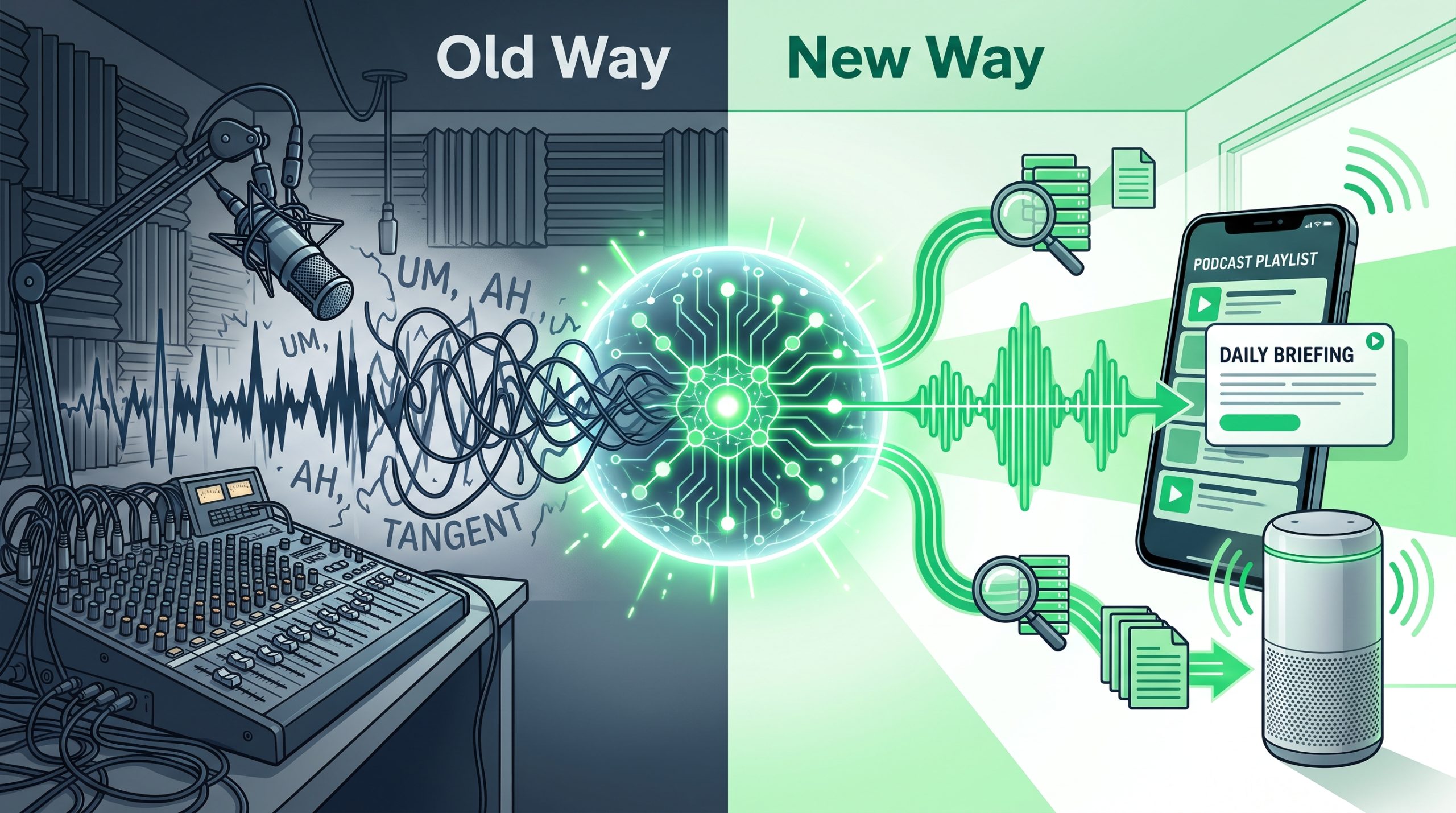
Podcasting used to be an incredibly heavy lift.
You needed a soundproof studio. You needed a four-hundred-dollar microphone. You needed a dedicated audio engineer to spend hours editing out every single “um” and “ah.”
Not anymore.
We are officially entering the era of synthetic audio.
Thanks to massive leaps in artificial intelligence, brands are bypassing the recording studio entirely. They are generating hyper-realistic, human-sounding podcasts with nothing more than a text file and an API call.
But here is the massive opportunity that 99% of marketers are missing:
Synthetic audio isn’t just a content creation hack. It is the ultimate SEO weapon.
Here is exactly why search engines are obsessed with AI-generated audio, and the specific SEO tactics you need to dominate the podcast SERPs.
The Automated Media Architecture
Let’s look at how modern publishers are actually building these systems.
They are not sitting behind a microphone reading scripts. They are building automated media architectures.
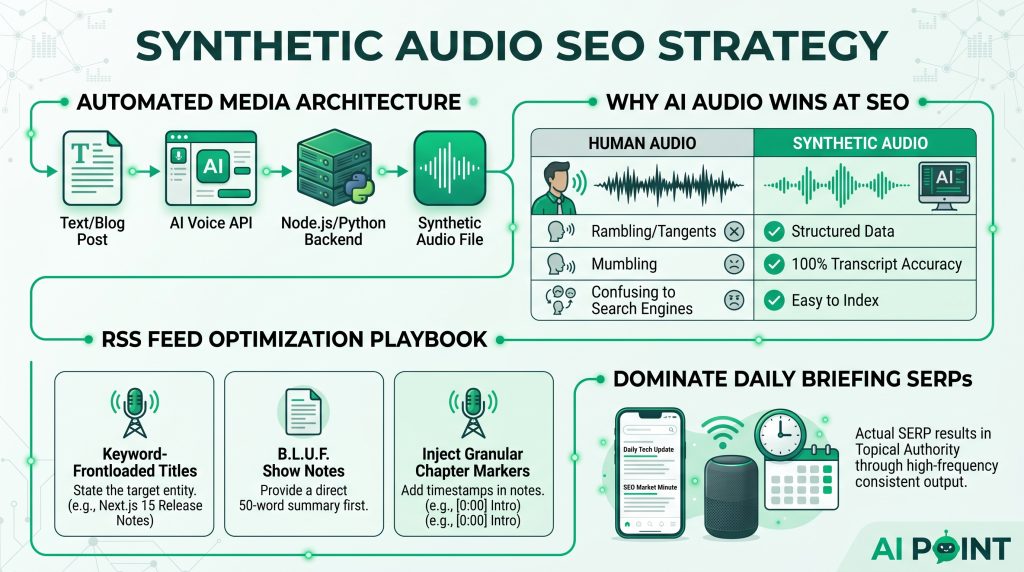
Using a Node.js or Python backend, a developer can take a standard text-based blog post, pipe it directly into a synthetic voice API, and instantly generate a flawless audio file. If they need to stitch multiple segments together, they just run it through FFmpeg post-processing.
The entire workflow happens in seconds.
Look at what is happening on platforms like TikTok and YouTube. Automated channels like Normzy Update News are publishing short international news updates using AI voiceover scripts at a volume a human broadcaster simply cannot match. Point-of-view channels like Edge Cam AI can produce endless content without a human ever stepping in front of a camera.
This same architecture is now hitting the podcast ecosystem.
You can take your entire backlog of written content and automatically convert it into a daily audio show.
You scale your media presence exponentially. But more importantly, you create a massive footprint of audio assets that search engines are desperately looking to index.
Why Search Engines Love Synthetic Audio
Why would Google or Apple Podcasts prefer an AI-generated show over a human-recorded one?
It comes down to data structure.
Search engines have a notoriously difficult time understanding raw, human-spoken audio. Humans ramble. We go on tangents. We mumble our words. Even the best natural language processing (NLP) algorithms struggle to transcribe a casual podcast conversation with 100% accuracy.
Synthetic audio solves this completely.
Because an AI-generated podcast is born from a structured text document, the metadata is inherently flawless.
There are no transcription errors. Every technical term, brand name, and geographic location is pronounced and documented perfectly. The exact script that generated the audio file becomes the transcript.
To a search engine crawler, synthetic audio is a perfectly mapped, completely transparent data source. It is incredibly easy to parse, index, and retrieve.
Structuring Your Podcast Feed for the AI Ear
Just generating the audio isn’t enough.
If you want your synthetic podcast to rank, you have to feed the search algorithms exactly what they are looking for through your RSS feed.
When a user asks Siri or Google Assistant a question, those AI b ots scrape podcast feeds looking for the perfect audio snippet to play back.
But optimizing an AI-generated podcast requires more than just an RSS feed; it requires you to implement strict Voice GEO strategies across your show notes and audio schema.
When you align your podcast’s XML feed with Voice-First Generative Engine Optimization, you are essentially hardcoding your audio files into the machine’s vector database. You transition from hoping a search engine listens to your file, to guaranteeing the algorithm reads it.
Dominating the “Daily Briefing” SERPs
So, what kind of content should you generate?
The highest ROI in synthetic audio comes from targeting the “Daily Briefing” SERPs.
Think about how people use smart speakers. They don’t usually ask their kitchen speaker to play a three-hour deep-dive interview. They ask for quick, recurring informational queries.
-
“Give me today’s tech news.”
-
“What is the crypto market doing today?”
-
“Read me the latest SEO updates.”
Because synthetic audio allows you to produce content instantly, you can completely dominate these high-frequency, daily search queries.
You can set up a programmatic SEO pipeline that scrapes breaking news, rewrites it into a scannable script, pushes it to a synthetic voice endpoint, and publishes a “Daily 3-Minute Briefing” to Spotify and Apple Podcasts every single morning at 6:00 AM.
You establish massive topical authority by simply being the fastest, most consistent voice in your industry.
SEO for the RSS Feed: Title, Show Notes, and Chapters
To guarantee those daily episodes actually rank, you need to ruthlessly optimize your RSS feed.
Here is the exact playbook.
1. Keyword-Frontloaded Episode Titles
Podcast search engines are primitive compared to Google. They weigh titles heavily. Do not use clever or obscure episode titles.
State the exact entity you are covering. Bad: “Episode 44: The Big Green Update” Good: “Next.js 15 Release Notes & Routing Updates (Daily Briefing)”
2. B.L.U.F. in the Show Notes
Your show notes are not a place for a generic summary.
Treat the first paragraph of your show notes exactly like a landing page FAQ. Use the B.L.U.F. (Bottom Line Up Front) framework. Provide a direct, 50-word text summary of the episode’s core fact immediately. This gives text-based crawlers the exact snippet they need to index the episode.
3. Inject Granular Chapter Markers
This is the biggest secret in podcast SEO right now.
Search engines are increasingly indexing individual podcast chapters, not just whole episodes. When you generate your synthetic audio, build timestamped chapter markers into the script.
Include these timestamps directly in your show notes. If a user searches for a specific sub-topic, Google can now surface your podcast and start playing the audio at the exact minute and second that chapter begins.
Conclusion: Audio is the New Blog
We are standing at the edge of a massive shift in content consumption.
Five years ago, if you wanted to build topical authority, you started a text blog. Today, as synthetic voice generation drops to near-zero cost, programmatic audio is taking its place.
Search engines want structured, high-quality audio. Users want on-the-go, screenless information.
By building an automated media architecture and aggressively optimizing your RSS feed, you can turn a simple text script into an unstoppable voice search engine.
