


Here is a hard truth about keyword research.
The way people search has completely changed.
For over a decade, we followed the exact same playbook: Find a high-volume keyword, tack on a few descriptive modifiers to create low-competition long-tail phrases, and build a targeted page.
It worked like a charm.
Until now.
With the explosive rise of conversational AI, users aren’t typing robotic keyword fragments into a tiny search bar anymore. They are chatting. They are debating. They are asking multi-variable questions in plain, conversational English.
And if your SEO strategy is still built around fragmented strings of keywords, your organic traffic is running on borrowed time.
Here is exactly how conversational AI is flipping long-tail search intent on its head—and what you need to do to dominate the new search landscape.
The Death of the Fragmented Keyword
Think about how traditional search engines trained us to behave.
For years, searchers typed like cavemen:
-
“best crm software”
-
“cheap flights lagos”
-
“react vs vue speed”
We typed like this because we knew search engines were fundamentally rigid. They relied on exact lexical matching. If you typed a full, nuanced sentence, the algorithm got confused and returned messy results.
So, SEOs built their entire businesses around tracking monthly search volume for fragmented three-word phrases.
Today, Large Language Models (LLMs) have rewritten those rules.
When someone interacts with ChatGPT, Perplexity, or Google’s AI Overviews, they don’t use keyword shorthand. They speak in complete, natural paragraphs.
Traditional keyword research tools look at historical monthly search volume. But conversational search queries are unique, dynamic, and virtually impossible to catch in a legacy database.
The fragmented keyword isn’t just changing. It is becoming obsolete.
What “Conversational Intent” Actually Looks Like
So, what does this new search behavior actually look like in the real world?
Let’s look at a concrete comparison.
The Old Way:
A developer wants to set up a database for an AI application.
They go to Google and type:
best vector database postgres
They click the top three results, skim for ten seconds, and try to piece the answer together themselves.
The Conversational AI Way:
That same developer now opens a conversational engine and types this:
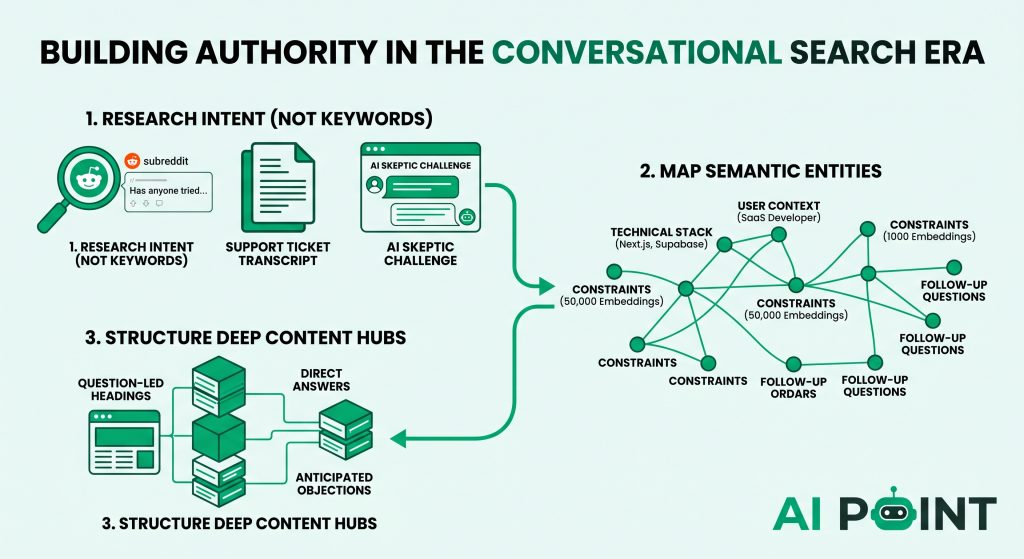
“I’m building a full-stack SaaS app using Next.js and Supabase. I need to store 50,000 text embeddings and run fast vector similarity searches without increasing my monthly hosting costs. Should I use pgvector with HNSW indexing, or should I pay for a dedicated vector database like Pinecone?”
Notice the difference?
The conversational query contains:
-
Specific user context: A full-stack developer building a SaaS application.
-
Exact technical stack: Next.js and Supabase.
-
Constraints and numbers: 50,000 embeddings and low hosting overhead.
-
Direct decision-making trade-offs: Comparing pgvector against Pinecone.
Even more important: Conversational search is multi-turn.
If the AI’s first answer is slightly too broad, the user doesn’t hit reset and start a brand-new search. They reply:
“Okay, but how does memory usage scale if I run pgvector inside my existing Supabase container?”
The conversation continues seamlessly. The context builds upon itself.
Optimizing for the Multi-Turn Conversation
This brings us to the million-dollar question:
How do you optimize for a query that has never been typed before and might never be typed the exact same way again?
The answer is simple: You stop optimizing for isolated strings of text, and you start optimizing for entities and conversational logic.
You have to design your content to answer the next three questions a user will inevitably ask.
When someone visits your article, don’t just give them a high-level definition. Anticipate their secondary objections, their technical constraints, and their implementation hurdles right on the same page.
Structure your sections with clean, question-led headings. Give direct answers immediately beneath each heading before diving into nuance.
More importantly, this conversational shift isn’t just happening in text boxes—it is dominating audio and voice interfaces.
To capture this new wave of highly contextual traffic across every medium, you need to transition your entire site architecture toward Voice-First Generative Engine Optimization.
When you optimize for Voice GEO, you ensure your brand’s core data is stored in a clean, modular format that LLMs can easily pull during multi-turn exchanges.
How to Reverse-Engineer Conversational Keywords
If traditional SEO tools can’t track these nuanced queries, where do you find them?
You have to go where people are already having unfiltered, multi-turn conversations.
Here are three practical strategies:
1. Mine Communities and Specialized Forums
Head to relevant subreddits and developer discussions in your niche. Look for posts that begin with phrases like:
-
“Has anyone tried…”
-
“What happens if I combine X with Y…”
-
“Struggling to choose between…”
The titles and comment threads inside these discussions are direct transcripts of conversational search intent.
2. Audit Customer Support and Sales Inquiries
Your sales calls and support tickets contain the exact words your prospects use when they are facing a real-world problem.
Export your support transcripts. Search for patterns. When multiple customers ask the same nuanced question about your product integration, that is a high-intent conversational query waiting to be turned into a piece of content.
3. Use AI to Challenge Your Own Content
Paste your draft into an LLM and prompt it:
“Act like a skeptical technical buyer reading this article. What are five follow-up questions you would immediately ask?”
Take those five questions and build them directly into your FAQ or sub-headings.
Semantic Mapping is the New Keyword Strategy
Search hasn’t gotten harder. It has gotten smarter.
The era of gaming algorithms with keyword density and shallow listicles is gone.
Conversational AI rewards clarity, depth, and genuine technical precision. If your content directly addresses the complex, messy, real-world problems that users are asking their AI assistants, you will win the citation.
Stop chasing fragmented search volume.
Start mapping conversational intent, answering multi-turn follow-ups, and building authoritative content hubs that machines and humans both trust.
