

Here is a dangerous assumption most marketers make today.
They spend thousands of dollars producing a high-end video, upload it to YouTube, embed it on their blog, and assume the SEO job is done.
In 2024, that might have worked.
But in the era of AI-driven search, that strategy is completely broken.
Why? Because despite all the hype around artificial general intelligence, AI bots still have a massive blind spot.
If you want Large Language Models (LLMs) to scrape your multimedia content and cite your brand as the definitive answer, you cannot just publish a video. You have to feed the machine exactly what it wants to eat.
And the machine eats structured text.
Here is the exact, step-by-step framework for optimizing your audio and video transcripts for AI ingestion.
The Blind Spot: Why AI Bots Can’t “Watch” Your Videos
Let’s clear up a major misconception.
When a user asks ChatGPT or Google’s Gemini a complex question, the AI does not spin up a virtual machine, hit “play” on your 45-minute YouTube video, and carefully listen for the answer.
It takes way too much computational power.
Instead, modern search engines rely on a process called Retrieval-Augmented Generation (RAG). They aggressively scrape the web for lightweight, easily parsable data.
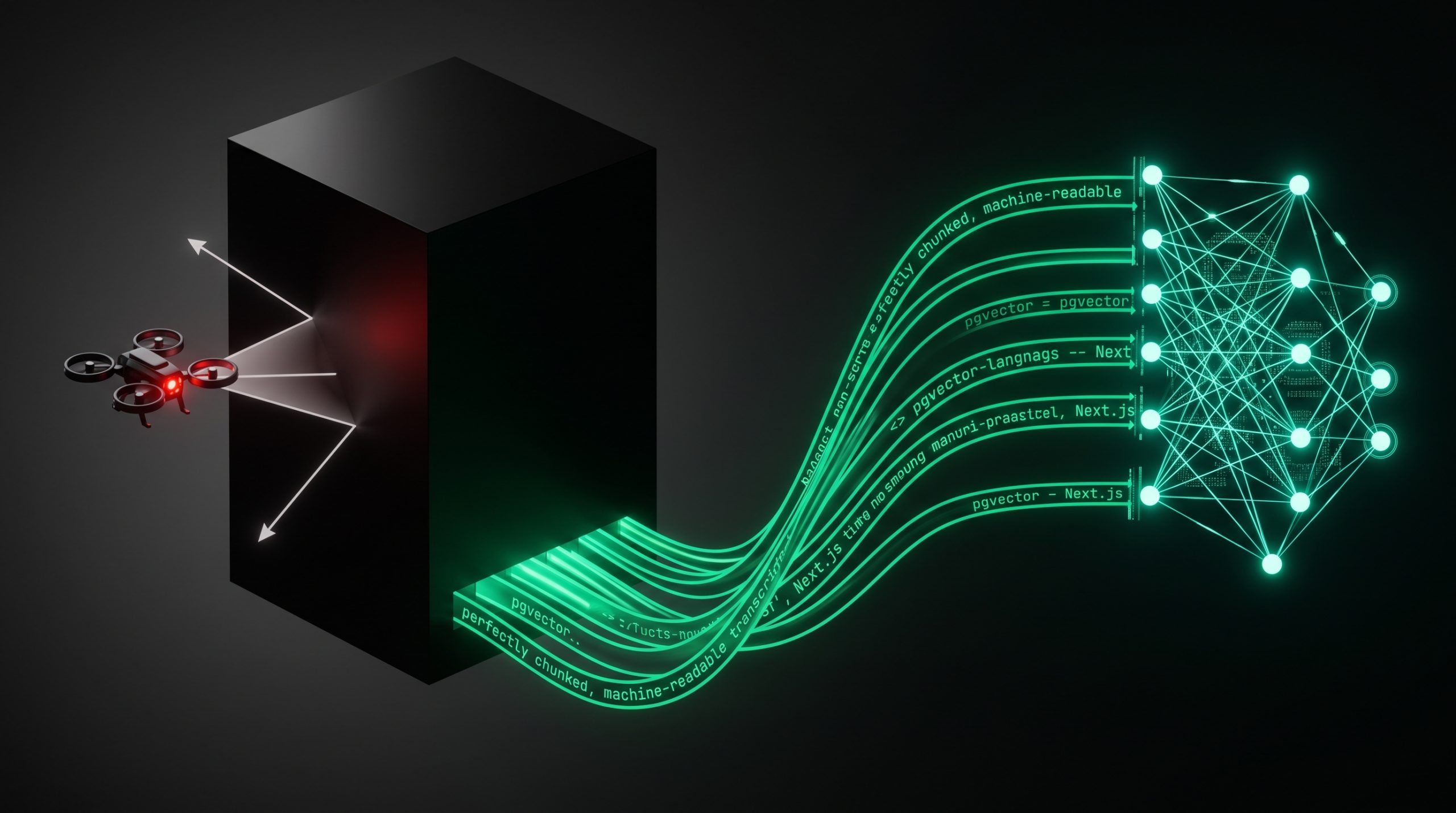
To an AI crawler, your beautifully edited video is just a massive, opaque file. It is a black box.
The AI cannot natively extract the factual nuance of your technical presentation. It relies entirely on the HTML, the schema markup, and most importantly, the text transcript wrapped around that media file.
If your transcript is buried, unstructured, or missing entirely, the AI will simply skip your page and pull the answer from a competitor’s text-based blog post.
To win, you have to turn your video into a machine-readable document.
The Transcript Chunking Strategy for RAG
If you just copy and paste a massive, 5,000-word transcript block under your video, you are doing it wrong.
Remember, AI uses vector databases to retrieve information.
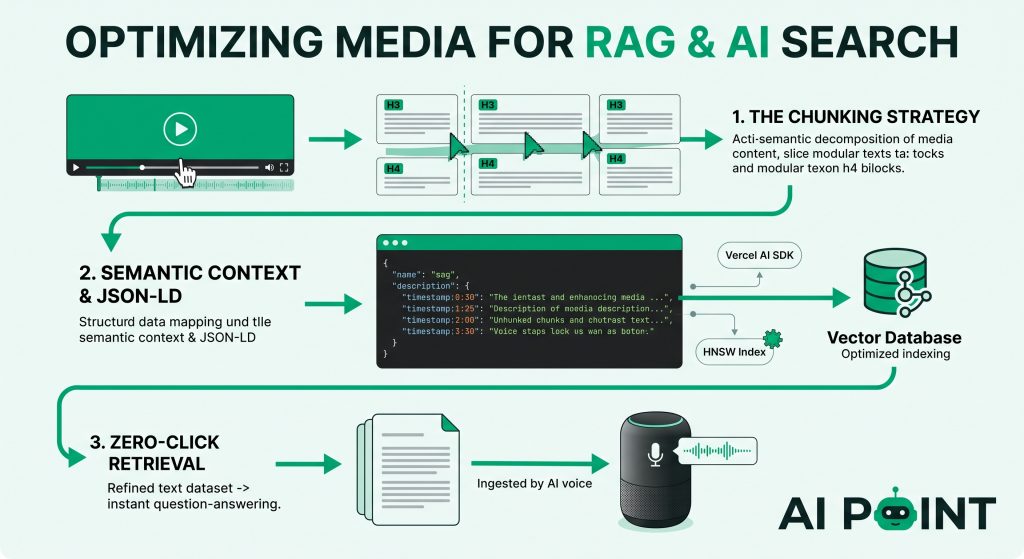
When your page gets crawled, the indexing system breaks your content down into numerical embeddings. If you are building modern applications, you probably know this happens via tools like pgvector utilizing an HNSW index.
But here is the catch.
If you feed a vector database one giant wall of unstructured text, the semantic meaning gets diluted. The AI won’t know where one topic ends and the next begins.
You need to use a strict Chunking Strategy.
You must break your transcript down into highly modular, standalone pieces.
1. Isolate the Core Concepts: Do not let paragraphs run on. Break down the spoken words into tight, two-to-three sentence blocks that focus on a single entity or factual claim.
2. Use Descriptive Subheadings: Inject H3 and H4 tags directly into the transcript body. If the speaker transitions from “Setting up a Next.js environment” to “Configuring API routes,” that needs a distinct heading.
3. Ensure Contextual Independence: If an LLM pulls a random paragraph from your transcript, it needs to make sense on its own. Replace spoken pronouns (“When you plug this into the backend”) with explicit nouns (“When you plug the Vercel AI SDK into the backend”).
When you chunk your data this way, the RAG system can instantly match a user’s prompt to the precise mathematical vector of your transcript paragraph.
Injecting Semantic Context: Timestamps and JSON-LD
Now that your text is chunked, you need to map it directly to the media timeline.
AI models love precise citations. If they can tell a user, “The answer is at the 4:12 mark of this video,” your content’s trust score skyrockets.
But you have to explicitly code this relationship using JSON-LD schema markup.
Specifically, you need to deploy VideoObject or AudioObject schema on the page. And within that markup, you must aggressively utilize the hasPart property.
This allows you to programmatically declare timestamped segments.
Here is what that structure looks like in practice:
-
Define the parent media file (e.g., your podcast episode).
-
Use
hasPartto declare “Chapter 1: The Definition of Semantic Search.” -
Provide the start time (
startOffset) and end time (endOffset). -
Include the exact chunked transcript for that specific section inside the schema description.
This is where programmatic SEO pipelines become incredibly powerful. If you are managing a massive library of media, you can use automated scripts to instantly generate this complex JSON-LD markup for every single video on your site.
You are literally handing the search engine a perfectly organized database of your spoken content.
The Bridge to Zero-Click Search
Why go through all this technical trouble?
Because the end game isn’t just getting your video to rank on standard desktop SERPs.
The end game is dominating screenless, zero-click searches.
When a user asks their voice assistant a technical question, they only receive one spoken answer. By properly structuring your media metadata and transcript chunking, you transform an unreadable video file into a highly retrievable text asset.
This technical structuring is the foundational step in Voice-First Generative Engine Optimization.
When your transcript is the cleanest, most accessible data source on a specific topic, the LLM has no choice but to cite your brand as the single source of truth.
Replacing Auto-Captions with Clean Data
I see this massive mistake all the time.
A content marketer uploads a video, toggles on the platform’s auto-generate captions feature, and assumes the transcript box is checked.
This destroys your SEO.
Auto-captions are notoriously garbage. They lack proper capitalization, they misspell brand names, and worst of all, they completely strip out punctuation.
Punctuation dictates semantic meaning.
If a sentence is a sprawling run-on without periods or commas, a natural language processing (NLP) algorithm cannot accurately map the relationships between the words. The semantic vector becomes muddy. The AI gets confused.
You cannot rely on auto-captions.
You must use high-fidelity transcription tools, and then heavily edit the output.
-
Clean up the “ums” and “ahs.”
-
Fix the grammatical errors of spoken English.
-
Ensure every single technical term, software brand, and location is spelled flawlessly.
You are not just transcribing for a human reader. You are meticulously curating a dataset for a machine. Treat it with that level of respect.
Conclusion: Text is the API for Media
In a generative AI world, your raw video file is just a storage container.
Your transcript is the API.
It is the connective tissue that allows modern search engines to interface with your multimedia content.
If you take the time to clean your transcripts, chunk them for vector databases, and wrap them in precise JSON-LD schema, you will establish an insurmountable moat around your content.
Stop treating transcripts as an accessibility afterthought. Start treating them as the most critical technical SEO asset in your media library.
