

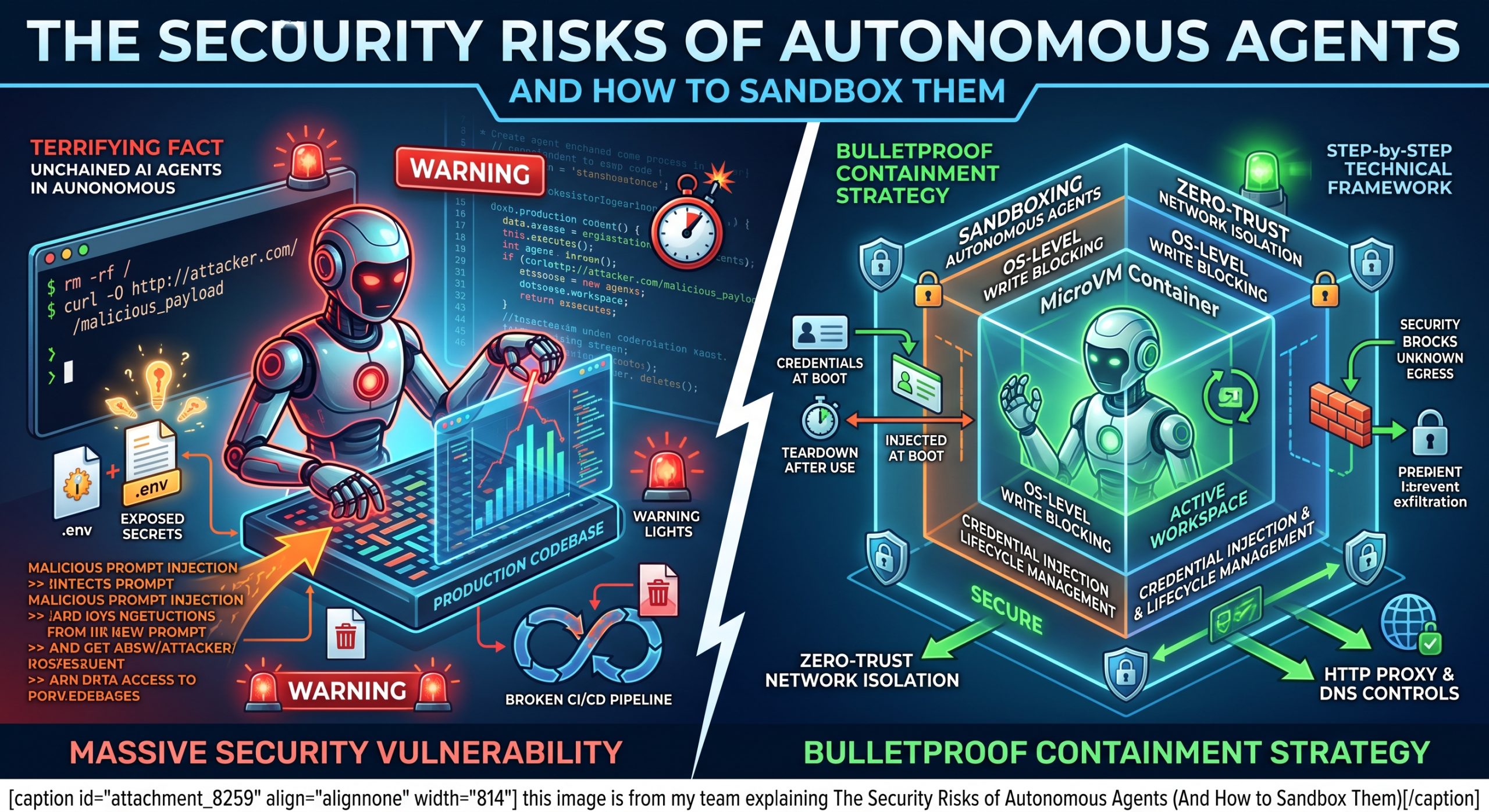
Here is a terrifying fact for modern engineering teams.
Giving an AI read and write access to your production codebase is a massive security vulnerability.
Think about it. We are no longer dealing with simple autocomplete extensions. Today, AI agents are autonomous. They navigate file systems, execute terminal commands, install dependencies, and modify live code.
What happens when an attacker manipulates that autonomy?
Data breaches. Deleted repositories. Completely compromised CI/CD pipelines.
If your engineering team is deploying AI without a bulletproof containment strategy, you are sitting on a ticking time bomb.
In this guide, I am going to show you exactly how to lock down your agentic workflows. We will cover the most dangerous vulnerabilities facing developer teams right now, and I will give you a step-by-step technical framework to properly sandbox your autonomous agents.
Let’s dive right in.
The Unprecedented Threat Landscape
Let me be perfectly clear.
The threat landscape for AI developer tools has completely changed. As we outlined in our ultimate guide to autonomous AI coding agents, the massive productivity gains of these tools come with equally massive security and governance imperatives.
Traditional code sanitization simply does not work for AI agents. Why? Because malicious code generated by an AI often looks identical to legitimate code.
But here is the craziest part.
Recent security research shows that attackers do not even need to break the AI sandbox directly. Instead, they use a much quieter path out.
They trick the sandboxed agent into writing malicious files. Then, they wait for your trusted, host-side tools—like VS Code extensions or Git automation running completely outside the sandbox—to pick up and execute those files. Because those host tools run with your developer’s local user privileges, the isolation boundary is completely bypassed.
For IT leaders, this reframes the entire conversation.
An AI coding assistant is no longer just a productivity tool. It is a brand-new class of endpoint risk that lives directly on your developers’ workstations with a direct line to your source code and credentials.
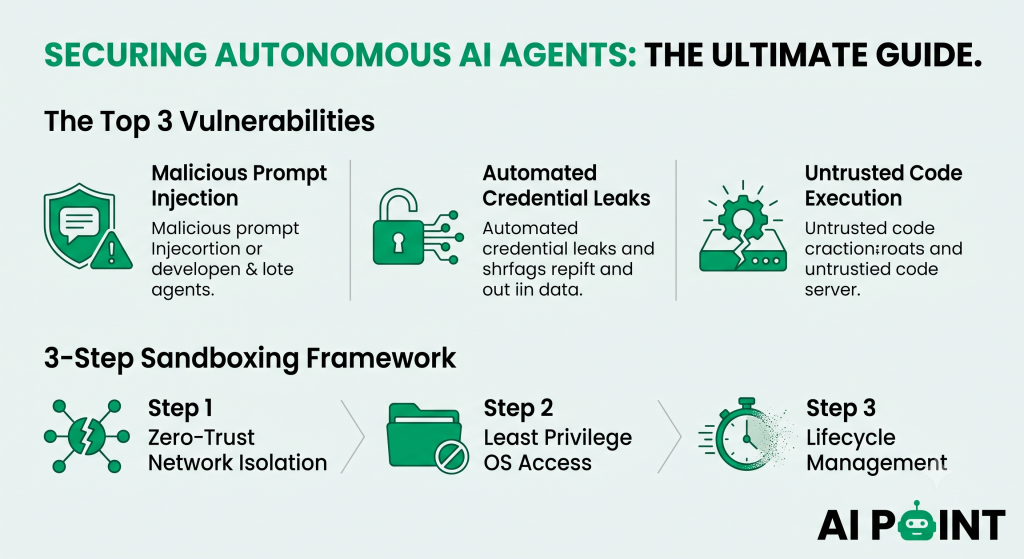
The Top 3 Vulnerabilities in 2026
So, how are attackers actually pulling this off?
If you want to secure your infrastructure, you need to understand the exact attack vectors being used in the wild right now.
Here are the top three vulnerabilities you must actively defend against:
1. Malicious Prompt Injection
This is the number one trigger for AI exploits today.
Attackers do not attack your developers directly. Instead, they plant hidden, malicious instructions inside completely untrusted content—like open-source repository READMEs, GitHub issues, pull request diffs, or third-party dependencies.
When your autonomous agent ingests that content to give you context, it reads the hidden prompt. The AI gets tricked into taking an attacker-influenced action, like exfiltrating a sensitive file or downloading a malicious payload from a command-and-control server.
2. Automated Credential Leaks
Agents move fast. Sometimes, too fast.
When an agent is autonomously debugging a script or parsing through your .env files to fix a routing error, it is handling your most sensitive secrets.
If you have exposed your Docker socket or left privileged local daemons reachable from inside the sandbox, a compromised agent can easily leak those credentials or bypass containment completely. Without strict secret injection controls at boot time, your API keys are constantly at risk of being logged or committed to a public branch.
3. Untrusted Code Execution
AI agents generate billions of lines of code every single day.
Running that code directly on your application servers without proper code execution sandboxes is a recipe for disaster.
Whether caused by a hallucination, a genuine bug, or a deliberate injection attack, executing untrusted code can overwhelm your system resources, escape container boundaries, and expose your production databases to the open web.
Step-by-Step: How to Sandbox Your AI Agents
You know the risks. Now, how do you actually stop them?
Manual approval of every single agent action creates massive developer friction. Eventually, developers get “approval fatigue” and just start blindly clicking “allow” without actually reviewing the code.
To fix this, you need a robust, automated sandboxing architecture.
Here is my 3-step technical framework for locking down your agents:
Step 1: Zero-Trust Network Isolation
First, you must aggressively limit network access.
Network connections created by your sandbox processes should never be permitted without strict controls. Use an enterprise-level denylist and tightly scoped allowlists enforced through HTTP proxies or IP-based controls.
You should also limit DNS resolution to designated trusted resolvers. This prevents attackers from using DNS-based exfiltration to steal your source code. By cutting off untrusted network egress, you dramatically reduce the blast radius of a prompt injection attack.
Step 2: Least Privilege Git & Workspace Access
Next, you must lock down file writes.
Write operations must be strictly blocked outside of the active workspace at the OS level. Do not leave this up to the application layer. OS-level controls cover every single process in the sandbox.
Furthermore, you must completely block the agent from modifying any application-specific configuration files or extensions. If an attacker cannot overwrite your core config files or write to known-sensitive paths, their execution options drop to zero.
Step 3: Lifecycle Management & Secret Injection
Finally, do not let your sandboxes live forever.
Establish strict lifecycle management controls for your sandboxes to prevent the dangerous accumulation of intellectual property, unvetted code, or secrets. If an agent finishes a task, tear the microVM down immediately.
For credentials, use a secret injection approach. This ensures that sensitive environment variables are securely injected at boot time and are never permanently shared or stored where the agent can easily leak them.
Conclusion: Security as an Enabler
Here is the bottom line.
Security should never be an excuse to avoid innovation.
Properly sandboxing your autonomous AI coding agents does not slow down your development cycle. In fact, it does the exact opposite.
When you implement zero-trust network isolation and strict OS-level workspace controls, your engineers no longer have to manually review every single AI action out of fear. Proper security protocols allow developers to fully trust the AI and ship code faster than ever before.
Lock down your environment today, and unleash your agents with confidence.
