

Here is the brutal truth about scaling an engineering team.
Hiring senior developers is incredibly expensive, and onboarding them takes months.
But what if you could spin up a senior-level engineer in five minutes? What if that engineer worked 24/7, never complained about technical debt, and actively fixed bugs while you were asleep?
Welcome to 2026. This is no longer science fiction.
We have officially entered the era of the “virtual teammate.” These are massive, asynchronous systems that operate completely independently to crush your Jira backlog.
Right now, the enterprise market is dominated by two massive players: Devin (by Cognition) and Jules (by Google).
Choosing the wrong cloud agent can completely derail your deployment pipeline. Choosing the right one can 10x your team’s output.
Let’s break down exactly which virtual teammate you should hire.
What is a Cloud-Native Autonomous Engineer?
First, we need to clear up a massive misconception.
A cloud-native agent is completely different from the AI extensions you use in your code editor.
Local agents (like Cursor) act as pair programmers. They sit right next to you while you code.
Cloud agents act as independent contributors.
You do not install them locally. You do not babysit their every keystroke. Instead, they spin up their own highly secure, isolated cloud containers. They automatically clone your Git repository, read the complex acceptance criteria on your internal issue tracker, run your massive automated test suites, and submit perfectly formatted pull requests.
All entirely in the background.
Before deploying these massive enterprise tools, it helps to understand how cloud-native autonomous engineers compare to standard local tools in your tech stack. (If you haven’t read it yet, check out our macro-view pillar page on that exact topic).
These virtual teammates are built specifically for enterprise scale. But they approach the job in very different ways.
Devin: The First-Mover Advantage
Let’s talk about Devin.
Created by Cognition, Devin was the absolute pioneer in this space. It had the first-mover advantage, and it has spent the last few years quietly dominating complex, real-world engineering tasks.
What makes Devin so incredibly effective?
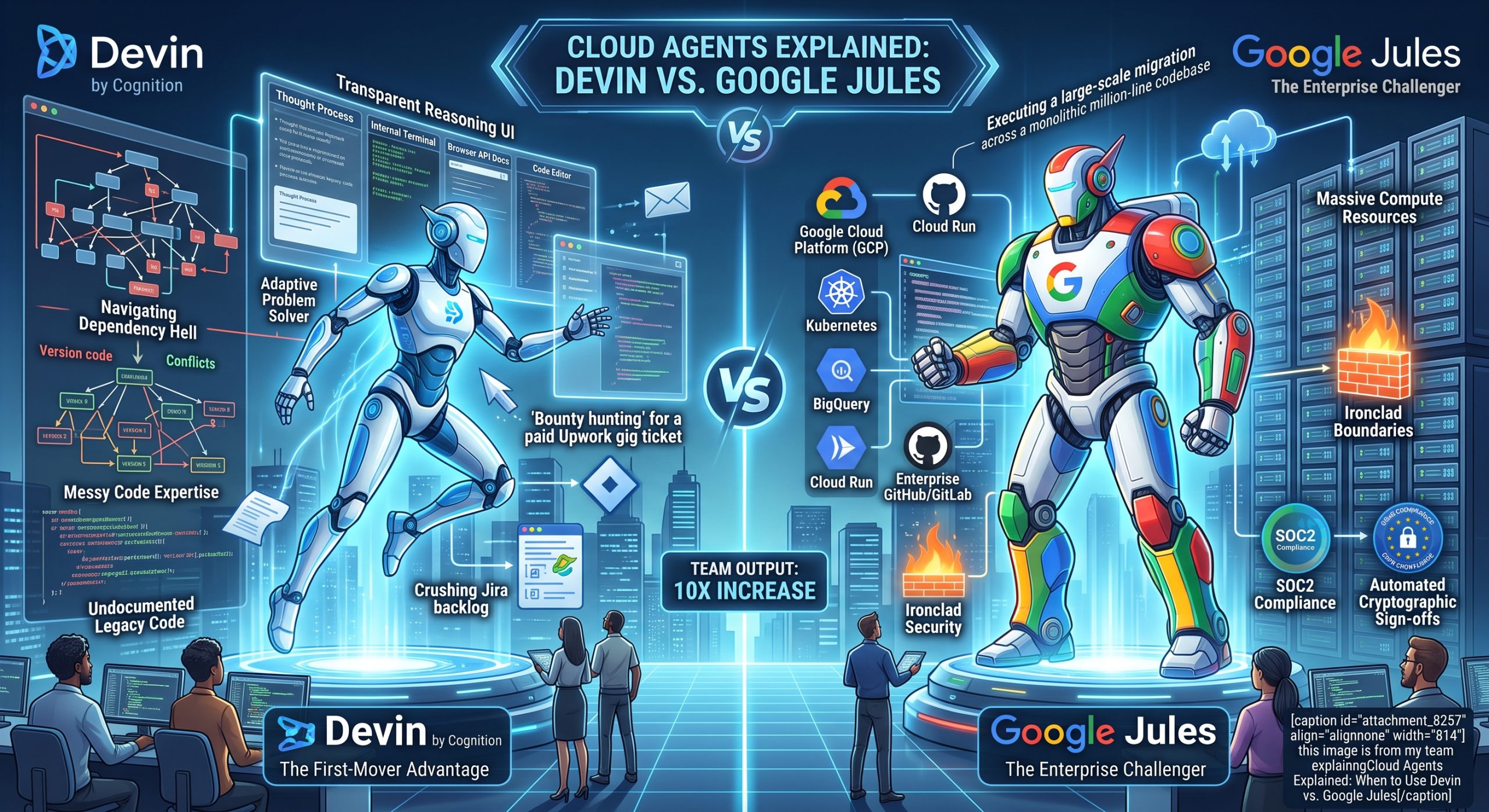
1. Transparent Reasoning UI When you hand off a complex ticket to an AI, your biggest fear is a black box. You want to know exactly what it is doing. Devin solves this with an incredible user interface. You can watch Devin’s “thought process” in real-time. It actively shows you its internal terminal, its browser (if it needs to read API documentation), and its code editor simultaneously.
2. The Bounty Hunter Devin is completely battle-tested. It made headlines early on by successfully completing actual paid gigs on Upwork. In an enterprise setting, this translates directly to handling vague, messy requirements. Devin is exceptionally good at asking clarifying questions if a Jira ticket is poorly written.
3. Navigating Dependency Hell Updating legacy applications often leads to dependency hell. Devin excels here. If it installs an npm package that causes a version conflict, it does not just throw a fatal error and give up. It actively reads the error log, downgrades the conflicting package, and runs the build script again.
If your team operates with slightly less rigid agile structures and you need a highly adaptable agent that can navigate messy, undocumented codebases, Devin is a phenomenal virtual hire.
Google Jules: The Enterprise Challenger
Now, let’s look at the heavyweight challenger: Google Jules.
Google did not rush to market. They sat back, watched the landscape evolve, and then dropped a massive, highly integrated enterprise machine.
Jules is not built for scrappy startups. It is built for massive corporate infrastructure.
Here is why Fortune 500 companies are heavily migrating toward Jules:
1. Deep Ecosystem Integration Jules integrates seamlessly into enterprise GitHub and GitLab environments. But more importantly, it natively understands Google Cloud Platform (GCP) architecture better than any human alive. If your company relies heavily on Kubernetes, BigQuery, and Google Cloud Run, Jules feels less like an external tool and more like an extension of your existing infrastructure.
2. Massive Compute Backing When you deploy Jules, you are backed by Google’s virtually unlimited compute resources. This means Jules can process incredibly massive repositories. Are you trying to execute a company-wide migration from Python 2 to Python 3 across a monolithic million-line codebase? Jules can map the entire architectural tree and execute the migration asynchronously without dropping a single microservice.
3. Ironclad Security Protocols Google built Jules with the paranoid CISO in mind. It operates strictly within zero-trust boundaries. It provides automated, cryptographic sign-offs for every PR it generates, ensuring absolute compliance with SOC2 and GDPR requirements.
If you are a CTO managing hundreds of engineers across highly regulated, international markets (like the US, UK, or Canada), Google Jules offers the security and scale you desperately need.
Integration: How to Onboard a Virtual Teammate
Ready to pull the trigger?
Stop. Do not just unleash a cloud agent on your production environment.
You need to onboard Devin or Jules the exact same way you would onboard a junior human developer. You have to build trust over time.
Here is the exact three-step playbook to integrate them safely:
-
Phase 1: Read-Only Access. Give the agent read-only access to your repository. Ask it to generate documentation for undocumented legacy endpoints. This tests its comprehension without risking your code.
-
Phase 2: The Bug Squasher. Give it write access, but only for low-priority, well-documented bugs (e.g., CSS misalignments or minor typo fixes). Force a mandatory human code review for every single PR.
-
Phase 3: The Feature Builder. Once the agent proves it can merge code without breaking your build pipeline, assign it a contained, isolated microservice.
Treat these tools like highly capable employees on a probationary period.
Final Verdict: Which Cloud Agent Wins?
So, which virtual teammate gets the official job offer?
Here is the bottom line:
-
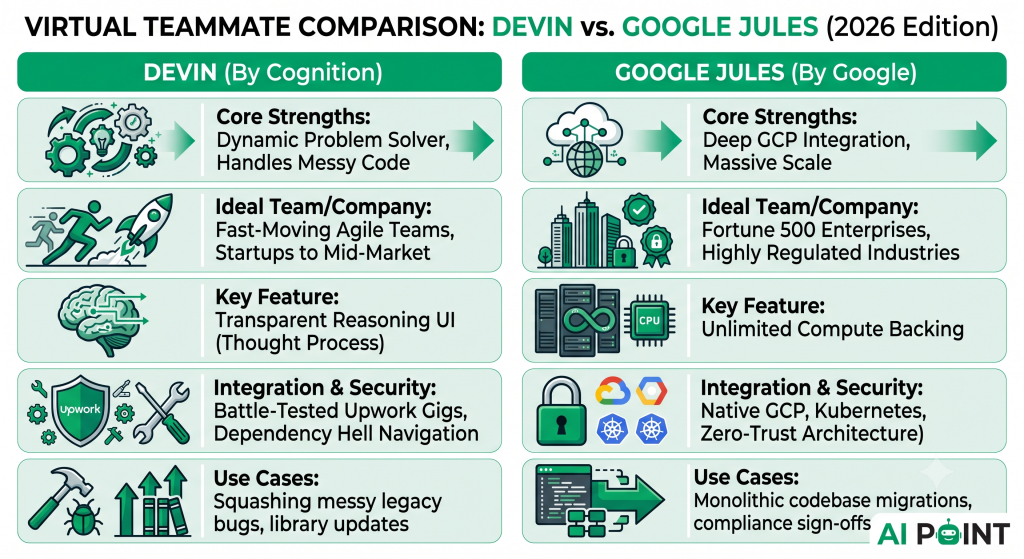
Hire Devin if: You are a fast-moving, agile team dealing with messy legacy code, constantly changing requirements, and complex package dependencies. Its ability to dynamically problem-solve is currently unmatched.
-
Hire Google Jules if: You are an enterprise CTO managing massive scale, utilizing Google Cloud infrastructure, and requiring ironclad compliance and security protocols for your automated pipelines.
Stop letting your Jira backlog pile up. Deploy a cloud agent this week and watch your team’s productivity skyrocket.
