

Let’s be honest.
When most solo developers decide to market their SaaS, they fall into a very expensive trap.
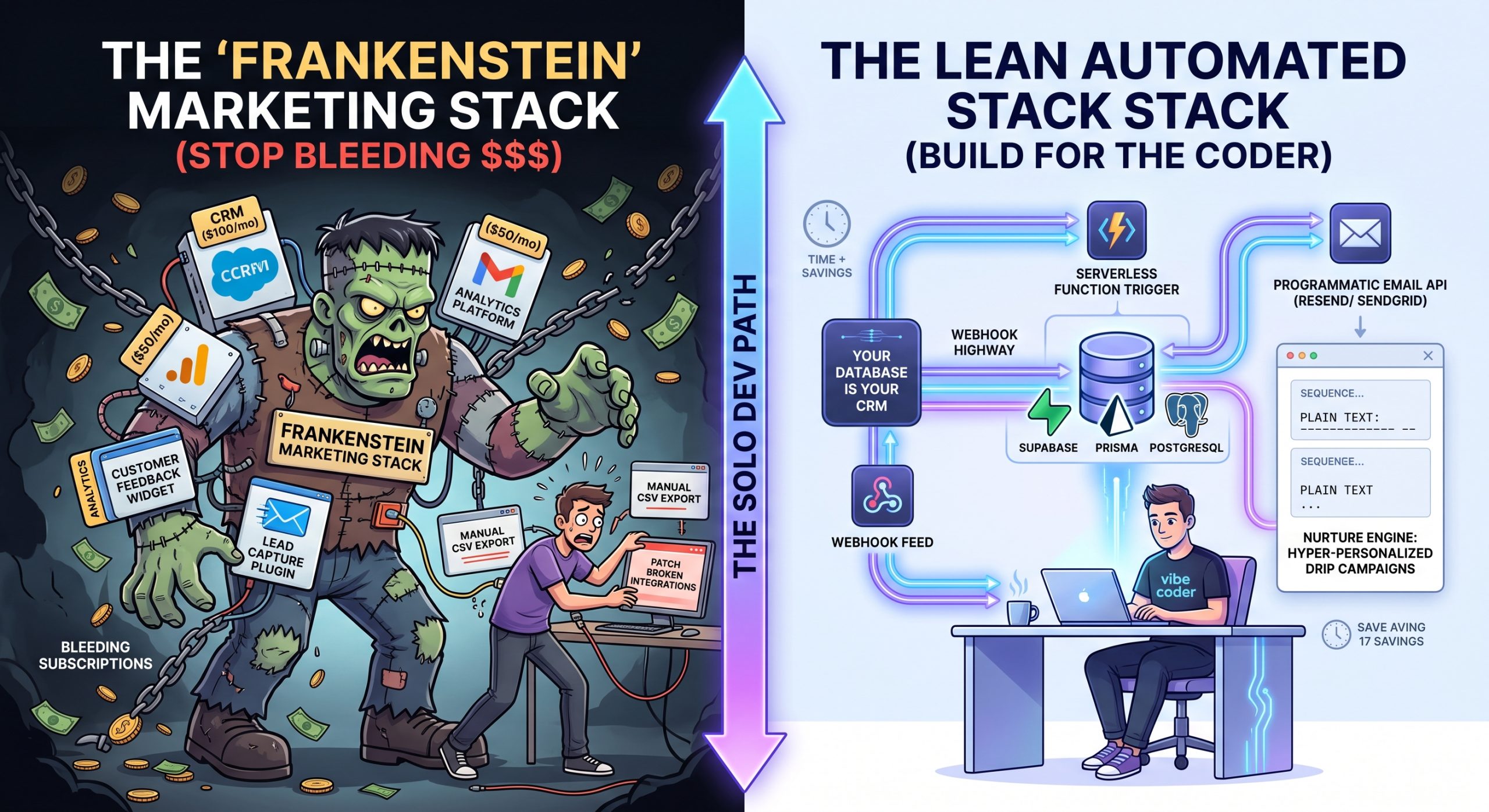
They build what I call the “Frankenstein” Marketing Stack.
They subscribe to a $100/month CRM. Then they add a $50/month email marketing tool. Add a separate analytics platform, a customer feedback widget, and a lead capture form plugin.
Before you know it, you are bleeding $400 a month on software subscriptions before you’ve even made your first dollar. And worse? None of these tools talk to each other properly. You spend half your day logging into different dashboards, manually exporting CSVs, and trying to patch broken integrations together.
If you are a solo vibe coder, you cannot afford this.
You need a lean, automated system that runs silently in the background. A stack built with the tools you already know how to code with.
Let’s look at how to build it.

The Central Source of Truth: Your Database
Here is the golden rule of solo developer marketing:
Your application database is your CRM.
Stop paying for enterprise customer management tools. If you are building with modern full-stack frameworks like Next.js, Python, Prisma, and Supabase, you already have everything you need right inside your codebase.
Think about it.
Every time a user signs up for your app, runs a search, or interacts with a feature, that event happens inside your database.
Why would you sync that data over to a third-party CRM when it’s already sitting right there in your PostgreSQL tables?
How to set up your marketing database:
-
Native Event Logging: Don’t just store user passwords and emails. Create tables specifically for tracking user milestones. Log when they hit their first “Aha!” moment, when they run a programmatic page query, or when they interact with a micro-tool.
-
Unified Schema: Keep your user profiles and marketing attributes in one place. When you want to run an email campaign or target users based on their usage behavior, you can query your own database directly using SQL or an ORM like Prisma.
By keeping everything under one roof, you eliminate data silos. You don’t have to worry about API rate limits or syncing errors between your app and an external tool.
Your database becomes the central brain of your entire operation. It runs 24/7, costs pennies on the cloud, and gives you absolute control over your user data.
The Webhook Highway: Automating the Flow
A central database is great. But a static database is useless if it doesn’t take action.
This is where the second layer of your stack comes in: The Webhook Highway.
You don’t want to manually check your database every morning to see who signed up yesterday. You want your system to react instantly.
How do you do that? Webhooks and serverless functions.
Whenever a key event happens in your Supabase database—like a new user signing up or completing an action—you configure a trigger. That trigger fires a webhook straight to a serverless API route.
That serverless function takes the data and instantly routes it to wherever it needs to go.
Building this lightweight infrastructure is step one. To see how to feed this machine with automated traffic, explore the full vibe coder’s guide to zero-to-one user acquisition.
The beauty of the webhook approach:
It’s completely asynchronous. It runs in the background while you sleep, while you code new features, or while you take a day off.
For example, when a user creates an account on your site, the database fires a webhook. That webhook instantly captures their email and passes it to your communication layer.
No manual data entry. No bloated dashboards. Just pure, clean automation running on serverless architecture.
It takes less than an hour to set up, but it saves you hundreds of hours of manual marketing grind down the road.
The Nurture Engine: Email & Beyond
Once your webhooks are firing, you need a way to actually communicate with your users.
This is your Nurture Engine.
Most traditional email tools force you into clunky, drag-and-drop template builders that look like corporate spam. As a developer, you don’t need fancy designs. You need reliability, speed, and plain text.
The Developer-First Email Stack:
Instead of Mailchimp or ConvertKit, hook your webhooks directly into a developer-friendly email API like Resend, SendGrid, or Postmark.
These services are built for code. They have incredible deliverability rates, and they let you send emails programmatically via simple API calls.
When a webhook fires from your database, your script triggers a plain-text email sequence.
Write your emails like a founder talking directly to another developer or business owner. Keep them short, conversational, and hyper-relevant to the action the user just took.
By keeping your email engine tied directly to your code, you can trigger hyper-personalized drip campaigns based on exact database triggers. If they use a specific micro-tool, your email sequence adapts. If they haven’t logged in for three days, a re-engagement email fires automatically.
Conclusion
Let’s recap your lean marketing stack:
-
The Brain: Supabase or Prisma acting as your unified database and CRM.
-
The Nervous System: Serverless webhooks automating actions instantly.
-
The Voice: Resend or SendGrid delivering clean, programmatic emails.
When you assemble these pieces, you stop wasting money on bloated SaaS tools. And more importantly, you stop wasting precious time managing manual marketing workflows.
A clean, tightly integrated tech stack is your ultimate competitive advantage as a solo founder.
It lets you punch way above your weight class, handling user onboarding, lead capture, and retention automatically while you focus on what you do best: writing great code.
Now, open up your editor, wire up your webhooks, and let your marketing engine run itself.
