

Let’s be honest.
The hardest part of going from zero to one isn’t building the product.
It isn’t setting up your infrastructure. It isn’t even driving the traffic.
The hardest part?
Asking for the credit card.
This is where technical founders absolutely drop the ball. They build a brilliant piece of software. They engineer a flawless, automated marketing machine.
And then they price their product completely wrong.
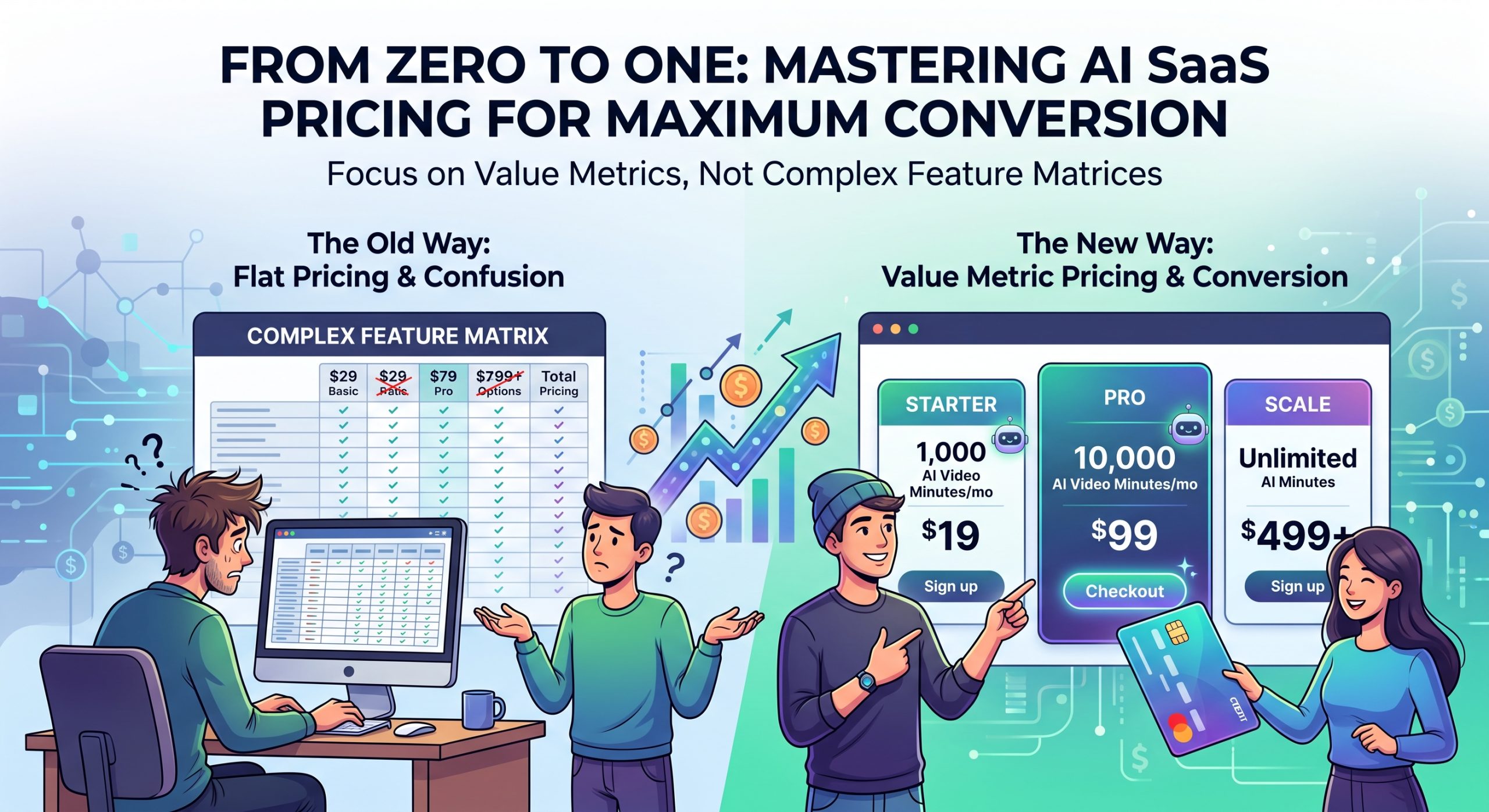
They use massive, complex feature matrices that confuse the buyer. They copy their competitors’ flat-rate pricing without understanding the psychology behind it. Or worse, they severely underprice their tool out of fear that nobody will buy it.
The result?
Sky-high churn and an abysmal conversion rate.
If you want to actually monetize your AI SaaS, you have to treat pricing like a core feature of your product.
In this chapter, I am going to show you exactly how to structure your tiers for maximum conversion.
Let’s dive right in.
Discovering Your Value Metric
Most SaaS products use flat monthly pricing.
$29 a month for the “Basic” plan. $79 a month for the “Pro” plan.
This is a massive mistake.
Why? Because flat-rate pricing has zero correlation with the actual value your user is getting. If a user logs in once, they pay $29. If a user logs in every single day and uses your tool to generate thousands of dollars for their own business, they still only pay $29.
You are leaving ridiculous amounts of money on the table.
Instead, you need to use a Value Metric.
A value metric is the exact unit of value your customer derives from your product.
Think about it like this:
-
If you sell an email marketing tool, your value metric is “emails sent.”
-
If you sell an AI video generator, your value metric is “minutes of video rendered.”
-
If you sell a database API, your value metric is “successful API calls.”
When you align your pricing with your value metric, your revenue scales naturally as your user grows.
If they only use a little bit of your product, they pay a little bit. It reduces the friction of signing up.
But when they experience that magical “Aha!” moment and start using your tool constantly? Their bill goes up. And they are completely happy to pay it, because your product is actively driving results for them.
Optimizing your pricing tiers is the final boss of the solo developer’s journey. For a comprehensive look at the funnel that brings users to this checkout page, read our vibe coder’s guide to zero-to-one user acquisition.
But figuring out what to charge is only half the battle. You also have to figure out how to get them into the product in the first place.
Freemium vs. Free Trial for AI Products
This is the eternal debate for technical founders.
Should you give your product away for free forever (Freemium)? Or should you lock it down after 14 days (Free Trial)?
Here is the truth:
It completely depends on your product’s viral loop and compute costs.
Let’s break it down.
When to use Freemium: You should use a Freemium model if your product is highly viral, B2C, or incredibly easy to understand. For example, if you build a tool that generates stylized TikTok videos, let people use it for free forever.
Why? Because you can slap a massive watermark on those free videos.
Every time a free user posts a video, they are doing your marketing for you. Their usage becomes your top-of-funnel traffic.
When to use a Free Trial: If you are building a heavy B2B workflow tool, Freemium will kill your business.
B2B tools require a behavioral shift. Users have to import data, invite team members, and change their daily habits. If you give them a free version forever, they will never feel the urgency to actually implement your software.
A 14-Day Free Trial forces the issue. It puts a ticking clock on their “Aha!” moment.
A quick warning about AI costs: If your SaaS relies heavily on LLM API calls, be incredibly careful with free tiers. A handful of power users can drain your OpenAI or Anthropic credits overnight. Always implement hard usage limits—even on your paid plans—to protect your margins.
The MVP Checkout Hack: Do Things That Don’t Scale
Here is where I see solo developers waste weeks of their lives.
You finally get the product working. You are ready to launch.
But instead of pushing it live, you spend three weeks building an insanely complex, multi-tiered Stripe integration with an automated API gateway, a custom customer billing portal, and automated invoice generation.
Stop.
Do not write a single line of backend billing automation yet.
When you are at the absolute zero-to-one stage, you need to follow Paul Graham’s golden rule: Do things that don’t scale.
You need to validate that people will actually pull out their credit cards before you spend a month over-engineering the payment infrastructure.
Let’s look at a highly specific example.
Imagine you are launching a new project. Maybe it’s a full-stack fundraising platform prototype where you’ve integrated your “funds Daniel” branding into the project headings.
You want to start taking donations or charging for premium features immediately.
Instead of delaying the launch to build a complex billing architecture, process the payment updates manually. Do not integrate an automated API gateway.
Just use a simple, static Stripe Payment Link.
Put a clear message on your checkout page that says: “Pay via this secure link. We process payment updates manually, so your account/campaign will be upgraded within 12 hours.”
Is it slightly clunky? Yes.
Will it require you to log into your database and manually flip a boolean from false to true when an email comes in? Yes.
But it takes exactly five minutes to set up.
More importantly, it immediately tests your product-market fit. If 100 people click the “Upgrade” button and nobody pays, you know your pricing or your product is broken. And you found out without wasting three weeks on backend code.
Once you are processing 10 manual upgrades a day and it becomes highly annoying, then you have permission to automate the API gateway.
Conclusion
Pricing is never a permanent tattoo.
It is a living, breathing experiment.
Do not let the fear of “getting it wrong” stop you from launching. The only way to find your perfect value metric is to put a price tag on your product and watch how real users behave.
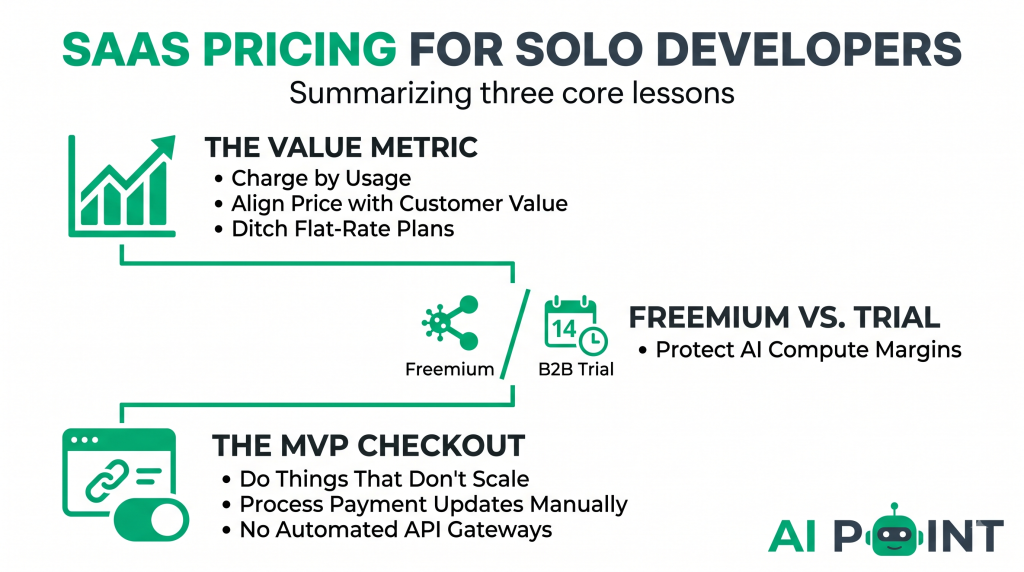
Keep your tiers simple. Align your price with the exact value your customer receives. Protect your AI compute margins. And don’t be afraid to do things manually on day one.
You’ve built the automated engine. You’ve generated the programmatic traffic. You’ve captured the leads.
Now, slap a simple checkout link on your pricing page, manually upgrade those first few users, and start generating real revenue.
