

Let’s be honest.
For years, text-to-speech sounded like a GPS navigation system from 2008. It was flat, robotic, and instantly turned users off.
If you tried to use legacy TTS for a video course, an automated podcast, or a dynamic marketing campaign, people would bounce in two seconds.
Times have changed.
Today, synthetic voice cloning and neural audio models can generate speech that breathes, pauses, and expresses genuine human emotion.
If you are a developer looking to build programmable media applications, mastering high-fidelity audio workflows is no longer optional—it is a core engineering skill.
In this guide, you are going to learn how voice cloning systems work under the hood, how to balance latency versus quality, and how to programmatically scale audio generation without breaking your budget.
Let’s dive right in.
Introduction: Why Audio Fidelity Makes or Breaks Your App
User retention comes down to quality.
When you are building software that talks to users—whether it is an AI tutor, an interactive customer support agent, or an automated news generator—audio is your primary interface.
If the voice sounds synthetic or hollow, your entire product loses credibility.
Conversely, when a user hears a hyper-realistic, cloned voice that matches a specific brand identity or creator, trust instantly goes up.
Voice cloning allows you to take a 60-second audio sample of a real person and train a custom model that can speak any text you pass through an API.
Voice generation is just one piece of the puzzle. To see how it integrates with visuals, review the core components of the AI media tech stack.
Once you understand how audio fits into the broader architecture, you can start building the backend systems required to process it at scale.
The Architecture of Voice Cloning Systems
To build a robust audio pipeline, you need to understand what happens when you hit an API endpoint like ElevenLabs or Play.ht.
Voice cloning doesn’t happen by magic. It relies on deep learning architectures that map phonemes to acoustic features using vector representations.
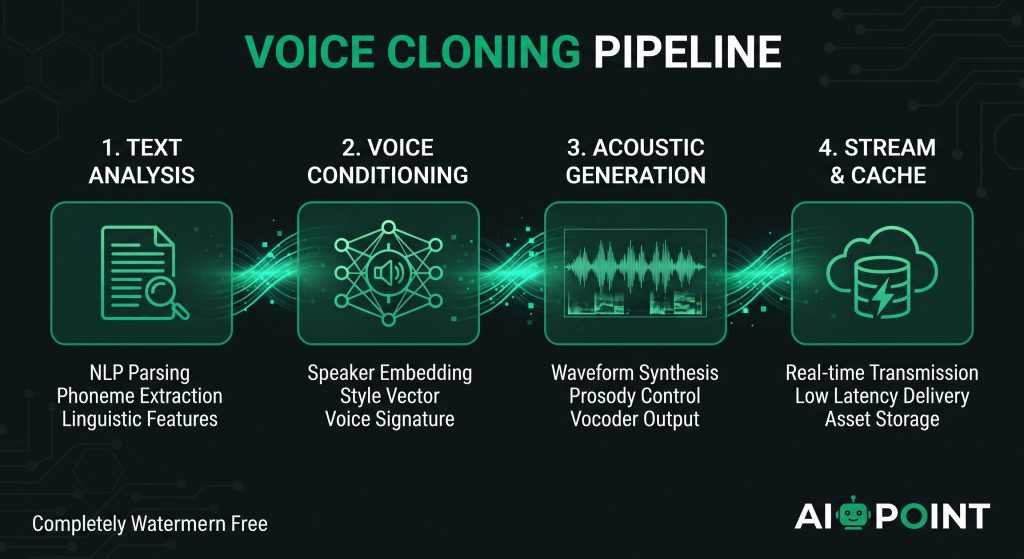
When you send a request to a voice cloning API, the system goes through three distinct phases:
-
Text Analysis: The model parses your input string, analyzing punctuation, sentence structure, and context to determine where breaths and pauses belong.
-
Voice Conditioning: The system applies your custom voice ID vector (derived from your cloned voice training data) to shape the timbre, accent, and pitch of the speaker.
-
Acoustic Generation: The neural network synthesizes the raw audio waveforms, returning an MP4 or WAV file via the API response.
Managing this flow requires careful backend orchestration. You are handling binary data and asynchronous processing.
If your server isn’t built to handle audio streaming or fast cloud file storage, your application will lag.
Balancing Latency vs. Audio Quality
One of the hardest engineering trade-offs in voice generation is choosing between speed and fidelity.
Every developer wants the highest-quality audio possible with zero latency. In reality, you have to choose your battles based on your use case:
-
Real-Time Conversational Agents: If you are building an AI voice bot that talks back to a user in real-time, latency is king. You need sub-second response times. This means using streaming endpoints, smaller model weights, and slightly lower-fidelity turbo models to keep conversations snappy.
-
Asynchronous Content Production: If you are generating a video tutorial, a podcast, or a daily social media clip, fidelity is king. Latency doesn’t matter as much because the user isn’t waiting on the other end of a live phone call. You can use deep, multi-layered high-fidelity models that take 10 seconds to render but sound indistinguishable from a professional recording studio.
Furthermore, you need to implement smart caching strategies.
If your application generates the same introductory greeting or frequent audio phrases repeatedly, do not hit the API every single time. Save the generated audio file to your cloud storage bucket or database, and serve the cached asset instantly.
Your API credit bill will thank you.
Programmatic Model Fine-Tuning and Parameter Control
Passing raw text to an audio API is only half the battle.
To get consistent, professional results, you need to manipulate the underlying API parameters via JSON payloads.
Modern voice APIs expose several developer-controlled variables that dictate how the model behaves:
-
Stability: Controls how consistent the voice sounds. Lower stability introduces more emotional variance and human-like expression, but can occasionally lead to artifacts. Higher stability makes the voice monotonous but very reliable.
-
Similarity Boost: Determines how closely the generated voice matches the original cloned profile. Setting this too high can create distortion; setting it too low makes the voice drift away from the target identity.
-
Style Exaggeration: Amplifies the emotional delivery of the model.
By programmatically tweaking these parameters based on the context of the script—for example, dialing up stability for formal news scripts or increasing expression for storytelling—you ensure your brand voice remains uniform across thousands of automated generations.
Security, Compliance, and Ethical Considerations
We have to address the elephant in the room.
Voice cloning is an incredibly powerful technology, and with great power comes strict compliance responsibility.
As a developer building these systems, you cannot treat voice data casually.
-
Explicit Consent: Never clone someone’s voice without their explicit, verifiable consent. Most reputable APIs require a verification recording where the speaker reads a legal consent waiver.
-
API Compliance: Ensure your application abides by the terms of service of your TTS provider regarding deepfakes, impersonation, and fraudulent audio generation.
-
Secure Storage: If you are storing voice training samples or custom voice IDs in your database, ensure your Row-Level Security (RLS) policies and environment variables are locked down tightly.
Build guardrails into your application logic to prevent users from uploading unverified audio samples or generating malicious content.
Conclusion
Voice cloning and high-fidelity audio generation have completely transformed what developers can build.
What used to require expensive recording studios, professional voice actors, and days of audio editing can now be executed in milliseconds via a simple API call.
By understanding the architecture of voice models, balancing latency against fidelity, tuning your parameters, and maintaining strict security standards, you can build audio engines that scale effortlessly.
The technology is ready. Now it is time to integrate it into your stack and bring your applications to life with a voice of their own.
