


Let’s get right to it.
If you’re building AI features into your web apps right now, you already know the ugly truth.
Building a prototype is incredibly cheap.
Scaling that prototype to thousands of users? It will absolutely destroy your server budget.
I’ve seen developers launch a simple Next.js application, only to wake up to a massive Stripe invoice from their API provider because they didn’t optimize their token usage.
In this guide, I’m going to show you exactly how to slash your API costs.
We are going to cover everything from stripping down your system prompts to architecting semantic caching layers in your database.
Let’s dive in.
1. The Economics of Production AI
Before we start cutting costs, we need to understand exactly what we are paying for.
When you send a request to a language model, you aren’t paying per query.
You are paying for tokens.
And not all tokens are created equal. You have two main buckets:
-
Input Tokens: The text, code, and system instructions you send to the model. (These are usually cheaper).
-
Output Tokens: The text the model generates and sends back to you. (These are usually 3x to 5x more expensive).
Here is the deal:
Most developers focus entirely on limiting output tokens. They use parameters like max_tokens and call it a day.
But that is only half the battle.
If you are passing a massive conversation history on every single request, your input tokens are compounding.
Every time a user says “hello”, you are paying to re-process the entire chat history.
This is the hidden tax of production AI.
To fix this, we need to completely rethink how we structure our requests. We need to move from “prompting” to “prompt architecture.”
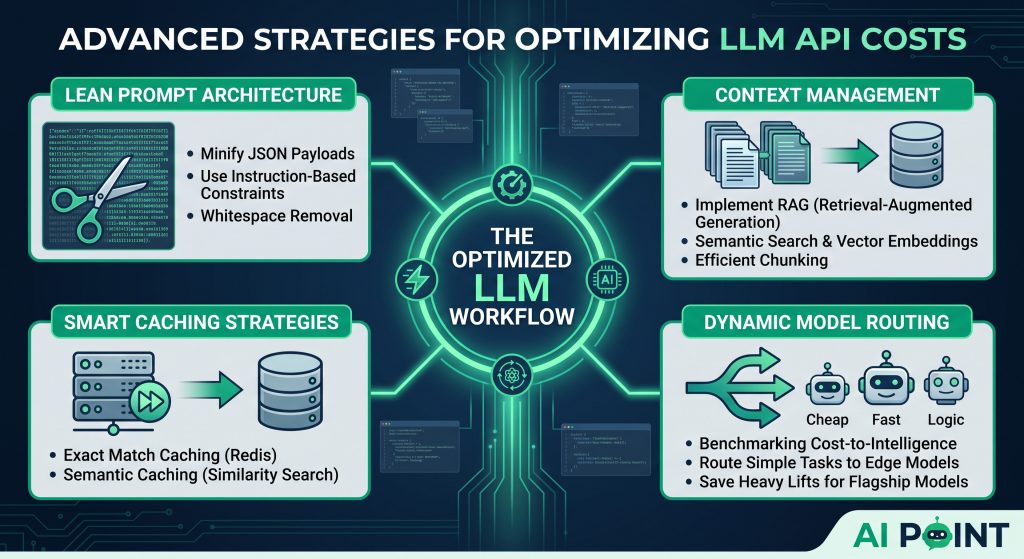
2. Lean Prompt Architecture
Want to instantly drop your API bill by 10% to 20% today?
Stop talking to the AI like it’s a human.
I see developers writing system prompts like this: “Please look at the following data and carefully extract the key points. I would really appreciate it if you could format it as a list.”
The model does not care about your manners.
Every “please,” “thank you,” and conversational filler word is eating your API credits.
Instead, you need to use Instruction-Based Constraints.
Make it brutal. Make it short.
“Extract key points from data. Return bulleted list.”
The Whitespace Tax
Code indentation, line breaks, and massive JSON payloads full of empty spaces are processed as tokens.
If you are passing a JSON object in your system prompt, minify it before sending it to the API. In Node.js, it’s as simple as using JSON.stringify(data) without the formatting arguments.
Advanced Prompt Compression
Taking whitespace out is just the beginner stuff.
When you start dealing with complex multi-agent workflows, you need to compress the actual semantic meaning of your prompts.
There are specific algorithms and token-stripping techniques that can reduce a 1,000-word prompt down to 300 words—without losing a single drop of reasoning capability.
Want the step-by-step system? Check out my deep dive on Prompt Compression: How to Slash API Credits Without Losing Quality.
3. Taming Massive Context Windows
Right now, we are in the era of massive context windows.
Models are boasting 200,000, 1 million, and even 2 million token limits.
It sounds amazing, right? Just dump your entire codebase or a dozen PDF documents into the prompt and let the AI figure it out.
Do not do this.
Just because you can pass 200k tokens doesn’t mean you should.
Passing massive context windows creates two massive problems:
-
Latency: It takes the model significantly longer to process the input. Your users will be staring at a loading spinner.
-
Cost: You are paying for every single token, even the 90% of the document that is completely irrelevant to the user’s specific question.
The RAG Alternative
Instead of stuffing the context window, you need to implement Retrieval-Augmented Generation (RAG).
Here is the exact workflow:
-
Take your large documents and break them down into small chunks.
-
Generate vector embeddings for those chunks.
-
Store those embeddings in a vector database (I highly recommend using PostgreSQL with
pgvector). -
When a user asks a query, search the database for only the 3 or 4 most relevant chunks.
-
Send only those relevant chunks to the LLM.
You just turned a 100,000-token request into a 1,500-token request.
Need to handle massive documents? Read the complete architecture guide on Managing Massive Context Windows (200k+ Tokens) Efficiently.
4. Middleware & Database Strategies
If you are querying the LLM provider directly from your frontend, you are doing it wrong.
You need a middleware layer.
Why? Because humans are predictable.
If you build an AI application, I guarantee that multiple users will ask the exact same questions.
If you don’t have a caching layer, you are paying the LLM provider to generate the exact same answer, over and over again.
Exact Match Caching
The easiest win is setting up Redis in your backend.
When a query comes in, hash the string. Check Redis. If the answer is there, serve it instantly. Cost: $0.00. Latency: 5ms.
Semantic Caching
Exact match is great, but what if User A asks “How do I reset my password?” and User B asks “Where is the password reset page?”
These are different strings, but they have the exact same meaning.
This is where you use Semantic Caching.
Instead of caching the exact string, you cache the vector embedding of the question in your database using an ORM like Prisma. When a new question comes in, you check the database for queries that are mathematically “close” to the new question.
If the similarity score is above 95%, serve the cached answer.
Want to build this infrastructure? I break down the exact code and database schema in my guide to Caching Strategies for High-Volume API Calls.
5. Vendor Analysis & Routing
Here is a costly mistake I see all the time:
Developers pick one flagship model and use it for absolutely everything.
They use a massive, expensive reasoning model to do simple tasks like text classification or sentiment analysis.
That is like using a Ferrari to drive to the end of your driveway to pick up the mail.
Implement Model Routing
Your application should dynamically route tasks to different models based on complexity.
-
Simple tasks (formatting, summarization, JSON structuring): Route these to fast, ultra-cheap edge models.
-
Complex tasks (coding, deep reasoning, logic puzzles): Route these to your heavy hitter flagship models.
But how do you choose the right heavy hitter?
The landscape changes every single week. You need to constantly run benchmarks on the cost-to-intelligence ratio.
Right now, the battle for the best API economics is fierce. You need to look closely at pricing structures, rate limits, and output quality.
Want to see the data? Check out my aggressive breakdown and benchmarking of Evaluating Credit Consumption: Claude Sonnet vs. Gemini 3.1 Pro.
6. Output Parsing & Search Impact
Finally, we need to talk about what happens after the model generates the text.
If you are building programmatic workflows, you usually need the AI to return structured data. You want a perfect JSON object so you can insert it directly into your database.
The JSON Token Trap
Forcing models into strict schemas often causes them to use significantly more output tokens. They generate extra brackets, keys, and formatting spacing.
Even worse, if the model hallucinates a single comma, your entire application breaks.
You need to optimize how you request structured data, utilizing built-in tool calling or structured output APIs rather than relying on raw system prompt coercion.
The SEO Reality Check
And let’s talk about the big picture. Why are we building this AI content in the first place?
Because the entire landscape of search is changing.
Traditional keyword stuffing is dead. Generating thousands of AI articles with zero unique value will tank your site.
Search engines are moving toward semantic search and generative summaries. To survive, your content strategy needs to adapt to how AI actually reads and understands relationships between entities.
Ready to future-proof your traffic? Read exactly How AI Overviews and Semantic Search are Changing Keyword Strategy & Handling JSON Outputs.
