

SEO has completely changed.
Writing 10 articles a month and praying for traffic? That strategy is dead.
If you want to dominate search results today, you need to scale.
And the only way to scale without hiring an army of writers is Programmatic SEO (pSEO).
But here is the hard truth.
The old version of programmatic SEO is dead, too.
A few years ago, you could scrape a list of 500 cities, plug them into a basic WordPress template, and rank for “plumber in [City]”.
Not anymore.
Google’s recent Scaled Content Abuse policies have wiped out sites relying on thin, spun content. Search engines now demand genuine, differentiated value on every single page.
So, how do you build a system that generates 100,000 pages that Google actually loves?
You build an autonomous programmatic SEO pipeline.
This isn’t about spinning text. It is about combining proprietary data, machine learning, and headless architecture to systematically map user intent to value at massive scale.
In this definitive guide, I am going to show you exactly how to engineer this pipeline from scratch.
From scraping messy web data to rendering ultra-fast Next.js pages and engineering automated graph-database internal links, we will cover the exact blueprint you need to build defensible organic traffic farms.
Let’s dive right in.
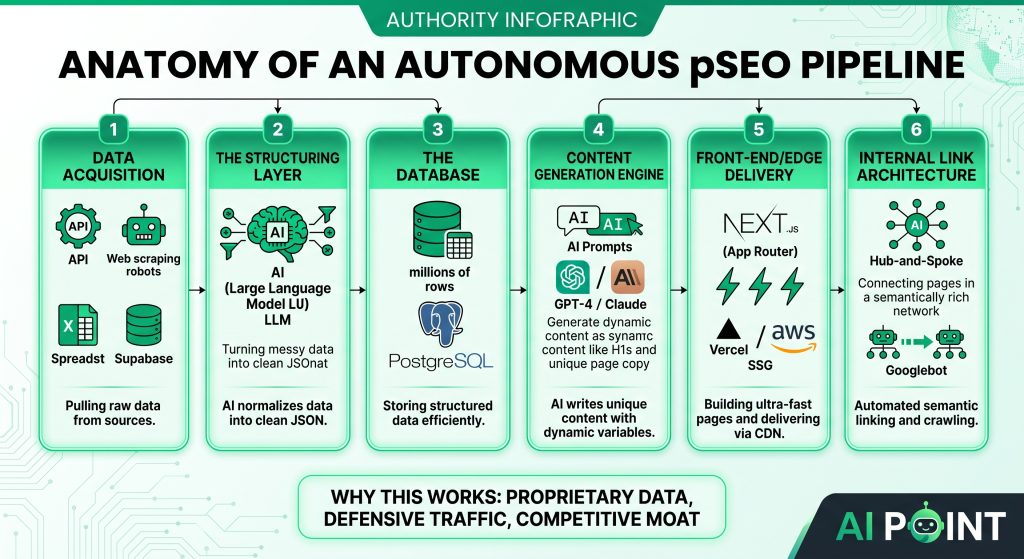
The Anatomy of an Autonomous SEO Pipeline
Before we get into the code, we need to understand the architecture.
At its core, a modern programmatic SEO pipeline relies on a very simple formula:
Database + Template = Unique Pages at Scale.
You define the structure of a page once, and you let structured data fill in the variables.
But building an autonomous pipeline means the system runs itself. It finds the data, cleans it, writes the copy, builds the page, and interlinks it—without you lifting a finger.
Here is the exact top-down architectural flow of a modern pSEO system:
-
Data Acquisition: The system pulls raw data from APIs, CRMs, or web scrapers.
-
The Structuring Layer: AI normalizes the messy data into clean, predictable JSON formats.
-
The Database: The structured data is stored in a relational or vector database.
-
The Content Generation Engine: The system merges the database rows with AI prompts to write unique page copy (H1s, FAQs, intros).
-
Front-End/Edge Delivery: A static site generator builds the pages at the edge for blazing-fast load speeds.
-
Internal Link Architecture: The system automatically maps semantic relationships so Google bots can crawl the new pages instantly.
Why is this specific flow so important?
Because of proprietary data.
If you want to survive Google algorithm updates, your pages must provide data that your competitors do not have.
When you build pages based on a robust, proprietary data pipeline, you provide genuine value. You are turning your website into an authoritative resource hub, not just a blog. Every new programmatic page strengthens your domain authority, creating a competitive moat that a manual editorial team could never match.
Now, let’s break down exactly how to build each phase.
Phase 1: Data Acquisition & Structuring
Data is the absolute foundation of your pipeline.
If you feed garbage data into your templates, you will get thin, penalized pages out. Period.
Your data strategy determines your scale. If your database only has 50 rows, your pSEO campaign caps out at 50 pages. But if you can aggregate 500,000 rows of rich, multi-variable data, your traffic potential is virtually unlimited.
The Challenge with Web Data
Finding data is easy. Getting it into a usable format is incredibly hard.
Let’s say you are building a programmatic directory for B2B software tools. You need pricing data, feature lists, and customer reviews from hundreds of different competitor sites and public directories.
In the past, developers had to write custom Regex (Regular Expressions) or complex DOM parsers (using tools like Puppeteer or BeautifulSoup) for every single website.
This is an absolute nightmare to maintain.
If a competitor changes a single CSS class on their pricing page, your scraping script breaks. Your pipeline halts. Your pages go blank.
You cannot scale a pipeline if you are constantly fixing broken scrapers.
Structuring the Unstructured
The solution to fragile scraping scripts? Large Language Models.
Instead of relying on rigid HTML tags, modern pSEO pipelines use LLMs as extraction engines.
You can take the raw, messy HTML from any webpage, pass it to an LLM, and instruct it to extract specific entities (like “Price”, “Features”, and “Rating”) into a strictly formatted JSON object.
Because the LLM understands the semantic meaning of the text, it doesn’t care if the website changes its layout. It will still find the pricing data and structure it perfectly for your database.
This completely eliminates maintenance bottlenecks and allows you to ingest massive amounts of unstructured web data at scale.
For a deep dive into replacing fragile scraping scripts with AI-driven extraction, read our guide on Scraping at Scale: Using LLMs to Structure Unstructured Web Data.
Data Readiness Checklist
Before moving to Phase 2, your data must pass this checklist:
-
Volume: Your database has at least 1,000+ unique data entities.
-
Depth: Each row provides at least 30% differentiated data versus adjacent rows (to avoid duplicate content).
-
Accuracy: The data is verified, structured, and free of formatting errors.
Once your data is locked in, it is time to build the engine that will serve it.
Phase 2: The Tech Stack – Database to Front-End
You have your structured data. Now you need to turn it into webpages.
This is where most SEOs make a fatal mistake.
The Problem with Legacy CMS Platforms
When people think of SEO, they immediately think of WordPress.
WordPress is fantastic for a 100-page blog.
But if you try to inject 50,000 programmatic pages into a standard WordPress database, the platform will buckle. Your site architecture will bloat. Your server response times (TTFB) will skyrocket. And your core web vitals will crash.
Google hates slow websites. If your programmatic pages take 4 seconds to load, they will not rank.
The Modern Setup: Headless and Serverless
To scale pSEO successfully, you must decouple your database from your front-end. You need a headless architecture.
This means storing your data in a highly scalable backend, and serving your pages through a static site generator or edge-rendered framework.
Here is the exact tech stack we recommend for enterprise-grade pSEO:
| Component | Tool Recommendation | Why It Works at Scale |
| Backend Database | PostgreSQL (via Supabase) | Handles millions of rows flawlessly. Offers instant RESTful APIs for your data. |
| Front-End Framework | Next.js (App Router) | Allows for Static Site Generation (SSG). Builds HTML pages at compile time for instant loading. |
| Hosting & CDN | Vercel or AWS Amplify | Distributes your static pages globally across edge networks. |
Why Next.js and Supabase?
Next.js is the absolute gold standard for programmatic SEO.
Instead of querying a database every single time a user loads a page (which is slow), Next.js uses Static Site Generation (SSG).
When you trigger a “build,” Next.js pulls all 50,000 rows from your Supabase database. It generates 50,000 lightning-fast, static HTML files.
When Googlebot crawls your site, it doesn’t have to wait for a database to load. It instantly reads pure HTML. This maximizes your crawl budget and ensures perfect indexability.
Meanwhile, Supabase acts as your incredibly robust, developer-friendly backend. It gives you all the power of a PostgreSQL database with an easy-to-use interface and instant API endpoints to connect to your Next.js front-end.
To see the exact code and configuration required to build this rendering layer, check out our technical walkthrough on Connecting Supabase to Next.js for Ultra-Fast Dynamic SEO Pages.
Phase 3: Content Generation & Fault Tolerance
Your framework is set up. Now it is time to generate the actual copy.
Having structured data is great, but a page that just lists data points looks like a spreadsheet.
To satisfy user intent (and Google’s helpful content guidelines), you must surround your data with rich, readable, semantic text.
LLM Orchestration
This is where the magic happens.
Your pipeline will take a row from your database and feed it into a dynamic LLM prompt.
Let’s say your row contains data for a “Plumber in Austin, TX”.
Your prompt template will look something like this:
“Write a 200-word introduction for a plumbing service page in {City}. Mention their average rating of {Rating} and their starting price of {Price}. Keep the tone professional and use the keyword ‘{Keyword}’ in the first sentence.”
The LLM generates a unique, contextually accurate introduction. It can also generate dynamic H1s, custom FAQ sections, and summary bullet points.
Suddenly, you have 50,000 pages that read as if a human wrote them specifically for that exact query.
The Massive Scalability Bottleneck
But here is the catch.
Generating content at scale is entirely different from testing a prompt locally.
If you try to run a Python script that asks OpenAI to generate content for 10,000 pages simultaneously, your pipeline will completely shatter.
Here is why:
-
Timeouts: LLMs are slow. A complex prompt might take 45 seconds to process. Standard HTTP requests time out after 30 seconds. Your script will crash while waiting for the AI to answer.
-
Rate Limits: OpenAI and Anthropic place hard caps on how many tokens you can process per minute (TPM). If you push 10,000 requests at once, the API will ban your IP and return 429 Error codes.
-
Server Crashes: If your webhook receiver goes down for even one minute, you will lose hundreds of generated pages into the void.
Building True Resilience
To run an autonomous pipeline, you cannot rely on synchronous, single-thread scripts. You must engineer fault tolerance.
You need to implement asynchronous task queues (like Celery or BullMQ). Instead of waiting for the LLM, your system puts the task in a queue. If the API fails or hits a rate limit, the queue automatically catches the error, waits 60 seconds, and retries the prompt.
You must also configure fallback models. If GPT-4 goes down, your system should automatically switch to Claude 3.5 Sonnet to ensure the pipeline never stops.
Generating content at scale is entirely different from local testing. Learn how to bulletproof your architecture in our advanced guide: Handling API Rate Limits and Webhook Failures in Automated Content Generation.
Phase 4: Architecture & Internal Linking at Scale
Congratulations. You have generated 50,000 high-quality, data-rich pages.
You hit “Publish.”
And then… nothing happens.
Search Console shows zero impressions. The pages aren’t ranking. In fact, they aren’t even indexed.
The Indexing Problem
This is the most common point of failure for programmatic SEO builds.
You can generate thousands of pages very quickly, but Google still needs to crawl, understand, and index them.
Googlebot relies on internal links to discover new content. If you just dump 50,000 pages into an XML sitemap and have zero links pointing to them from your main website, Google will view them as “Orphan Pages” and refuse to index them.
Without a well-thought-out internal linking concept, you risk your new pSEO pages rotting in the dark.
The Hub-and-Spoke Architecture
To solve this, you must build a flawless hierarchical architecture.
You need to keep the “Crawl Depth” under 3 clicks. This means Googlebot should be able to reach any of your 50,000 pages within 3 clicks from your homepage.
To achieve this, implement the Hub-and-Spoke model.
Instead of linking 50,000 pages in your footer, you create robust Category Hub pages.
For example, a Hub page for “Texas Services” links to sub-hubs for “Austin,” “Dallas,” and “Houston.” The “Austin” hub then links to all the specific programmatic service pages in that city.
This funnels “link juice” (PageRank) smoothly from your homepage all the way down to the deepest long-tail landing page.
The Relational Linking Challenge
But Hub pages are only half the battle.
The real SEO superpower is lateral internal linking.
On every single programmatic page, you must link to 3 or 4 highly relevant sibling pages.
On a page for “Best CRM Software for Dentists,” you should have a dynamic section linking to “Best Email Marketing for Dentists” or “Best CRM Software for Orthodontists.”
This proves to Google that your site is a highly connected semantic entity.
But dynamically calculating these related pages using standard SQL queries is incredibly slow and resource-heavy at scale. If your Next.js build has to execute 50,000 complex JOIN queries to find related items, your build time will take days.
To ensure Google crawls your massive site efficiently, you must engineer relationships perfectly. Explore how to map these entities dynamically in Automating Internal Linking Structures Using Graph Databases.
By using graph technology (like Neo4j), you can pre-compute relationships based on semantic similarity instantly, allowing your templates to inject highly relevant internal links into every single page with zero performance lag.
Conclusion & Maintenance
Building an automated data pipeline for programmatic SEO is not a weekend project.
It requires serious engineering, clean data architecture, and an obsession with quality control.
But once the pipeline is active, it becomes the ultimate asymmetric growth lever. Your code works 24/7, constantly ingesting new data, rendering new pages, and capturing untapped long-tail search demand.
Monitoring Quality Over Time
However, automation is not a “set it and forget it” solution.
Automation creates quantity, but analytics create improvement.
You must set up automated monitoring dashboards to track the health of your massive site. When you have 50,000 pages, you cannot check them manually.
You need to pull data directly from the Google Search Console API to track:
-
Indexing Rate: Are your pages actually getting indexed, or are they getting stuck in “Discovered – currently not indexed”?
-
Average Position per Template: Is your “Review” template outperforming your “Comparison” template?
-
Crawl Budget: Is Googlebot wasting time crawling low-value pagination pages instead of your primary programmatic targets?
If a specific cluster of pages isn’t ranking, you don’t delete them. You go back to your pipeline. You enrich the data source, tweak the LLM prompt to add more depth, push a Git commit, and let Next.js automatically rebuild all 5,000 pages in minutes.
Programmatic SEO is not about spamming search engines with thin templates.
It is about systematically answering specific user intents at a massive, structural scale.
Stop writing pages one by one. Start engineering solutions.
Begin by locking down your data pipeline using the technical frameworks linked throughout this guide, and build an organic growth engine that your competitors simply cannot replicate.
