


You just built the ultimate content machine.
You mapped out your keyword topic clusters. You connected your frontend directly to an AI API.
You hit “Run” to generate 10,000 highly optimized articles.
You lean back and wait for the magic to happen.
But a few minutes later, your stomach drops.
Your terminal is bleeding red error messages. Your script has crashed entirely.
What went wrong?
The answer is brutally simple.
You slammed face-first into API rate limits and webhook failures.
Here is the truth.
When you scale automated content, generating the text is actually the easy part. The real challenge is keeping your data pipelines alive when external servers start rejecting your massive wave of requests.
If you do not handle these bottlenecks correctly, your content vanishes into the void.
In this guide, I am going to show you exactly how to bulletproof your system. I will reveal the exact retry logic, queue management, and rate-limiting strategies you need to scale without breaking a sweat.
The “429 Too Many Requests” Nightmare
Let’s get one thing straight about how APIs actually work.
API providers like OpenAI, Anthropic, or even GitHub do not want you crashing their servers.
To protect their infrastructure, they implement rate limiting. API rate limiting restricts the volume of requests a user or bot can make within a specific time window.
These limits prevent denial-of-service attacks and stop sudden traffic spikes from overwhelming the provider’s memory and CPU.
There are a few core algorithms they use to enforce this:
Token Buckets: Imagine a bucket filled with tokens that refills at a steady, fixed rate. Every incoming API request has to spend one token to get through. If your script bursts 100 requests and the bucket is empty, you get blocked until new tokens are added.
Leaky Buckets: All incoming requests are dumped into the top of a bucket, but they only process (or “leak” out of a hole in the bottom) at a slow, constant rate. This is perfect for sanding down spiky traffic and keeping server loads predictable.
Sliding Windows: The system tracks the exact timestamp for every single request. It constantly slides the window forward to ensure you do not exceed your quota over a rolling timeframe, like 60 seconds.
When you fire off thousands of automated prompts for content generation at once, you instantly drain your token bucket.
The server panics. It flags your bulk operations.
And then? It hits you with an HTTP 429 status code.
This means “Too Many Requests”. It is a standard response signaling your sending service to slow down.
If your script is not programmed to seamlessly handle a 429 response, it just dies. The event is completely lost unless your platform is explicitly configured to retry the request.
But how you retry is what separates the amateurs from the pros.
Why Linear Retries Destroy Your Pipeline
Most developers try to solve this with a basic linear retry.
When they get an HTTP 429 or a 5xx server error, they tell their script to wait exactly 5 seconds and try again.
For a small 100-page blog, this works fine.
But at scale? It is a complete disaster.
If the API endpoint is genuinely overloaded or down, hammering it with new requests on a fixed interval only makes things worse.
You create a constant, heavy load on a system that is already struggling to breathe.
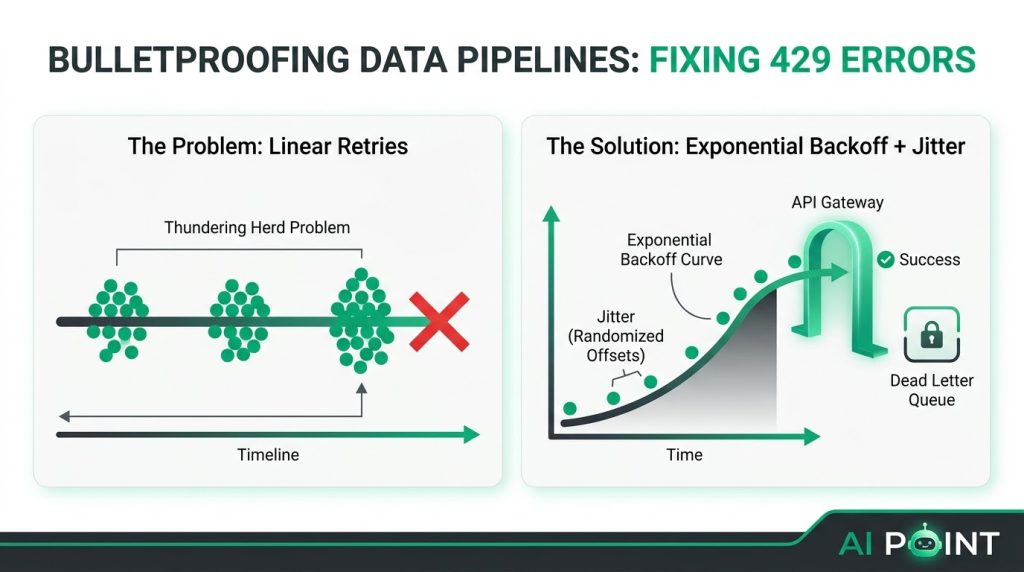
Worse, if multiple webhooks fail at the same time and retry on the exact same fixed schedule, you trigger a retry storm. This creates the “thundering herd” problem.
Your simultaneous requests hit the recovering server all at once, overloading the system again.
You will stay rate-limited forever.
The solution? Stop using fixed intervals.
Start using Exponential Backoff.
The Holy Grail: Exponential Backoff with Jitter
Exponential backoff is a fundamental strategy for building resilient, distributed systems.
Instead of waiting a fixed amount of time, this algorithm multiplicatively increases the wait time between each failed attempt.
It gives the struggling external service actual breathing room to recover.
Here is exactly how the delay pattern looks in practice:
Attempt 1: Wait 1 second.
Attempt 2: Wait 2 seconds.
Attempt 3: Wait 4 seconds.
Attempt 4: Wait 8 seconds.
Attempt 5: Wait 16 seconds.
The standard formula is incredibly simple: calculate your delay by multiplying your base delay by 2 to the power of the attempt number.
But remember that thundering herd problem I mentioned? Exponential backoff alone does not entirely solve it.
If 100 payload requests fail together due to a network glitch, they will all calculate the same backoff. They will all wait exactly 8 seconds and attack the server at the exact same millisecond.
This is where you must introduce Jitter.
Jitter adds a small, randomized amount of time to every single delay interval.
Instead of retrying exactly at 4 seconds, one request might retry at 3.2 seconds, and another at 4.8 seconds.
This variation completely spreads out your retry attempts. It prevents synchronized surges and guarantees system stability.
There are two critical rules you must follow when implementing this:
First, cap your maximum delay. Unbounded exponential growth eventually produces absurd wait times. After 20 attempts with a 1-second base, you would be waiting over 12 days to retry. Set a reasonable maximum delay, like one hour, and continue retrying at that interval.
Second, if the API sends a Retry-After header in its 429 response, always honor it. If the header says wait 10 seconds, wait at least 10 seconds before calculating your backoff.
Bulletproofing Webhooks with Dead Letter Queues
Generating the text is only step one. Step two is getting that content into your database or CMS via webhooks.
And webhooks fail constantly.
You will deal with timeouts, connection refusals, and 5xx upstream errors.
If you are focused on Building Automated Data Pipelines for Programmatic SEO, you cannot afford to drop payloads.
You need a safety net for when all of your retry attempts completely fail.
Enter the Dead Letter Queue (DLQ).
If a webhook fails continuously and exhausts its maximum retry limit, do not just let it vanish.
Send that failed event straight to a Dead Letter Queue.
A DLQ is a secure holding pen for unresolved failures. It preserves the full event context so your team can manually investigate the issue without losing data.
Maybe the payload was too large, or a permanent 4xx error meant the endpoint URL was incorrect.
Whatever the case, the DLQ ensures absolutely no events are permanently lost. Once you patch the underlying bug, you simply replay the stored events from the DLQ and your content successfully goes live.
You should also implement Circuit Breakers alongside your queue.
If 50% of your webhooks are failing over a 1-minute window, or if 5 of the last 10 requests failed, stop sending them immediately.
Open the circuit. Give your receiving endpoint time to recover, and rely on your DLQ to hold the line until the network is restored.
Lastly, you must ensure your endpoints are idempotent. Because retries guarantee at-least-once delivery, duplicate deliveries are expected. Idempotency ensures that processing the exact same event multiple times produces the exact same result without causing database errors.
Scaling content generation requires ruthless engineering.
By abandoning linear retries, implementing exponential backoff with jitter, and safeguarding your data with a Dead Letter Queue, you instantly solve the most painful automation bottlenecks.
Your systems stay compliant, your webhooks deliver reliably, and your massive programmatic campaigns actually see the light of day.
