


Google heats slow website
If your new 50,000-page directory takes 4 seconds to load, you simply will not rank.
It does not matter how good your content is. It does not matter how many backlinks you build. If your Time to First Byte (TTFB) is in the red, Googlebot will abandon your site, and your pages will never see the first page of the search results.
This is the exact wall that most SEOs hit when they try to scale.
When people think about building a website, they immediately default to legacy Content Management Systems like WordPress.
WordPress is a fantastic platform for a standard 100-page blog. But it is fundamentally broken for Programmatic SEO (pSEO).
Here is why.
If you inject 50,000 programmatic pages into a standard wp_posts database, the entire platform buckles under the weight. Your site architecture bloats. Your server CPU maxes out. Your core web vitals crash overnight.
If you want to dominate search results at scale, you have to ditch the legacy CMS.
You need a modern, headless architecture.
In this guide, I am going to show you exactly how to pair the Next.js App Router with a Supabase PostgreSQL backend to generate tens of thousands of lightning-fast pages that Google actually loves to crawl.
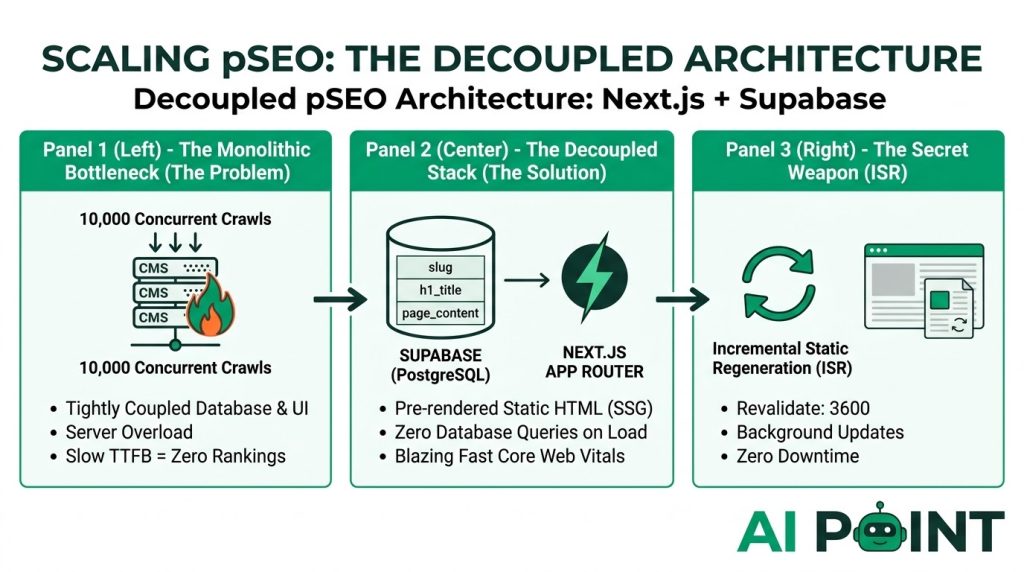
Why Decoupling is Mandatory for pSEO
To understand why this tech stack works, you have to understand the fatal flaw of traditional web architecture.
Most websites use a monolithic structure.
The database (where your content lives) and the front-end (what the user sees) are tightly glued together on the same server.
Every single time a user clicks on a link, your server has to wake up. It has to execute a complex PHP script, run an SQL query against your massive database, wait for the data to return, stitch it into an HTML template, and finally send it to the user.
For one visitor, this takes half a second.
But what happens when Googlebot hits your site and tries to crawl 10,000 new programmatic pages at the exact same time?
Your server queues up 10,000 simultaneous database queries. The server chokes. The response time skyrockets to 10 seconds. Googlebot registers your site as “unresponsive” and leaves.
Your massive pSEO campaign fails before it even begins.
To fix this, you have to completely sever the tie between your database and your user.
You must decouple your architecture.
In a decoupled system, your database sits safely in the background. It never talks directly to your users. Instead, a static site generator builds your pages in advance and distributes them across a global Content Delivery Network (CDN).
Ultimately, to achieve lightning-fast core web vitals while building automated data pipelines for programmatic SEO, you must separate your PostgreSQL database from your front-end rendering.
Setting Up the Supabase Backend
So, where do you store hundreds of thousands of rows of structured data?
You use Supabase.
Supabase is an incredibly powerful open-source alternative to Firebase. But more importantly, it is built entirely on top of PostgreSQL.
PostgreSQL is the undisputed king of relational databases. It is battle-tested. It can handle millions of rows of data flawlessly, and it scales effortlessly as your pSEO empire grows.
But the real magic of Supabase is the API layer.
Normally, if you set up a Postgres database, you have to spend days writing custom backend code (like Node.js or Python endpoints) just to get your data out of the database and into your website.
Supabase does this automatically.
The second you create a table, Supabase instantly generates a secure, RESTful API endpoint for it.
To set this up for pSEO, you want to create a dedicated table called seo_pages.
You don’t just dump raw data in here. You want this table to be perfectly formatted for your front-end template.
Your columns should look something like this:
-
slug: The exact URL path (e.g.,best-plumber-austin-tx). -
h1_title: The dynamically generated headline. -
meta_description: The optimized snippet for the search results. -
page_content: The rich, AI-generated HTML or Markdown body copy. -
structured_data: A JSON column holding your specific entities for Schema markup.
When your automated AI pipeline finishes writing a page, it pushes the data straight into these columns.
Your backend is now fully locked, loaded, and ready to be served.
Fetching Data in Next.js App Router
Now we need to turn that database into actual webpages.
This is where Next.js comes in.
Next.js is the absolute gold standard framework for Programmatic SEO. Period.
Why? Because of a feature called Static Site Generation (SSG).
Next.js allows you to build your entire massive website at compile time.
Here is exactly how it works in the modern App Router.
Inside your Next.js project, you create a dynamic route file. It looks like this: app/[slug]/page.tsx. This single file will act as the master template for all 50,000 of your pages.
Inside this file, you use a special function called generateStaticParams.
When you trigger a “build” (when you tell your server to update your website), this function fires. It reaches out to your Supabase API and says: “Give me every single slug in the database.”
Supabase hands over the 50,000 slugs.
Next.js then loops through every single slug, pulls the associated h1_title and page_content, and generates 50,000 pure, static HTML files.
This is the secret to dominating core web vitals.
When you host this Next.js app on a platform like Vercel or AWS Amplify, those 50,000 HTML files are instantly distributed to edge servers all over the world.
When Googlebot crawls your new page for “Plumber in Austin”, it does not trigger a database query. It does not run a PHP script.
It simply downloads a static HTML file from a server located just a few miles away.
The page loads in milliseconds. Your crawl budget is maximized. Your indexing rate skyrockets.
Handling Updates with Incremental Static Regeneration (ISR)
But there is one obvious problem with Static Site Generation.
What happens when your data changes?
Let’s say you run a programmatic directory comparing software tools, and a competitor changes their pricing.
Your Supabase database updates automatically via your scraping pipeline. But your Next.js front-end is static. The HTML file is already built.
Do you have to rebuild all 50,000 pages just to update a single price tag? A full rebuild could take hours.
Absolutely not.
Next.js solves this with an incredibly powerful feature called Incremental Static Regeneration (ISR).
ISR allows you to update static pages in the background without requiring a full site rebuild.
When you write your fetch request to Supabase inside Next.js, you simply add one tiny line of code:
revalidate: 3600
This tells Next.js to cache the static page for 3600 seconds (one hour).
For that entire hour, millions of users and bots can hit that page, and they will get the blazing-fast static cached version.
But when the hour is up, the very next user who visits the page triggers a background process.
Next.js quietly reaches out to Supabase, checks if the data has changed, and rebuilds just that one single page behind the scenes.
The user never sees a loading spinner. The site never slows down. And your programmatic content stays completely fresh and accurate for search engines.
It is the perfect balance of static performance and dynamic data.
By combining the robust data storage of Supabase with the edge-rendered speed of Next.js, you are not just building a website. You are engineering an absolute fortress of organic traffic.
You are building a site architecture that can handle hundreds of thousands of pages without dropping a single frame of performance.
What is the biggest bottleneck slowing down your current CMS? Let me know in the comments below.
