


Content marketing has changed. Drastically.
A few years ago, publishing one high-quality, 2,000-word blog post a week was enough to dominate your niche.
Today? That strategy is like bringing a knife to a gunfight.
Your competitors aren’t writing articles one by one anymore. They are deploying automated pipelines that generate hundreds of perfectly optimized pages in a single afternoon.
Welcome to the world of Programmatic SEO (pSEO).
But there is a massive catch.
If you just hook up OpenAI to a WordPress site and spam the publish button, Google will obliterate your rankings. It happens every day.
Here is the truth: Search engines don’t penalize automation. They penalize unhelpful garbage.
In this definitive guide, I am going to show you the exact architecture needed to build a zero-to-one automated publishing machine. We are going to cover everything from setting up your database and clustering keywords, to configuring webhooks and dynamically generating schema markup.
Ready? Let’s dive in.
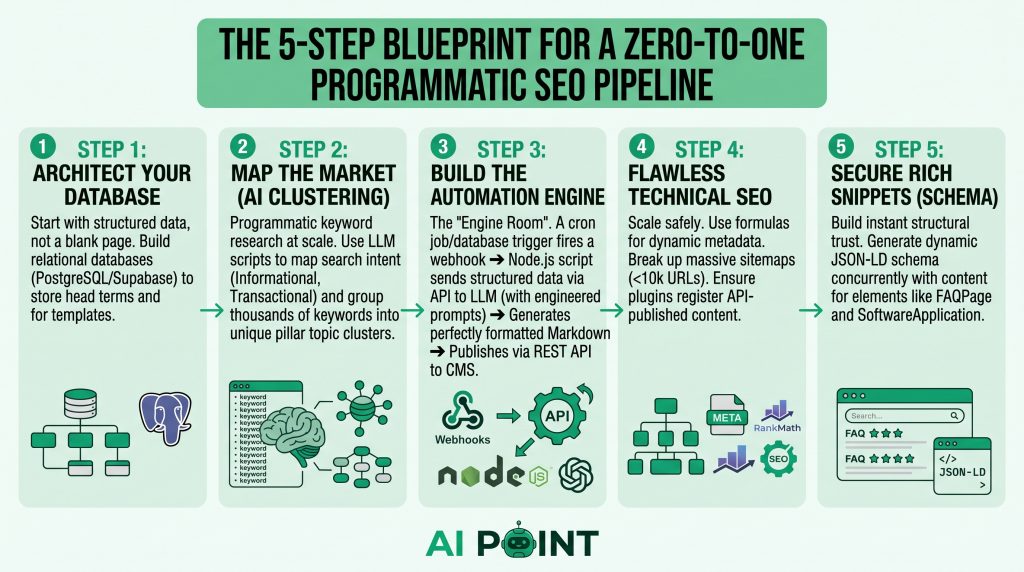
1. The Anatomy of a Modern Programmatic SEO Pipeline
Before you write a single line of code or touch an API, you need to understand the architecture.
Most people get pSEO completely wrong. They treat it like a giant text editor.
You need to treat it like a database.
A robust programmatic strategy starts with structured data, not a blank page. The most successful pSEO builds run on relational databases like PostgreSQL (often managed via Supabase) or robust headless CMS setups.
Here is why: You aren’t writing articles. You are building templates that pull variables from a dataset.
The Head Term vs. The Modifier
Every successful programmatic campaign relies on a simple formula.
You have a Head Term (the core subject) and a Modifier (the specific variable).
Let’s say you run an AI technology blog like AI Point.
-
Your Head Term: “AI Tools for [Profession]”
-
Your Modifiers: “Developers,” “Marketers,” “Copywriters,” “Data Scientists.”
When you combine them, you have the blueprint for hundreds of unique pages. But scaling this introduces a massive risk. If your templates are too thin, or if the variables don’t change the core meaning of the page enough, Google’s algorithms will flag it as duplicate content.
To survive the Helpful Content updates, your architecture must inject unique, structured data (like specific APIs, real-world examples, or custom data points) into every single page. If you want to dive deep into architecting templates that actually rank, read our complete guide on How to Build a Programmatic SEO Pipeline Without Getting Penalized.
2. Mapping the Market: AI-Driven Intent and Clustering
Now that you understand the architecture, it is time for step two: Keyword Research.
But not the kind you are used to.
If you are generating 5,000 pages, manually checking search volume and intent for every long-tail variation in Ahrefs is impossible.
Traditional keyword research is dead at this scale.
Instead, you need to use Large Language Models (LLMs) to map search intent programmatically.
The Semantic Grouping Workflow
When you scrape thousands of keywords, many of them mean the exact same thing.
-
“Best AI coding agent”
-
“Top autonomous AI developers”
-
“Which AI coder is best”
If you build three different programmatic pages for these terms, you will cannibalize your own rankings.
Here is the solution: You pass your massive, raw list of keywords through an LLM using a Python script. You instruct the model to categorize every keyword by Search Intent (Informational, Navigational, Transactional) and group them into parent topic clusters.
By the time the script finishes running, you don’t have a messy list of 10,000 keywords. You have a clean, perfectly mapped database of 500 targeted pillar topics, ready to be fed into your generation pipeline.
To see the exact system prompts and scripts needed to execute this, check out our walkthrough on AI-Driven Keyword Clustering: Mapping Search Intent at Scale.
3. The Automation Engine: Webhooks, APIs, and CMS Publishing
This is where the magic happens. This is the engine room.
How do you actually move data from a spreadsheet or database, through an AI, and onto a live website without clicking a single button?
You need a modern tech stack.
Connecting the Nodes
Whether you are building a custom headless Next.js frontend or routing data into a traditional CMS, the flow looks exactly the same.
-
The Trigger: A cron job runs on your server, or a new row is added to your Supabase database using Prisma as your ORM.
-
The Webhook: A Node.js backend script fires a webhook, sending your structured data variables straight to an LLM API (like OpenAI or Claude).
-
The Strict Prompt: The API receives a heavily engineered system prompt. It tells the AI exactly how to format the output using Markdown.
-
The Delivery: The generated Markdown is routed directly to your CMS via a REST API.
The best part? This entirely removes human error from the publishing flow.
If you want to automate your featured images, format your HTML blocks perfectly, and push everything live effortlessly, here is our step-by-step breakdown on Automating WordPress Publishing Using AI APIs and Webhooks.
4. Technical SEO and Plugin Configuration for Scaled Sites
Your content is generated. It is live on the site.
You are done, right?
Wrong.
Once your content hits the site, your technical SEO needs to be absolutely flawless. A single broken meta tag duplicated across 5,000 programmatic pages is a disaster that can tank your entire domain.
Dynamic Metadata is Mandatory
You cannot write custom Title tags and Meta descriptions for thousands of pages. You have to write formulas.
Your backend needs to inject your database variables directly into the metadata. For example: Top {Modifier_1} AI Workflows for {Modifier_2} in 2026.
Taming the Sitemap Monster
When you drop 5,000 pages onto a site in one day, Googlebot gets confused.
You must break up massive sitemaps. Keep them under 10,000 URLs per map. If you are generating pages dynamically, your sitemap must also update dynamically.
Standard SEO plugins often struggle out-of-the-box with API-published content. They don’t always register the focus keywords or update the internal link counters when an article is pushed via REST API. To fix this, you need to programmatically inject this data. Here is exactly how to handle Configuring Rank Math and SiteSEO for AI-Generated Sites.
5. Winning the SERP: Dynamic Schema and Rich Snippets
This final step separates the amateurs from the absolute pros.
Want to dominate the Search Engine Results Pages (SERPs)? You need structured data.
Why Schema Matters More for AI Content: Search engines are inherently skeptical of pages spun up by automation. Valid, rich JSON-LD schema helps Google instantly parse the entities, relationships, and facts on your page, building instant structural trust.
Automating JSON-LD
You can’t hardcode schema for a pSEO campaign. It has to be generated concurrently with the text.
When you send your prompt to the LLM API to write the article, you add one more instruction:
“Based on the content generated above, output a perfectly formatted JSON-LD script for an FAQPage and SoftwareApplication schema.”
When your Node.js webhook receives the payload back from the API, it separates the article body from the JSON-LD and injects the schema straight into the <head> of your page.
It is a completely hands-off way to secure Rich Snippets. If you want the exact prompts required to execute this without breaking your site’s code, read Generating Dynamic Schema Markup and Rich Snippets with LLMs.
Conclusion & The Future of Programmatic SEO
Programmatic SEO is not a trend. It is the new baseline.
The workflow is clear: Data Collection ➔ Intent Clustering ➔ API Generation ➔ CMS Automation ➔ Technical SEO ➔ Schema Markup.
But remember this: The goal of automation is not to completely remove the human from the loop. The goal is to elevate you from being a typist to being an architect. You design the system, the database, and the quality standards. The code just handles the heavy lifting.
What is the first step you plan to take to transition your current content strategy into an automated pipeline?
