

Let’s get one thing straight.
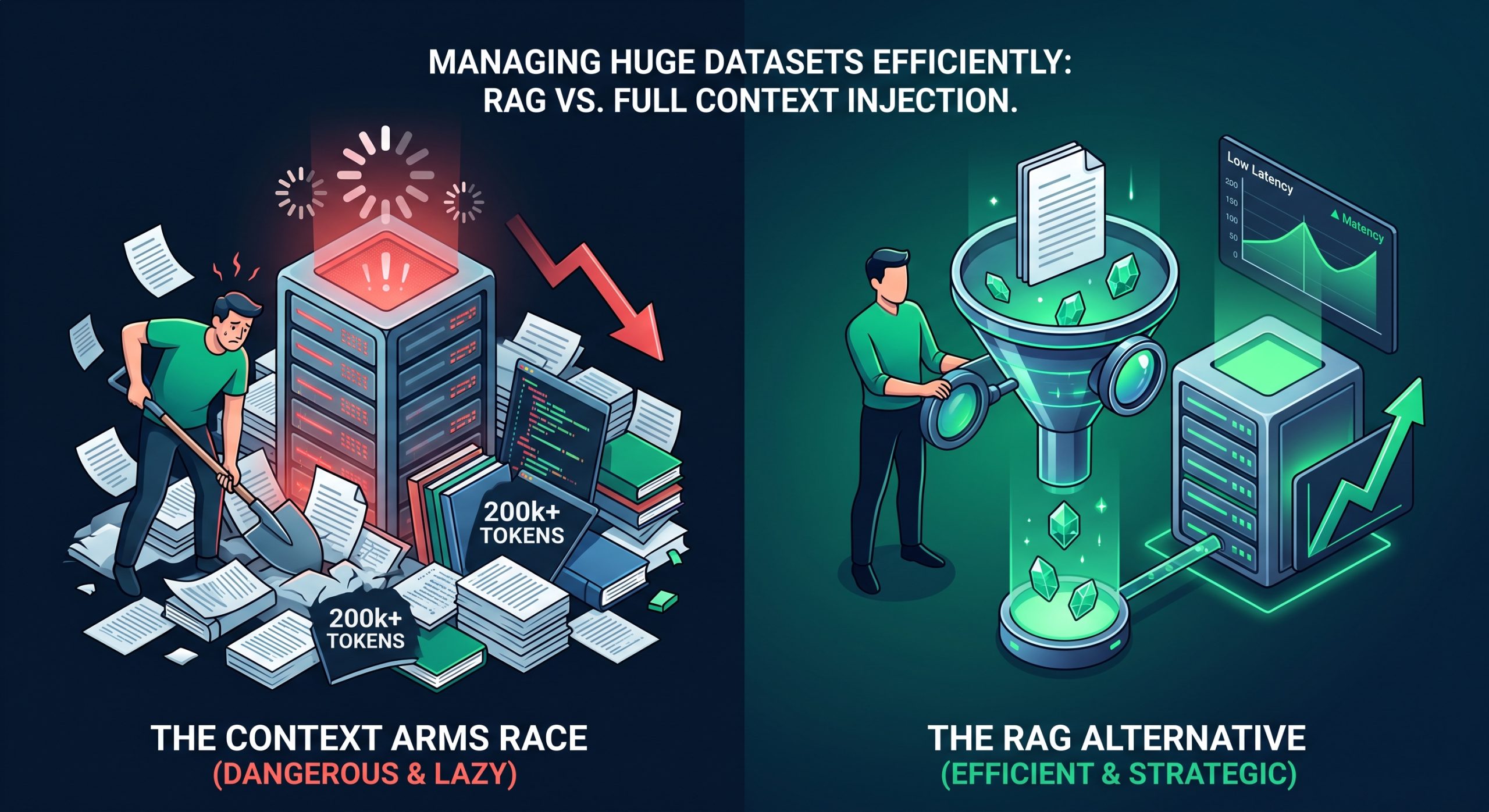
The massive context window arms race is a double-edged sword.
Today, LLMs are boasting 200,000, 1 million, and even 2 million token limits.
It sounds like a developer’s dream. Just dump your entire codebase, API documentation, and a dozen PDF reports into the prompt. Let the AI figure it out.
Do not do this.
Relying on massive context windows is the fastest way to bankrupt your project.
In this guide, I’m going to show you why stuffing the context window is a massive architectural mistake, and exactly how to manage huge datasets efficiently.
Let’s dive in.
The Jevons Paradox in AI
Have you ever heard of the Jevons Paradox?
In economics, it states that when a resource becomes cheaper and more efficient to use, people end up consuming way more of it, offsetting the savings.
This is exactly what is happening with LLM tokens.
Because base token prices have dropped, developers are getting lazy. Instead of writing precise search algorithms, they just pass a massive 150,000-token payload on every single API call.
This destroys your application in two ways:
-
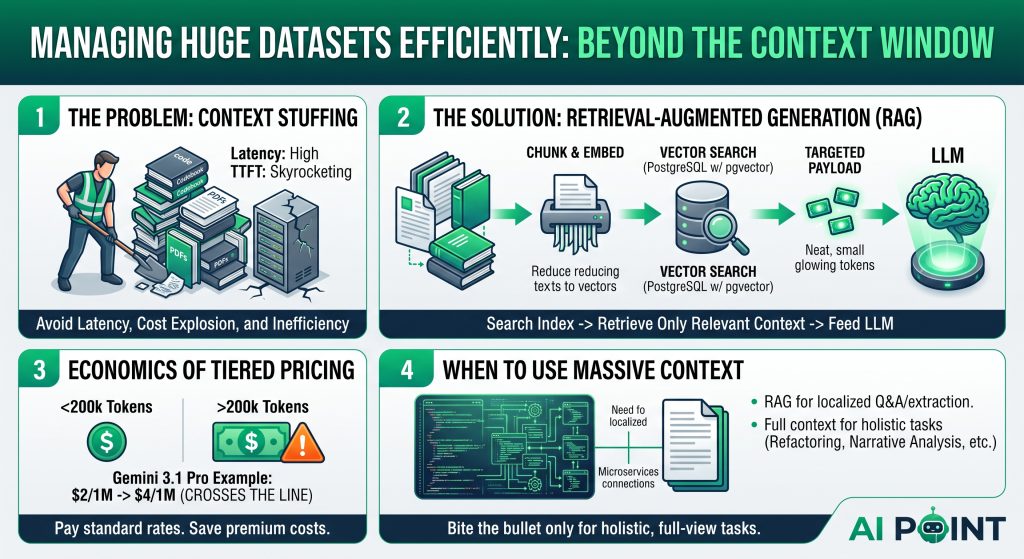
Latency: Loading 200,000 tokens takes a massive amount of computational time. Your Time-To-First-Token (TTFT) will skyrocket. Your users will be staring at a loading spinner while the model digests the data.
-
Cost: You are paying for every single token, even the 95% of the document that is completely irrelevant to the user’s specific question.
The Economics of 200k+ Context
If you want to protect your margins, you need to understand how tiered pricing works.
Many API providers heavily penalize you for crossing the 200k threshold.
Let’s look at the baseline economics of a flagship model like Gemini 3.1 Pro.
If your prompt is under 200,000 tokens, you pay a base standard rate of $2.00 per million input tokens.
But the second your prompt crosses that 200k line? The price instantly doubles to $4.00 per million input tokens.
Now, factor in conversational compounding.
If a user is chatting with an AI and they send 10 messages, you have to re-process that massive conversation history on every single request. You are paying that $4.00 premium rate over and over again for the exact same text.
This tiered pricing structure is why context discipline is the most critical component of our ultimate guide to optimizing LLM costs.
RAG vs. Full Context Injection
So, what is the alternative?
Retrieval-Augmented Generation (RAG).
Instead of forcing the LLM to read a 2,000-page manual every time a user asks a question, you build a search index. You only give the LLM the exact paragraphs it needs to answer the prompt.
Here is the exact architecture you should use:
-
Step 1: Chunking. Break your massive documents or codebases down into small, 500-token chunks.
-
Step 2: Embedding. Pass those chunks through a fast embedding model to convert the text into mathematical vectors.
-
Step 3: Storage. Store those vectors in a dedicated vector database. (I highly recommend using PostgreSQL with
pgvectorhosted on a BaaS like Supabase). -
Step 4: Retrieval. When a user asks a question, embed their query. Do a similarity search in your database to find the top 3 most relevant chunks.
-
Step 5: Generation. Send only those 3 chunks to the LLM.
You just turned a massive, latency-heavy 200,000-token request into a lightning-fast 1,500-token request.
Latency Trade-Offs and Database Execution
Let’s look at what this actually looks like in production.
If you are using Prisma and pgvector in your Next.js or Node backend, your retrieval step is just a simple SQL query. You calculate the cosine distance between the user’s question and your stored documents.
JavaScript
// Example: Semantic search using Prisma and pgvector
const userQuestion = "How do I configure the Stripe webhook?";
const questionEmbedding = await generateEmbedding(userQuestion);

// Retrieve only the highly relevant chunks
const relevantDocs = await prisma.$queryRaw`
  SELECT content
  FROM "DocumentChunk"
  ORDER BY embedding <=> ${questionEmbedding}::vector
  LIMIT 3;
`;

// Now, send a tiny, optimized prompt to the LLM
const prompt = `
  Answer the user's question using ONLY the following context.

  Context: ${relevantDocs.map(doc => doc.content).join('\n')}
  Question: ${userQuestion}
`;
This execution takes milliseconds.
By the time a full-context application is still uploading its 200,000-token payload to the API provider, your RAG-based application has already streamed the final answer back to the user’s screen.
When to Actually Use 200k+ Tokens
Am I saying you should never use massive context windows?
No. There are specific, high-value tasks where RAG falls short and full context is absolutely required.
RAG is terrible for holistic tasks. If you need the LLM to understand the overarching narrative of a book, execute a massive cross-file codebase refactoring, or find bugs spanning across multiple microservices, you cannot just feed it random, disconnected chunks.
For those tasks, bite the bullet. Pay the tiered premium. Load the full 200,000 tokens.
But for standard Q&A, customer support, and localized data extraction?
Never send the full file. Build a vector index, retrieve only what matters, and keep your API budget in check.
