

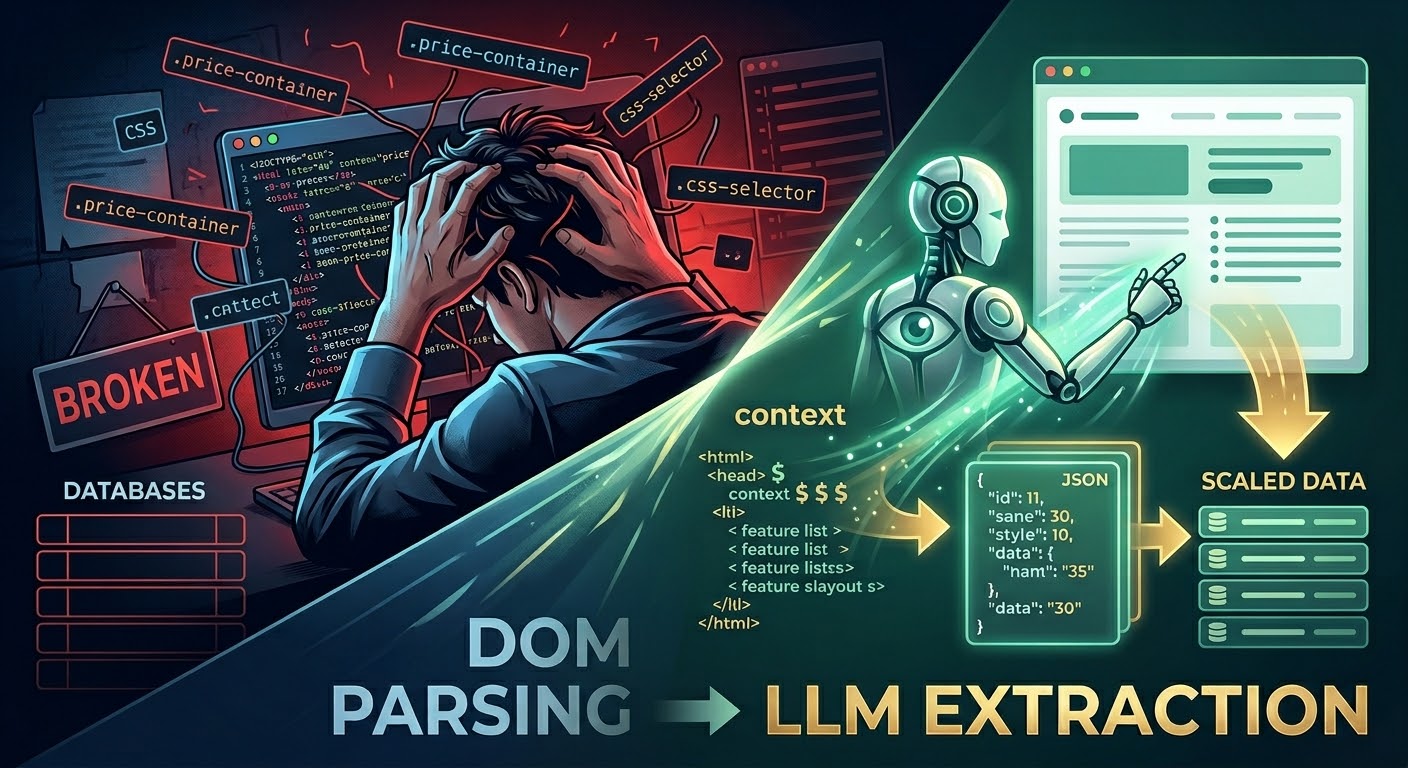
Web scraping used to be a complete nightmare of broken CSS selectors and fragile RegEx.
You know the drill.
You spend hours writing a custom Python script using BeautifulSoup. You map out every single HTML tag, class, and ID. You hit “run”, and it flawlessly extracts 10,000 rows of beautiful data.
You go to sleep feeling like an absolute genius.
But you wake up the next morning, and your entire database is filled with blank rows and Null errors.
What happened?
Your target website simply updated their theme. They changed a single <div> class from .price-container to .pricing-box-new.
And just like that, your entire scraping operation is dead in the water.
If you want to scale your data acquisition today, traditional DOM parsing is no longer an option. You need a system that adapts automatically.
You need Large Language Models (LLMs).
In this guide, I am going to show you exactly how to stop relying on rigid HTML tags and start using AI to extract semantic meaning at a massive scale.
The Fragility of Traditional Web Scraping
Let’s get one thing straight.
Finding data on the internet is incredibly easy. Getting that data into a clean, structured database? That is the hardest part of programmatic SEO.
In the past, developers relied heavily on tools like Puppeteer, Cheerio, or Selenium.
These tools are great for small projects. But they have one massive, fatal flaw.
They rely on structure, not substance.
When you write a traditional scraping script, you are essentially telling your code: “Go to this webpage, find the third <ul> tag, and grab the text inside the second <li>.”
It is highly specific.
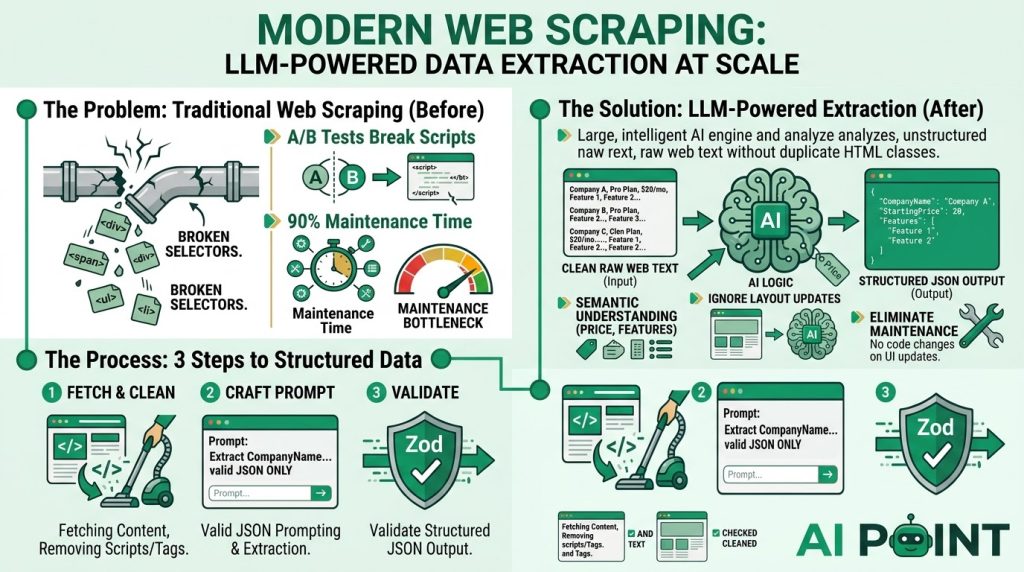
But the modern web is dynamic. Developers push new code every single day. A/B tests change layouts in real-time.
If you are trying to scrape 500 different competitors to build a massive B2B software directory, you have to write 500 unique scripts. And when (not if) those websites update their UI, your scripts break.
You end up spending 90% of your time fixing broken scrapers instead of actually growing your traffic.
This is what I call the Maintenance Bottleneck.
You cannot scale a pipeline if you are constantly putting out fires.
The LLM Extraction Paradigm: How It Works
So, what is the solution?
You stop looking at the code, and you start looking at the context.
Enter the LLM Extraction Paradigm.
Instead of using fragile code to target specific HTML classes, you use Artificial Intelligence to read the page exactly like a human would.
Think about it.
When you look at a pricing page, you don’t care if the price is wrapped in an <h1> or a <span>. You know it’s the price because it has a dollar sign next to it and sits above a list of features.
Large Language Models like GPT-4 and Claude 3.5 understand this semantic context perfectly.
With this modern approach, you simply grab the messy, raw, unfiltered text from a webpage and hand it over to the AI.
You give the LLM a prompt: “Find the company name, the monthly price, and the top three features, and format them perfectly into a JSON object.”
Because the AI understands the actual meaning of the words, it completely ignores layout changes.
The website can completely redesign its entire brand overnight. The CSS can change. The HTML structure can flip upside down.
The LLM doesn’t care. It still finds your data.
This completely eliminates the maintenance bottleneck. And as you will see, this extraction layer is the critical first step in building automated data pipelines for programmatic SEO.
Without clean data, your entire engine stalls.
Step-by-Step: Prompting LLMs for Strict JSON
Ready to build this?
Here is the exact three-step process to structure unstructured web data at scale.
Step 1: Fetch and Clean the Raw HTML
First, you still need to pull the page data.
But instead of parsing it carefully, you just want to rip the text right out of the DOM.
You can use a simple tool like Cheerio in Node.js to grab the <body> tag and immediately strip out all <script>, <style>, and <svg> tags.
Why? Because sending raw code to an LLM wastes your token limits. You only want to send the raw, readable text.
Step 2: Craft the Extraction Prompt
This is where the magic happens.
You are going to use OpenAI’s “JSON Mode” or Claude’s “Tool Use” feature to force the AI to return structured data.
Your prompt should look something like this:
“You are an expert data extraction assistant. I am going to provide you with raw text from a webpage. You must extract the CompanyName, StartingPrice, and a list of CoreFeatures. You must return ONLY a valid JSON object.”
When you execute this, the AI strips away all the marketing fluff and hands you a perfectly formatted database row.
Pro Tip: When visualizing this transformation for your AI Point readers, I highly recommend creating a quick UI mockup. Use a custom Jade Green code block showing the messy text on the left, and the clean, structured JSON on the right. It makes the “aha!” moment instant for your audience.
Step 3: Validate the Output
AI is powerful, but it can still hallucinate.
If you inject a hallucinated string into a database column expecting an integer, your application will crash.
To prevent this, you must use a validation library like Zod (for TypeScript). Zod allows you to define a strict schema.
You tell Zod: “The StartingPrice must be a number. The CompanyName must be a string.”
When the LLM returns the JSON, you pass it through Zod. If it matches, it goes into your database. If the AI messes up, Zod catches the error, and your script automatically asks the LLM to try again.
This creates an impenetrable shield for your database.
Cost & Scale Considerations
Now, I know exactly what you are thinking.
“Using AI for every single page scrape? That is going to cost a fortune!”
A year ago, you would be absolutely right. Running 100,000 pages through GPT-4 would have bankrupted your project before it even launched.
But the landscape has completely changed.
Today, we have access to incredible “small” models that are incredibly cheap and ridiculously fast.
You do not need the heavy reasoning power of GPT-4 Omni for simple data extraction. Instead, you should route these tasks to models like OpenAI’s GPT-4o-mini or Anthropic’s Claude 3.5 Haiku.
These models cost fractions of a cent per request.
In fact, you can often extract clean JSON from thousands of URLs for less than the price of a cup of coffee.
When you factor in the sheer amount of developer hours you save by never having to fix a broken RegEx script again, the ROI is massive.
But scaling isn’t just about cost. It is about speed.
If you want to process massive datasets, you have to run these requests asynchronously. You cannot wait for one page to finish before starting the next.
You need to queue up thousands of requests simultaneously and let the LLM endpoints do the heavy lifting in parallel.
The era of fragile, code-heavy web scraping is over.
By swapping out rigid CSS selectors for the semantic understanding of Large Language Models, you build a data pipeline that is virtually unbreakable.
Your data becomes cleaner. Your maintenance costs drop to zero. And most importantly, you unlock the ability to scale your operations to hundreds of thousands of pages.
Stop writing DOM parsers. Start writing extraction prompts.
If you want more technical breakdowns on scaling your traffic with AI, make sure to subscribe to AI Point so you never miss an update.
