


You just launched your MVP.
It feels amazing, right?
You probably used OpenAI or Anthropic to get it off the ground. And honestly? That was the exact right move.
The Honeymoon Phase of Cloud APIs
When you are first starting out, Cloud APIs are a cheat code.
You do not have to worry about provisioning servers, installing CUDA drivers, or managing infrastructure.
You just send a prompt, and magic happens.
During this honeymoon phase, your traffic is low. Your API bills are barely a blip on your radar.
You are moving fast. You are testing product-market fit. You are tweaking your system prompts.
At this stage, the zero-infrastructure setup is worth its weight in gold.
But then… your app starts getting traction.
And suddenly, that cheat code turns into a trap.
The Scaling Trap: How API Costs Eat Your MRR
Here is the dirty little secret of Cloud APIs.
They scale linearly.
Sometimes, they even scale exponentially.
Let’s say you are building an AI wrapper that summarizes large PDF reports. You are feeding massive documents into the API’s context window.
At first, you are paying pennies per request.
But as your user base grows, those pennies turn into dollars. Fast.
Because API pricing is heavily tied to token usage, every single word you send (input tokens) and every word the AI generates (output tokens) chips away at your Monthly Recurring Revenue (MRR).
If you rely on heavily detailed system prompts or massive Retrieval-Augmented Generation (RAG) pipelines, you are penalized for your own complexity.
The more context you provide, the higher your bill climbs.
It is a painful realization. The very thing driving your growth is actively destroying your profit margins.
If you are dealing with this scaling trap, you are not alone. In fact, for a broader look at how this impacts your entire tech stack, check out our full breakdown on Local LLMs vs. Cloud APIs for indie hackers.
So, how do you stop the bleeding?
You run the math on self-hosting.
The Math: OpenAI Pricing vs. Renting a GPU
Let’s get into the nitty-gritty numbers.
As of late 2026, OpenAI’s budget powerhouse, GPT-4o-mini, charges around $0.15 per 1 million input tokens and $0.60 per 1 million output tokens.
That sounds insanely cheap.
But let’s compare that to renting your own hardware.
If you rent an RTX 4090 GPU on a service like RunPod, you are looking at roughly $0.69 per hour for a high-end tier.
If you keep that server running 24/7 for a whole month, your fixed infrastructure cost is about $504.
Here is the massive difference between the two models:
With OpenAI, you pay for what you use. If you process zero tokens, you pay zero dollars.
With a rented GPU, you pay that $504 whether you are processing 100 tokens or 100 million tokens.
Your server cost is locked in.
This means self-hosting only wins when you keep that GPU busy.
If your app only gets a few requests an hour, renting a dedicated GPU is a massive waste of money.
But if you are hammering that model with constant, high-volume requests? The GPU rental becomes the ultimate bargain.
Calculating Your Breakeven Volume
How do you know when to make the switch?
It all comes down to finding your breakeven point.
This is the exact moment where your OpenAI bill surpasses the fixed cost of renting a cloud GPU.
Here is a dead-simple formula you can use today:
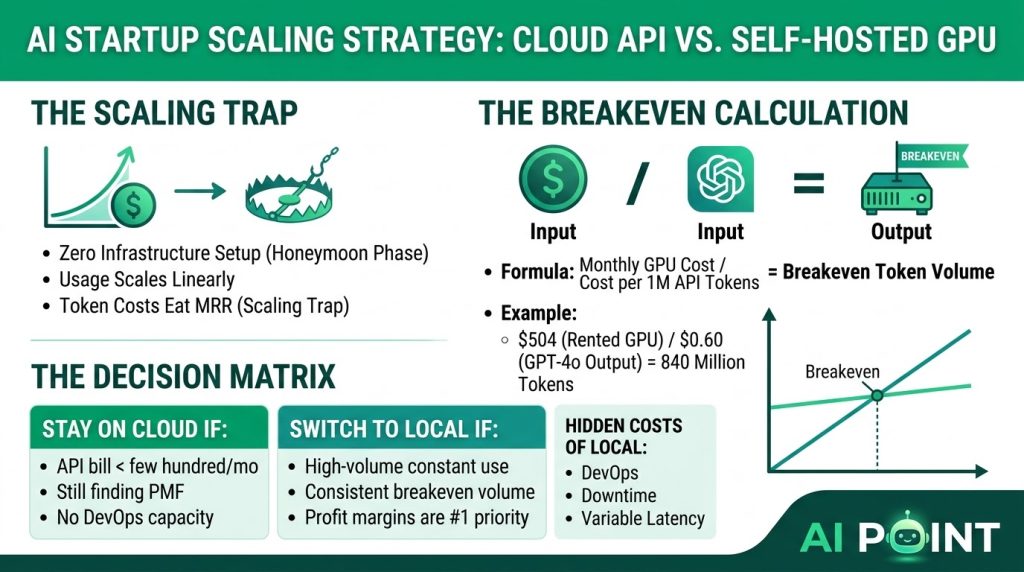
Monthly GPU Rental Cost / Cost per 1M API Tokens = Breakeven Token Volume
Let’s plug in the numbers.
Assume you are renting that RunPod RTX 4090 for $504 a month.
And let’s say your app is heavily skewed toward generating text, so we will use the $0.60 per 1 million output tokens as our benchmark.
$504 / $0.60 = 840.
That means your breakeven volume is roughly 840 million output tokens per month.
If you are generating less than 840 million tokens? Stick with OpenAI. It is cheaper and easier.
But if you are crossing that 840 million token threshold? You are officially losing money by staying on the Cloud API.
It is time to spin up a local model.
Keep in mind, if you are using more expensive frontier models for complex reasoning tasks, your breakeven point will be drastically lower.
The Hidden Costs of Self-Hosting
Now, before you go cancel your OpenAI subscription, we need to talk about reality.
Self-hosting is not a magical silver bullet.
Yes, your compute costs drop. But your operational costs spike.
When you manage your own open-source models, you have to deal with some serious friction.
Look at the hidden costs:
DevOps Nightmares: You are now responsible for managing Python environments. You have to update CUDA drivers. You must troubleshoot broken Docker containers.
Downtime Realities: If your RunPod instance crashes at 2 AM, OpenAI is not going to fix it. You are the sole on-call engineer.
Variable Latency: Depending on your batch sizes and concurrent users, a self-hosted model can sometimes take longer to spit out that crucial first token compared to a highly optimized Cloud API.
You have to factor in the cost of your own engineering time.
If managing the infrastructure takes you 10 hours a week, is the financial savings actually worth it?
For many bootstrapped solo founders, the answer is a hard no. You should be building features, not wrestling with dependencies.
Making the Final Call
So, where does that leave you?
Making the switch from OpenAI to local models is one of the biggest architectural decisions you will face as an indie hacker.
Here is a quick checklist to help you decide.
You should stay on OpenAI if:
You are still finding product-market fit.
Your monthly API bill is under a few hundred dollars.
You do not have the time to play DevOps engineer.
You should switch to Local Models if:
Your app relies on high-volume, continuous generation like programmatic SEO.
Your token volume consistently crushes your breakeven point.
Protecting your profit margins is your number one priority as a business.
The AI landscape is moving extremely fast. Models are getting smaller, and cloud GPUs are getting significantly cheaper.
Stay vigilant. Keep an eye on your Stripe dashboard. And run the math every single month.
Want more teardowns on how to build a profitable AI startup?
Join the AI Point newsletter today. We send out actionable, no-BS guides on scaling your technical infrastructure every single week.
