

Imagine hitting “Run” on a script at 10 PM.
You wake up at 7 AM.
And boom: 5,000 perfectly formatted, search-optimized articles are sitting inside your database, complete with custom JSON-LD schema markup.
Total cost for the entire run?
Zero dollars.
That isn’t a pipe dream. That is the reality of running a local model like Llama 3 for high-volume content generation.
If you have ever tried doing this with commercial APIs, you already know the brutal reality.
Let’s look at why the cloud breaks down when volume spikes.

Why High-Volume Content Breaks Standard APIs
Here’s the deal:
Cloud APIs were built for interactive apps.
They shine when a single user types a prompt into a chat box and waits for an answer.
They fall apart when you want to automate programmatic content pipelines.
Why?
Two big reasons.
First, the cost.
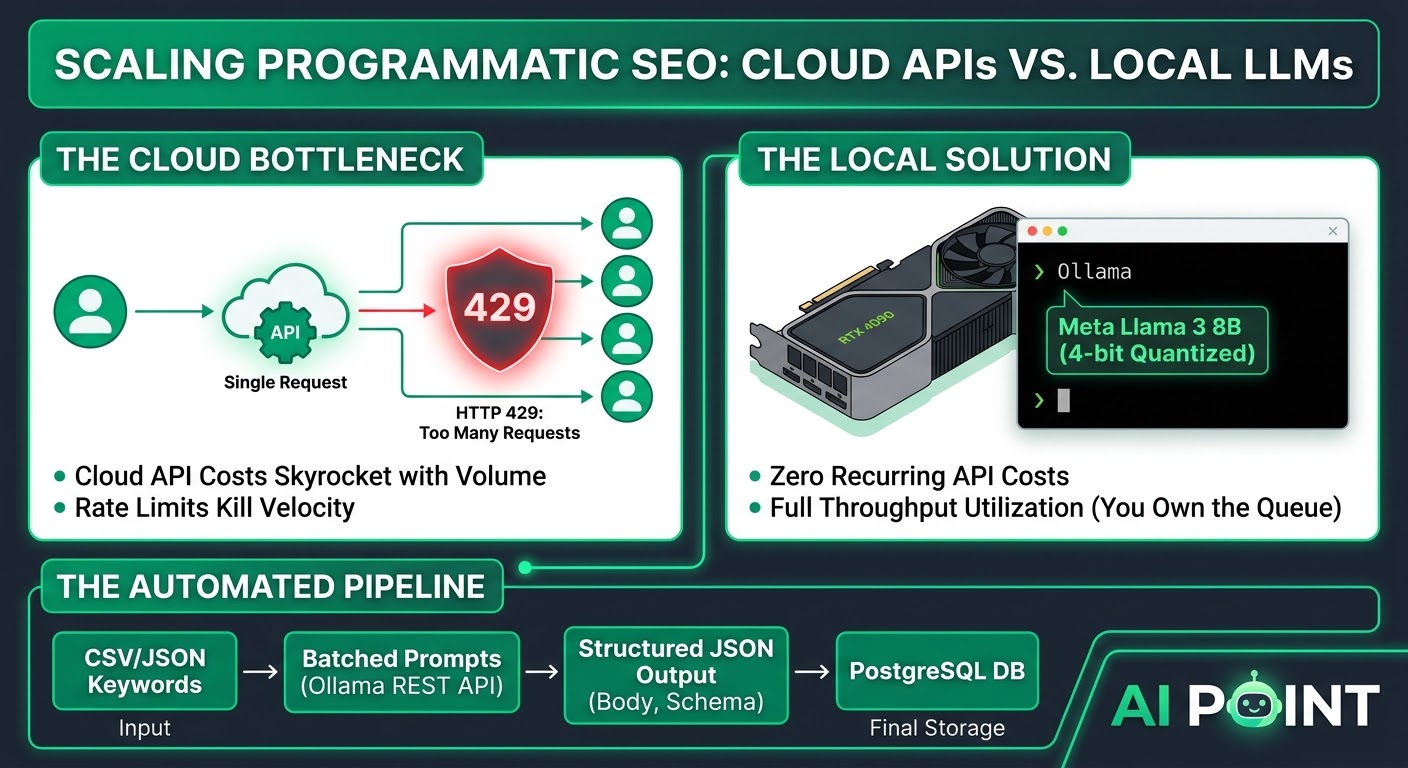
If you want to generate 10,000 long-form landing pages, sending all that context through proprietary frontier models will drain your bank account before you even index a single URL.
Second, the dreaded rate limit.
The moment you fire off dozens of parallel requests, cloud servers slam you with this:
HTTP 429: Too Many Requests.
Now you have to write exponential backoffs, build complex retry queues, and watch your script stall out for hours.
It completely kills your velocity.
In fact, if you are still deciding between infrastructure types, read our guide comparing Local LLMs vs. Cloud APIs to see why throughput matters.
When you run your own models, rate limits disappear completely. You become the sole owner of the queue.
Hardware Requirements for Llama 3 8B
Let’s bust a huge myth right now.
You do not need a $30,000 enterprise GPU cluster to generate high-quality text at scale.
Thanks to modern quantization techniques, open-source models can run on consumer hardware that you probably already own.
For bulk content generation, Meta’s Llama 3 8B is the absolute sweet spot. It produces sharp, coherent prose while remaining remarkably light on system resources.
Here is what you need to run it smoothly:
- VRAM: The uncompressed model takes around 16GB of VRAM in 16-bit precision. But if you run a 4-bit quantized version (Q4_K_M), it shrinks down to roughly 5.5GB of memory.
- Nvidia GPUs: Any consumer card with at least 8GB to 12GB of VRAM—like an RTX 3060, RTX 4070, or RTX 4090—will fly through inference.
- Apple Silicon: If you use a Mac with an M-series chip (M2, M3, or M4) and at least 16GB of unified memory, you can run Llama 3 effortlessly. Apple’s unified memory architecture feeds the GPU directly without PCI bus bottlenecks.
Once your hardware checks out, setting up the runtime takes under five minutes.
Setting up Your Local Inference Engine
A year ago, getting an open-source model running meant wrestling with Python virtual environments, conflicting CUDA drivers, and broken dependencies.
Not anymore.
Today, tools like Ollama handle all the heavy lifting in the background.
Here is how simple it is:
Step 1: Download and install Ollama on your machine.
Step 2: Open your terminal and pull down the model:
ollama pull llama3:8b
Step 3: Spin up the inference server:
ollama run llama3:8b
That is literally it.
Ollama instantly exposes a lightning-fast REST API on http://localhost:11434/api/generate.
Even better? Ollama provides an OpenAI-compatible endpoint at http://localhost:11434/v1/chat/completions.
That means you don’t even have to rewrite your prompt libraries or SDK wrappers. You simply swap the base URL in your code and point it directly to your localhost.
Structuring Batched Prompts for Programmatic SEO
Now comes the secret sauce: throughput optimization.
If you send prompts one by one in a standard loop, you leave massive GPU performance on the table. GPUs love parallel workloads.
To extract the maximum speed from your local setup, you want to use batched processing.
Here is the exact workflow:
Create a Node.js or Python worker script that reads your raw data source—such as a CSV or JSON file loaded with target keywords, search intent labels, and semantic entities.
Next, set up a concurrency worker (using libraries like p-limit in Node.js).
Feed the worker 4 to 8 concurrent prompts at a time. Each prompt should strictly enforce structured output:
- Instruct the model to adopt an authoritative, punchy editorial tone.
- Demand valid JSON containing the article body, meta description, and dynamic JSON-LD schema markup.
- Set temperature to 0.7 to keep the copy engaging without losing factual structure.
Because your local server has no artificial throttling, the GPU will chew through these batches at full utilization.
Storing the Output: Connecting to PostgreSQL
High-volume generation is useless if your data ends up trapped in loose text files.
You need a clean pipeline directly into your database.
As your worker script receives completed JSON payloads from Ollama, pipe the structured text straight into a PostgreSQL database.
If you are using an ORM like Prisma, you can automate the entire database insertion in a few lines of code.
Store the parsed fields cleanly:
- title: The optimized H1 headline.
- slug: Clean, URL-friendly permalink.
- content: The formatted markdown body.
- schema_markup: The structured schema array ready for web crawlers.
- topic_cluster_id: The relational foreign key connecting the spoke to your pillar page.
By saving the structured schema directly in your database, your frontend application can dynamically render rich snippets for search engines instantly upon deployment.
Scaling Your Local Content Machine
Building a programmatic content machine is the ultimate leverage for solo founders.
Instead of babysitting expensive API credits or worrying about sudden billing spikes, you build an automated system that runs quietly on your own hardware.
You kick off your queue before you go to sleep.
Your GPU processes thousands of programmatic pages overnight.
And when you wake up, your content cluster is loaded, validated, and ready to publish.
The era of being gatekept by cloud API costs is officially over.
Take control of your compute, own your infrastructure, and start scaling your traffic on your own terms.
