


If you manage paid media across multiple channels, this scenario will sound painfully familiar.
It’s Monday morning. You grab your coffee and open up 14 different browser tabs.
You have Google Ads open on monitor one. Meta Ads on monitor two. LinkedIn Campaign Manager tucked away in the corner.
You spend the next two hours pulling yesterday’s performance data, dropping it into a massive, color-coded Google Sheet, and manually tweaking your daily budgets.
You lower Facebook because the Cost Per Click (CPC) was too high. You bump up Google because Search had a “good day.”
It is exhausting. It is tedious.
Worse? It guarantees you are wasting ad spend.
Humans simply cannot crunch real-time auction variables fast enough. By the time you manually lower a bid on a poorly performing campaign on a Monday morning, your budget has already been draining all weekend long.
The smartest growth teams in 2026 are abandoning siloed budgets and manual spreadsheets entirely.
Instead, they are handing a single, unified budget to AI platforms to manage pacing dynamically.
Here is exactly how they are doing it, and how you can replicate it today.
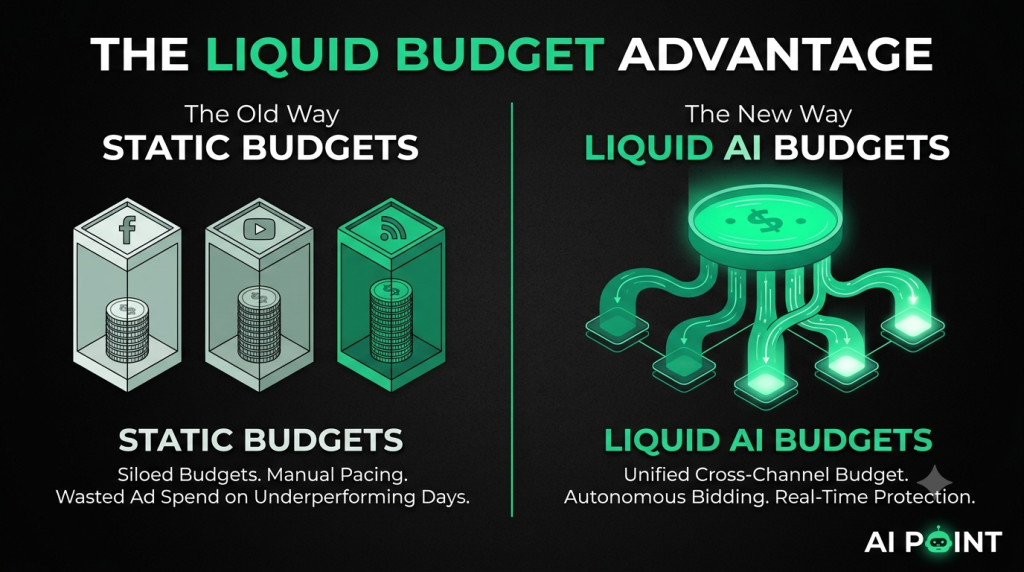
The Era of “Liquid” Cross-Channel Budgets
Let’s get one fundamental rule of performance marketing straight.
You shouldn’t care where a conversion comes from, as long as the Customer Acquisition Cost (CAC) is profitable.
In the past, we gave strict, rigid daily limits to specific platforms. You might say, “$500 a day for Google. $300 a day for Facebook. $100 a day for LinkedIn.”
This is a terrible strategy.
What happens if Facebook is having an incredibly high-converting day, but it hits that $300 manual cap at 2:00 PM? Your campaigns shut off right when they should be scaling. Meanwhile, your Google Ads might be struggling, but they keep spending until they hit their $500 limit.
You leave money on the table, and you waste budget on losers.
The Shift to Liquid Budgets:
Enter the concept of “Liquid Budgets.”
A liquid budget means an AI platform connects to all of your ad accounts via API. It constantly watches every platform, every campaign, and every ad set simultaneously.
It throttles spend on underperforming platforms and shifts those dollars to the channel currently offering the cheapest conversions in real-time.
If Meta gets expensive at 9:00 PM, the AI instantly pulls budget and pushes it to Google Search, where CPCs just dropped.
Automating this budget allocation isn’t just a massive time-saver; it’s a core example of how artificial intelligence is redefining digital marketing and SEO]by removing human error from complex, high-speed data environments.
Real-Time Anomaly Protection
AI doesn’t just optimize your budget for better returns. It acts as a 24/7 financial guardrail for your ad spend.
Imagine this scenario.
It’s 11:00 PM on a Saturday night. You are asleep.
Suddenly, a massive new competitor enters your core Google Ads auction. They have a huge budget, and they start bidding aggressively. Within minutes, they drive your Cost Per Click (CPC) up by 400%.
If you are managing bids manually, you won’t see this disaster until Monday morning. You will wake up to thousands of dollars in wasted spend with zero conversions to show for it.
The AI Execution:
An AI media buyer detects that statistical anomaly in micro-seconds.
The moment your CPA spikes beyond a predefined, acceptable threshold, the machine learning model steps in. It instantly pauses the campaign or drastically lowers the bid limit.
It protects your downside while you sleep.
To do this today, you can use automated rules within your native ad platforms, or leverage third-party AI media buying agents to establish strict “hard stops” on rapid cost spikes.
Predicting Creative Fatigue Before ROAS Drops
Ad fatigue is a silent budget killer.
It sneaks up on you. You launch a brilliant new video ad. It performs beautifully for three straight weeks.
But then, slowly, the click-through rates tank. The engagement drops. The costs soar.
Usually, marketers only notice this and replace the ad after the profitability has completely dropped. You waste days of budget paying for an ad that people are sick of seeing.
The AI Upgrade:
Machine learning models don’t wait for your ROAS to tank. They analyze the exact decay rate of your ad creatives.
The AI knows exactly when an audience is getting tired of a specific image, headline, or video based on micro-shifts in engagement velocity.
The AI will automatically pause the fatigued ad and cycle in a fresh asset from your creative library before your profitability drops below your target margin.
(Note: Add your link in the sentence below!)
When you pair these fresh, AI-cycled ad creatives with a backend system that is using AI to optimize user acquisition funnels and conversion rates, you create a frictionless, highly relevant journey from the first click all the way to the final sale.
Top AI Budgeting Tools for 2026
You know you need to automate your multi-channel budgets. You know the spreadsheets have to go.
So, what tools should you actually use?
The SaaS landscape for AI media buying is evolving rapidly, but a few platforms are currently leading the charge for mid-market and enterprise brands.
- Madgicx: Incredible for Meta and Google ecosystems. It uses AI to analyze your account, create autonomous budget optimization rules, and cycle creatives based on performance.
- Albert.ai: A true cross-channel AI. Albert plugs into your search, social, and programmatic accounts, taking a single budget and pacing it across the entire internet based on where your customers actually are.
- Skai (formerly Kenshoo): Built for larger budgets, Skai offers incredibly deep predictive analytics and automated budget shifting across walled gardens.
Your First Step:
Don’t hand over the keys to the machine completely on day one.
Start by consolidating your ad spend tracking into a single AI-powered dashboard. Let the AI make recommendations first.
Once you see that the AI’s suggestions are consistently beating your manual adjustments, turn on autonomous pacing for a small, 14-day pilot campaign.
Watch the machine work.
Conclusion
Your marketing team should be focused on high-level growth strategy, deep customer research, and brilliant copywriting.
They should not be glorified data-entry clerks.
Let the machines handle the spreadsheets, the bidding, and the pacing.
Now I want to hear from you.
Have you tested liquid cross-channel budgets yet, or do you still give strict daily caps to Google and Meta separately?
Leave a comment below and let me know.
