

Let me know if this sounds familiar.
Your Customer Acquisition Costs (CAC) are skyrocketing. Your ad click-through rates are tanking.
And no matter how much you tweak your ad copy, your conversion rate just won’t budge.
Why is this happening?
Because you are treating every single visitor exactly the same.
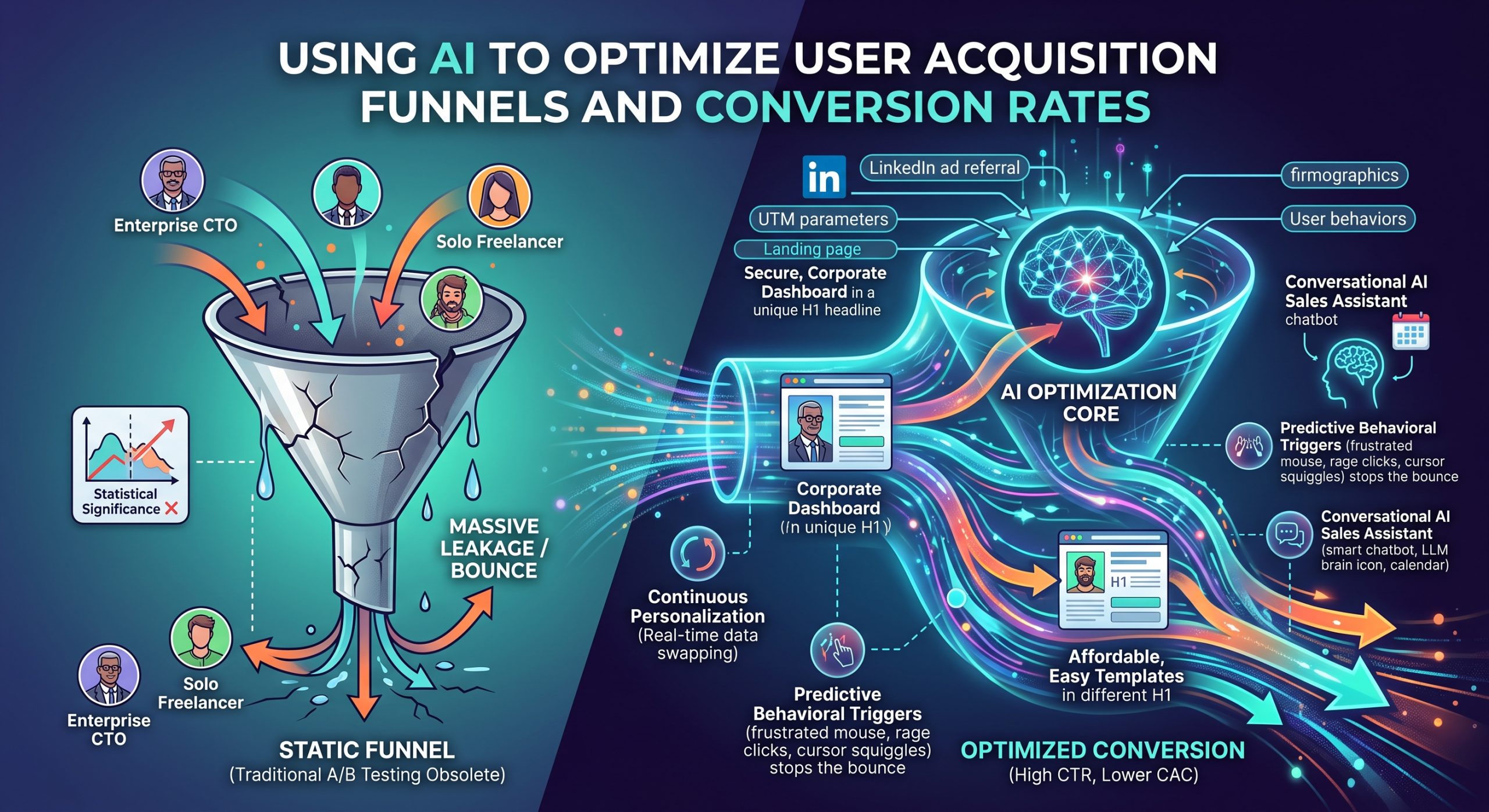
Think about it. We spend hours segmenting our ad audiences. But then? We force all of those unique humans through a single, static landing page.
It’s a massive conversion killer. The “average” user doesn’t exist anymore.
But there is a solution.
Artificial intelligence is officially turning static, rigid funnels into living, breathing, hyper-personalized experiences.
In this guide, I’m going to show you exactly how to use AI to build funnels that adapt to your visitors in real-time.
Let’s dive in.
Why Traditional A/B Testing is Officially Obsolete
For years, the gold standard for Conversion Rate Optimization was A/B testing.
You would change a button from blue to green. Wait three weeks for statistical significance. And celebrate a 0.2% bump in conversions.
Those days are over.
Today, changing a headline or a button color rarely moves the needle.
Worse? Traditional A/B testing is painfully slow. By the time you collect enough data to declare a “winner,” your market has already shifted.
We don’t have time to wait weeks for data anymore.
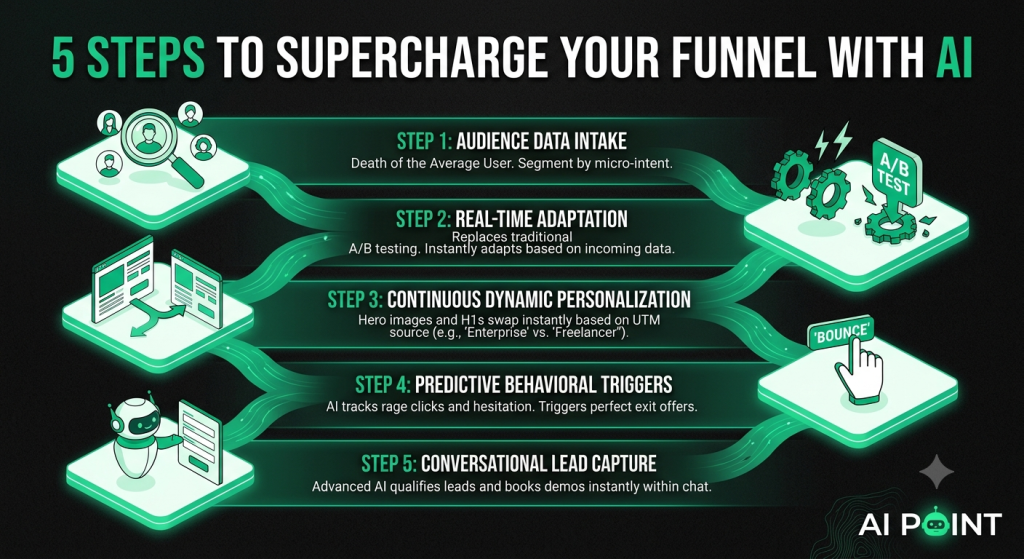
To win in 2026, you need systems that adapt in real-time. Instead of testing Page A against Page B, AI allows you to serve the perfect page to the exact right person, instantly.
This shift away from static testing is just one part of a much larger web evolution. If you look at how artificial intelligence is redefining digital marketing and SEO, it becomes clear that real-time machine learning is replacing manual marketing across the board.
Continuous Dynamic Personalization (The Core Strategy)
This brings us to the core strategy of the modern AI funnel:
Continuous Dynamic Personalization.
What does that mean?
It means your landing page actually builds itself based on exactly who is looking at it.
Here is a concrete example.
Let’s say you sell project management software. Two different people click on your ads.
User A is an Enterprise CTO who clicks a highly targeted LinkedIn ad.
User B is a solo freelancer who clicks a Google Search ad for “cheap project tools.”
If you send them to the same static page, one of them will bounce. Guaranteed.
But with Continuous Dynamic Personalization, the AI engine instantly analyzes their data (like UTM parameters, IP firmographics, and device type).
For the CTO, the AI dynamically swaps the hero image to a corporate dashboard. It rewrites the H1 to focus strictly on enterprise-grade security.
For the freelancer? The page instantly shifts to highlight affordable monthly plans and easy-to-use templates.
It’s the exact same URL. But it’s a completely different experience.
How to do this today:
You don’t need a team of developers to pull this off.
Tools like Mutiny or Intellimize allow marketers to easily swap out text, images, and CTAs dynamically based on firmographics and referral data.
Just connect your ad platforms, set your audience rules, and let the AI generate the variations that convert best. You can start small: use AI to swap out just the main headline based on the exact Google Ad keyword the user searched. Once you see the conversion lift, you can start personalizing the entire page.
4. Predictive Behavioral Triggers: Stopping the Bounce
We all hate those “time-on-page” popups.
You’ve been on a site for exactly 10 seconds, and suddenly a massive box interrupts you demanding your email address.
It destroys the user experience.
But AI is completely upgrading how we capture leads.
Instead of dumb timers, modern machine learning models track invisible micro-behaviors.
The AI is watching your mouse velocity. It notices cursor hesitation. It tracks rapid scrolling and “rage clicks.”
It learns exactly what a frustrated user looks like.
How to implement this:
You can now set up predictive behavioral triggers.
Instead of firing a popup for every single visitor, you train the AI to intervene only when a user is struggling.
You can configure the algorithm so that it only fires an exit-intent offer (like a special discount or a live chat prompt) when there is a 90%+ probability that the user is frustrated and about to bounce.
If they are reading deeply and highly engaged? The AI stays invisible.
You save the bounce without annoying your best prospects.
5. Replacing Static Forms with Conversational AI
Let me be blunt.
Traditional 7-field lead capture forms are conversion killers. No one wants to fill them out.
The solution?
Replacing static forms with Conversational AI.
I’m not talking about those clunky, frustrating chatbots from 2020 that could only say, “I didn’t understand that.”
I’m talking about advanced, LLM-powered sales assistants.
How it works:
Instead of a form, a user engages with an AI agent.
If the prospect asks, “Does this software integrate with our custom Salesforce setup?”, the AI instantly reads your technical docs and provides a perfect answer.
It can handle pricing objections, qualify the lead based on company size, and book a calendar demo directly in the chat window.
You completely remove friction from the bottom of your funnel.
6. Conclusion
The digital marketing playbook has changed.
A static funnel forces your users to adapt to your website. But the best funnels in the world do the exact opposite.
They adapt to the user.
By leveraging dynamic personalization, predictive triggers, and conversational AI, you can drastically lower your CAC and finally fix your leaky funnel.
Now, I’d love to hear from you.
Are you still running traditional A/B tests? Or have you started experimenting with dynamic personalization?
Let me know by leaving a quick comment below right now.
