

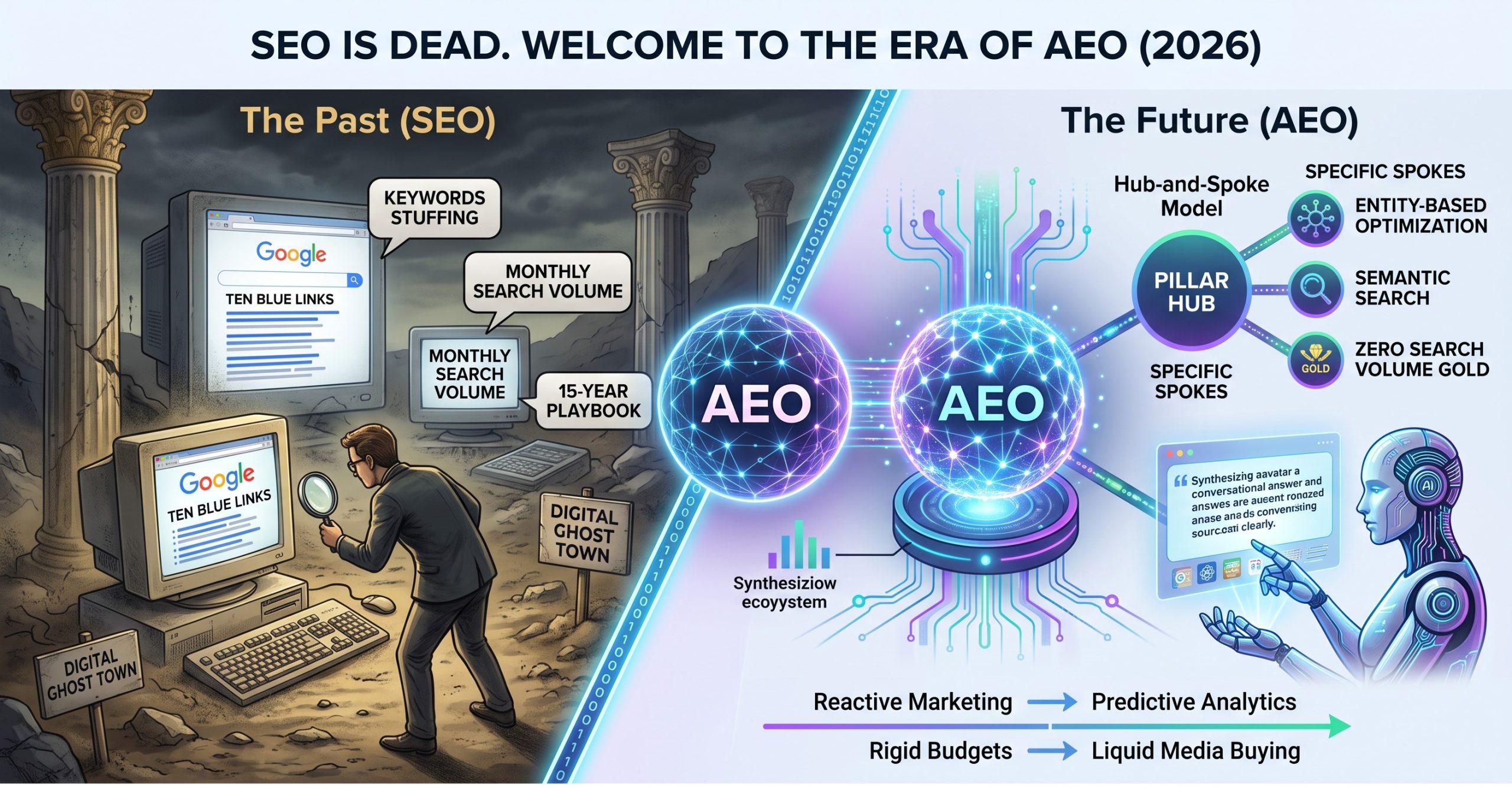
SEO as we know it is dead.
I know, I know. You’ve heard that a million times. But this time? It’s actually true.
For the last 15 years, the playbook was simple: Find a keyword with high search volume, write a 2,000-word blog post, stuff it with LSI keywords, build some backlinks, and watch the organic traffic roll in. You were fighting for one thing: getting a user to click one of those ten blue links on page one.
Not anymore.
Welcome to 2026. The era of Search Engine Optimization is over. We are now in the era of Answer Engine Optimization (AEO).
When a user types a query into Google, Perplexity, or ChatGPT today, they aren’t looking for a list of links to click. They want an instant, synthesized answer. And search engines are giving it to them. AI Overviews and generative engines are scraping the web, evaluating competing claims in real-time, and presenting a conversational response right there on the results page.
If your strategy is still focused purely on generating clicks, you are going to get left behind. Fast.
To succeed today, you need to become the cited source. You need these Large Language Models (LLMs) to view your content as the undisputed authority so they pull your data into their synthesized answers.
So, how do you do that? How do you signal deep, undeniable topical authority to an AI crawler?
The answer is the Hub-and-Spoke (Topic Cluster) model.
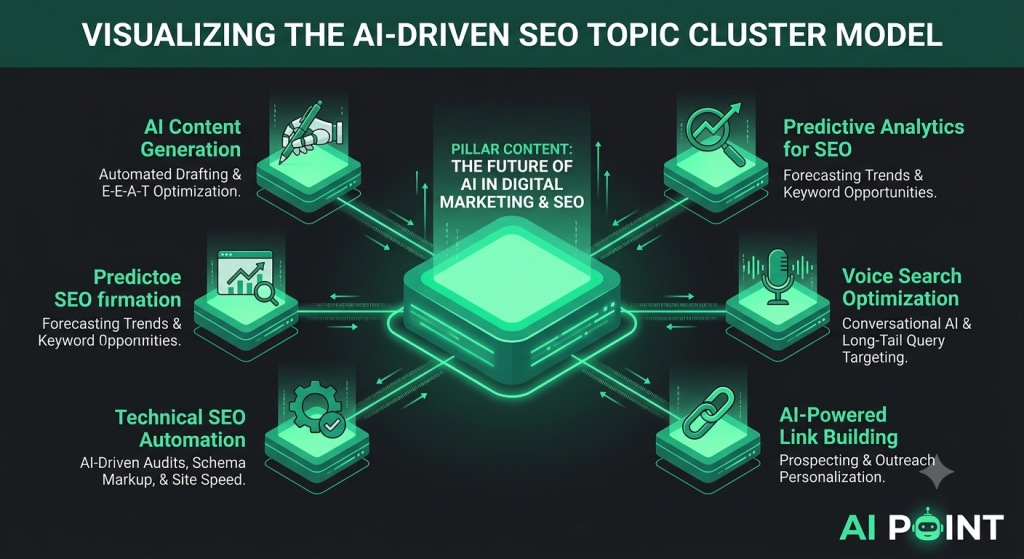
This isn’t just about siloing content anymore. It’s about building a structured web of information that machines can easily parse. It requires connecting a massive, comprehensive pillar page to highly specific, long-tail spoke articles that answer the exact hyper-niche questions AI engines are trying to resolve.
In this guide, I’m going to show you exactly how artificial intelligence is rewriting the rules of the game. We’re going to cover how AI is disrupting every layer of your strategy—from overhauling user acquisition funnels and content production, to transforming predictive analytics and how you manage your marketing budgets.
Most importantly, I’m going to give you the exact blueprint to build a semantic keyword strategy that actually works in 2026.
Let’s dive in.
Before we get into the tactical execution of the Hub-and-Spoke model, audit your current content strategy to see how prepared you are for Answer Engine Optimization.
The Evolution of Keyword Strategy & Semantic Search
For years, keyword research was a simple numbers game.
You would open up Ahrefs or Semrush. You’d filter for keywords with a Monthly Search Volume (MSV) of at least 1,000. You’d check the Keyword Difficulty (KD). And you’d start writing.
If a keyword showed “0” searches per month? You ignored it. It was a waste of time.
But in 2026? That traditional playbook is completely broken.
Why?
Because search volume is no longer the holy grail of SEO.
In the era of Answer Engine Optimization (AEO), humans don’t type caveman queries like “best CRM small business” anymore.
Instead, they open ChatGPT or Google’s AI Overview and ask highly complex, conversational questions: “What is the best CRM for a freelance graphic designer who uses a Mac, hates monthly subscription fees, and needs QuickBooks integration?”
Traditional keyword tools will tell you that query has zero searches.
But I’m here to tell you that Zero Search Volume (ZSV) queries are the biggest untapped goldmine in digital marketing today.
Let me explain.
When an AI engine processes a massive, complex query, it doesn’t just look for exact-match keywords on a page. It uses Semantic Search and Entity-Based Optimization to understand the meaning behind the words.
Search engines no longer match strings of text. They match things (Entities).
If you want an LLM to cite your brand as the answer, you can’t just sprinkle LSI keywords into a 2,000-word post. You have to establish your page as a definitive “Entity” in the Knowledge Graph. You have to comprehensively cover the topic, its subtopics, and its relationship to other concepts in your industry.
Which brings us to the biggest shift in content architecture.
Because search engines now understand context and intent on a superhuman level, creating a rigid list of exact-match phrases is less effective than developing a broader semantic search keyword strategy that anticipates AI overviews, allowing you to capture highly converting long-tail traffic that traditional keyword tools miss entirely.
(Note: When Spoke 5 goes live, replace “spoke-5-url-placeholder” with the actual URL).
So, how do you actually execute this? How do you optimize for intents and entities instead of outdated search volumes?
Step 1: Stop chasing the head term. If you sell project management software, ranking for “project management tool” is an ego metric. The AI engines are going to synthesize that high-level answer using Wikipedia, G2, and Forbes. You won’t win.
Step 2: Cluster by Intent, not by Keyword. Group your content into tightly knit semantic clusters. If a user wants to know about “agile marketing workflows,” they also want to know about sprint planning, kanban boards, and velocity tracking. One pillar page should act as the definitive hub for all of these interconnected entities.
Step 3: Mine for ZSV Gold. Where do you find these hyper-specific questions? Get out of your SEO tools. Go to Reddit. Go to Quora. Listen to your sales team’s call recordings. Look at customer support tickets.
Find the 15-word questions real humans are asking, and format your content to answer them directly, concisely, and explicitly. (We call this “Golden Answer” formatting, which we’ll cover in the next section).
Here is the bottom line:
If you optimize for the exact-match keyword, you are optimizing for the past.
If you optimize for the entity and the intent, you are optimizing for the AI.
Scaling Content Production Without Losing Quality
Let’s talk about the elephant in the room.
Content production.
In 2026, cranking out content is incredibly easy. You can click a button on an AI tool and generate 50 blog posts before your morning coffee.
But there is a massive problem with this approach.
It doesn’t work anymore.
Why?
Because if you can generate a 2,000-word guide on a topic in 10 seconds, so can your competitors. And so can Google’s AI Overview.
The internet is officially flooded with generic, synthesized AI garbage.
To combat this, search engines have drastically updated their algorithms to reward one thing above all else:
Information Gain.
What is Information Gain? It simply means your content adds new value to the internet. Unique data. First-hand experience. A contrarian perspective.
If your content just summarizes what is already out there, AI engines will ignore it. They might use it as training data, but they will never cite it as a source.
Which brings us to E-E-A-T (Experience, Expertise, Authoritativeness, and Trustworthiness).
Here is the hard truth about generative AI: An LLM has no real-world experience.
ChatGPT has never run a marketing campaign. It has never lost money on Facebook Ads. It has never negotiated a SaaS contract.
Only humans have experience.
So, if pure automation is a trap, how do you actually scale your content output today?
You shift your mindset from “AI Automation” to “AI Augmentation.”
However, simply asking an LLM to ‘write a blog post’ results in generic content that Google’s helpful content system penalizes. To scale effectively while maintaining brand authority, marketers need a framework for automating SEO content strategies with Large Language Models that includes strict quality assurance and E-E-A-T guidelines.
(Note: When Spoke 2 goes live, replace “spoke-2-url-placeholder” with the actual URL).
Here is exactly how the best SEO teams are executing this augmented approach in 2026:
Rule #1: AI builds the skeleton. Humans provide the soul. Stop using AI to write your final drafts.
Instead, use it to scale the heavy lifting. Use LLMs for entity research, analyzing SERP intent, generating detailed outlines, and formatting data tables.
Let the AI build the structure. Then, let a human writer step in to inject voice, humor, and nuance.
Rule #2: Mine your internal SMEs (Subject Matter Experts). The ultimate secret weapon for content in 2026? Your own team.
Record a 15-minute Zoom call with a product manager, a sales rep, or a customer success lead. Ask them about the real problems your customers are facing.
Feed that raw transcript into a custom GPT and prompt it to extract the unique insights, specific examples, and contrarian opinions.
Boom.
You now have the foundation for an article rich in Information Gain that no competitor can copy.
Rule #3: Train Custom LLMs on your brand voice. Generic AI writing is easy to spot. It uses words like “delve,” “testament,” and “in conclusion.”
Don’t use out-of-the-box prompts. Instead, feed a custom model your top 50 highest-converting articles. Tell the AI to analyze your sentence structure, paragraph pacing, and specific vocabulary.
When you do use AI to draft sections of text, it will actually sound like your brand.
Here is the bottom line:
Content scale used to be about word counts.
Today, it is about scaling your unique expertise.
Supercharging the User Acquisition Funnel
Let’s talk about Conversion Rate Optimization (CRO).
In the past, CRO meant changing a button from green to red. You’d run a split test for three weeks, see a 0.5% lift, and call it a day.
But in 2026? That approach is painfully slow. And frankly, it’s completely outdated.
Why?
Because Customer Acquisition Cost (CAC) is at an all-time high. Ad platforms are charging a massive premium just for a single click. Capturing organic traffic is fiercely competitive.
You simply cannot afford to leak the traffic you actually acquire. Every bounced visitor is burning a hole in your marketing budget.
Furthermore, we are no longer building for the “average” user.
Because the average user doesn’t exist.
Think about it.
If you send 10,000 visitors to a static landing page, you are forcing 10,000 unique human beings into a single, rigid experience.
It doesn’t matter how brilliant your copywriting is. A static page has a hard conversion ceiling. It will always alienate someone.
Enter AI-driven acquisition funnels.
Today, the best marketing teams aren’t running traditional A/B tests. They are running Continuous Dynamic Personalization.
Imagine two users click the exact same Google Ad for your SaaS product.
User A is an enterprise CTO located in New York.
User B is a freelance designer in London.
When they land on your site, an AI engine instantly analyzes dozens of data points. Their location. Their referral source. Their past browsing history. Their device type.
Then, the AI builds a custom landing page for that specific user. In real-time.
For the CTO, it changes the headline to focus on enterprise security, swaps the hero image to a corporate dashboard, and adjusts the pricing tier to show annual contracts.
For the freelancer, it highlights ease-of-use and affordable monthly plans.
This level of dynamic personalization means you are no longer serving a static, one-size-fits-all page to every visitor.
By using AI to optimize user acquisition funnels and conversion rates, you can dynamically adjust the UX, swap out imagery based on the user’s origin, and present the absolute most effective CTA in real-time.
(Note: When Spoke 1 goes live, replace “spoke-1-url-placeholder” with the actual URL).
So, how do you actually upgrade your funnel from static to dynamic?
Here is the 3-step playbook working right now in 2026:
Step 1: Deploy AI Copy Variations. Don’t write one landing page headline. Write twenty. Feed them into your CMS testing engine. Let the AI serve variations to different traffic segments and automatically double-down on the winners. You no longer have to wait weeks for statistical significance. The AI evaluates multivariate tests in hours. If someone clicks through from a LinkedIn ad about “saving time,” the AI should instantly render a landing page headline focused purely on efficiency. If they came from a Reddit thread about “saving money,” the page should emphasize ROI. Context is everything.
Step 2: Implement Predictive Behavioral Triggers. Stop asking users for their email immediately upon arrival. It destroys trust. Instead, use machine learning to track micro-interactions: mouse movements, scroll depth, and hesitation. When the AI detects that a user is confused or about to bounce (like rapid scrolling or cursor flinching), that is when you trigger a helpful, exit-intent intervention. But if the AI sees they are reading deeply and highly engaged? Trigger a soft, inline CTA instead. You deliver the right offer at the exact second they are most receptive.
Step 3: Replace Forms with Conversational Agents. Let me be clear. Traditional 7-field lead forms kill conversions. Period. Instead of static forms, we are seeing a massive shift toward Conversational AI. These aren’t the clunky, frustrating chatbots from 2020. These are advanced, LLM-powered sales assistants. If a user asks, “Does this integrate with my custom Salesforce instance?”, the AI instantly responds with the exact technical documentation and a personalized calendar link. They can handle pricing objections, qualify the lead, and book a demo without any human intervention.
Here is the bottom line:
In 2026, you shouldn’t have to guess what your users want.
Your funnel should learn what they want, and build it for them on the fly.
Predictive Analytics: The End of Reactive Marketing
Let’s talk about your analytics dashboard.
If you are like most digital marketers, you probably spend hours staring at Google Analytics, HubSpot, or Mixpanel.
You look at last month’s traffic. You look at yesterday’s conversion rate. You painstakingly review the churn rate from Q3.
But there is a massive problem with this traditional approach to data.
It is entirely reactive.
You are essentially driving a high-speed car while staring exclusively into the rearview mirror.
By the time you actually see the data on your screen, the visitor has already bounced. The customer has already canceled their subscription. The marketing budget has already been wasted.
It is simply too late to do anything about it.
But in 2026, artificial intelligence is flipping this entire model upside down.
Welcome to the era of Predictive Analytics.
We are officially moving away from historical dashboards that tell you what did happen, and moving toward machine learning models that tell you exactly what will happen.
Think about it.
In the past, you would set up a retargeting campaign for users who abandoned their shopping cart. You were reacting to a lost sale.
Today? AI analyzes thousands of invisible micro-behaviors across your website in real-time. It looks at how fast a user scrolls, where their mouse hovers, the exact sequence of pages they visit, and how long they linger on a pricing tier.
Then, the algorithm predicts which users are going to abandon their cart before they actually do it.
This changes absolutely everything.
Instead of looking at last month’s dashboard to figure out who churned, modern teams are leveraging predictive analytics to anticipate user behavior in performance marketing. This allows them to identify high-intent cohorts and adjust their ad spend before the user even completes their first search.
(Note: When Spoke 3 goes live, replace “spoke-3-url-placeholder” with the actual URL).
So, how are the best marketing teams actually making the leap from reactive reporting to predictive modeling today?
Here are the three predictive shifts you need to implement right now:
Shift 1: Forecasting Customer Lifetime Value (LTV) on Day One. You shouldn’t have to wait 12 months to know if a specific cohort of users is actually profitable. Predictive AI models can now analyze a user’s very first interaction with your brand. It looks at their referral source, their geographic location, their device type, and the specific sequence of their initial clicks. Within seconds, the AI assigns a predicted LTV to that specific user. If the algorithm predicts they will be a high-value enterprise customer, you instantly tell your ad platform to bid aggressively to acquire them. If it predicts they are a low-value tire-kicker, you throttle your spend. You optimize your budget for the future, not the past.
Shift 2: Pre-emptive Churn Prevention. Churn is the silent killer of SaaS and subscription businesses. Traditionally, companies send a desperate “we miss you” email after the user hits the cancel button. (Spoiler alert: That rarely works). Predictive models look for invisible behavioral patterns. Maybe a user logged in 10% less this week. Maybe they stopped using a core feature they used to love. When the AI detects a high probability of churn, it automatically triggers a proactive intervention. It might email a personalized discount, trigger a high-priority ticket for your Customer Success team, or surface an in-app tutorial. You save the account before they ever decide to leave.
Shift 3: Identifying Pre-Search Intent Cohorts. This is where AI gets truly futuristic. Machine learning can now group users into highly specific cohorts based on behaviors that happen before they ever type a transactional keyword into Google or ChatGPT. By analyzing vast amounts of top-of-funnel behavioral data, AI engines spot the early warning signs that someone is entering a buying cycle for your exact software. You aren’t just capturing demand anymore. You are predicting it.
Here is the bottom line:
In 2026, looking backward is a waste of time.
Stop analyzing what your customers did yesterday, and start predicting what they will do tomorrow.
AI in Media Buying and Budget Allocation
Let’s talk about your advertising budget.
If you’ve ever managed a multi-channel performance marketing campaign, you know the drill.
You have a massive spreadsheet with a dozen tabs.
You have a set budget for Google Ads. A set budget for Meta. A set budget for LinkedIn.
Every morning, you log in, check yesterday’s Return on Ad Spend (ROAS), and manually tweak your daily caps. You shift $500 from Google to Meta because Facebook had a “good day.”
It is exhausting.
And frankly? In 2026, it is a complete waste of human potential.
Why?
Because humans are terrible at real-time pacing.
Think about the sheer volume of variables in a modern ad auction. Time of day, local weather, competitor bids, user device, historical click-through rates… the list goes on.
You simply cannot crunch that data fast enough. By the time you adjust your bid downward, your budget has already been drained by an underperforming demographic.
This is where AI media buying steps in.
Today, the smartest growth teams are entirely abandoning manual budget pacing.
Instead of assigning rigid budgets to individual platforms, they are giving a single, unified budget to a central AI engine.
Attempting to balance ROAS manually across a dozen different channels is a recipe for wasted ad spend. Instead, teams are increasingly adopting dedicated AI tools for managing multi-channel marketing budgets to automate pacing, shift funds dynamically to top-performing campaigns, and eliminate manual spreadsheet errors.
(Note: When Spoke 4 goes live, replace “spoke-4-url-placeholder” with the actual URL).
So, how does this automated allocation actually work in practice?
Here are the three AI bidding shifts you need to make today:
Shift 1: Liquid Cross-Channel Budgets. Siloed budgets are officially dead. You shouldn’t care where the conversion comes from, as long as the CAC (Customer Acquisition Cost) is highly profitable. AI platforms look at your entire marketing ecosystem globally. If Google Search gets unexpectedly expensive on a Tuesday morning, the AI instantly throttles Google spend and reallocates those dollars to a high-performing Meta campaign. Liquid budgets ensure your money is always flowing toward the path of least resistance.
Shift 2: Real-Time Anomaly Protection. Ever wake up on a Monday to find out a broken ad spent $2,000 over the weekend with zero conversions? We all have. AI media buyers act as a 24/7 financial guardrail. They detect statistical anomalies in micro-seconds. If your Cost Per Click (CPC) suddenly spikes by 300% due to a new competitor entering the auction, the AI automatically pauses the campaign. It protects your downside while you sleep.
Shift 3: Creative Fatigue Prediction. This is a massive competitive advantage. AI doesn’t just manage the money; it manages the creative lifecycle. Machine learning models analyze the decay rate of your ad creatives. When the algorithm detects that a video is beginning to experience ad fatigue—even before the ROAS fully tanks—it automatically cycles in a fresh creative from your asset library.
Here is the bottom line:
Your marketing team should be focused on strategy, creative, and messaging.
Leave the spreadsheets, the bidding, and the pacing to the machines.
Conclusion: Your AI Marketing Action Plan
The digital marketing playbook from 2020 is officially obsolete.
If you are still optimizing for ten blue links, manually adjusting ad bids, or blasting static landing pages to thousands of unique visitors, you are fighting a losing battle.
AI isn’t just a trendy buzzword anymore. It is the fundamental infrastructure of the modern web.
But here is the good news:
You don’t need to rebuild your entire marketing department overnight. You just need to start making the pivot from reactive execution to proactive prediction.
Now, it’s your turn.
How do you actually put all of this into practice today?
Here is your 3-step AI readiness checklist to get started this week:
- Step 1: Audit for Information Gain. Take your top 5 highest-traffic blog posts. Read them critically and ask: “Is this information generic, or is it unique?” If an AI can easily replicate your post, it’s time to interview your internal SMEs and inject some real-world E-E-A-T.
- Step 2: Launch One Liquid Budget Pilot. Stop separating your Google and Meta budgets. Set up a single, multi-channel performance campaign using an AI pacing tool. Give the machine a target CAC and let it find the cheapest conversions for you.
- Step 3: Test Dynamic Personalization. Pick your highest-converting landing page. Use an AI funnel tool to create just two dynamic variations based on referral source (e.g., one for LinkedIn traffic, one for organic search). Watch what happens to your bounce rate.
The brands that win in 2026 will be the ones that let machines handle the data, so humans can handle the strategy.
And once your digital marketing engine is fully optimized, you need to make sure the products you are actually selling are built for the AI era, too.
To see how these same machine-learning principles apply to product creation, check out our complete masterclass on [The ultimate guide to AI assisted software development in 2026].
Now I’d like to hear from you:
Which of these AI shifts are you going to implement first?
Are you going to focus on predictive analytics? Or maybe you want to revamp your semantic keyword strategy?
Let me know by leaving a comment below right now.
