

Let’s be honest. The temptation is real.
With tools like ChatGPT, it takes exactly one click to crank out 50 blog posts a day.
But there is a massive catch.
The internet is now flooded with generic, synthesized garbage. And Google is not messing around. Their algorithms are actively hunting down and penalizing unoriginal, AI-regurgitated content.
If you are using AI as a “set it and forget it” content machine, your organic traffic is going to tank.
So, what is the solution?
The goal isn’t to replace your human writers with AI.
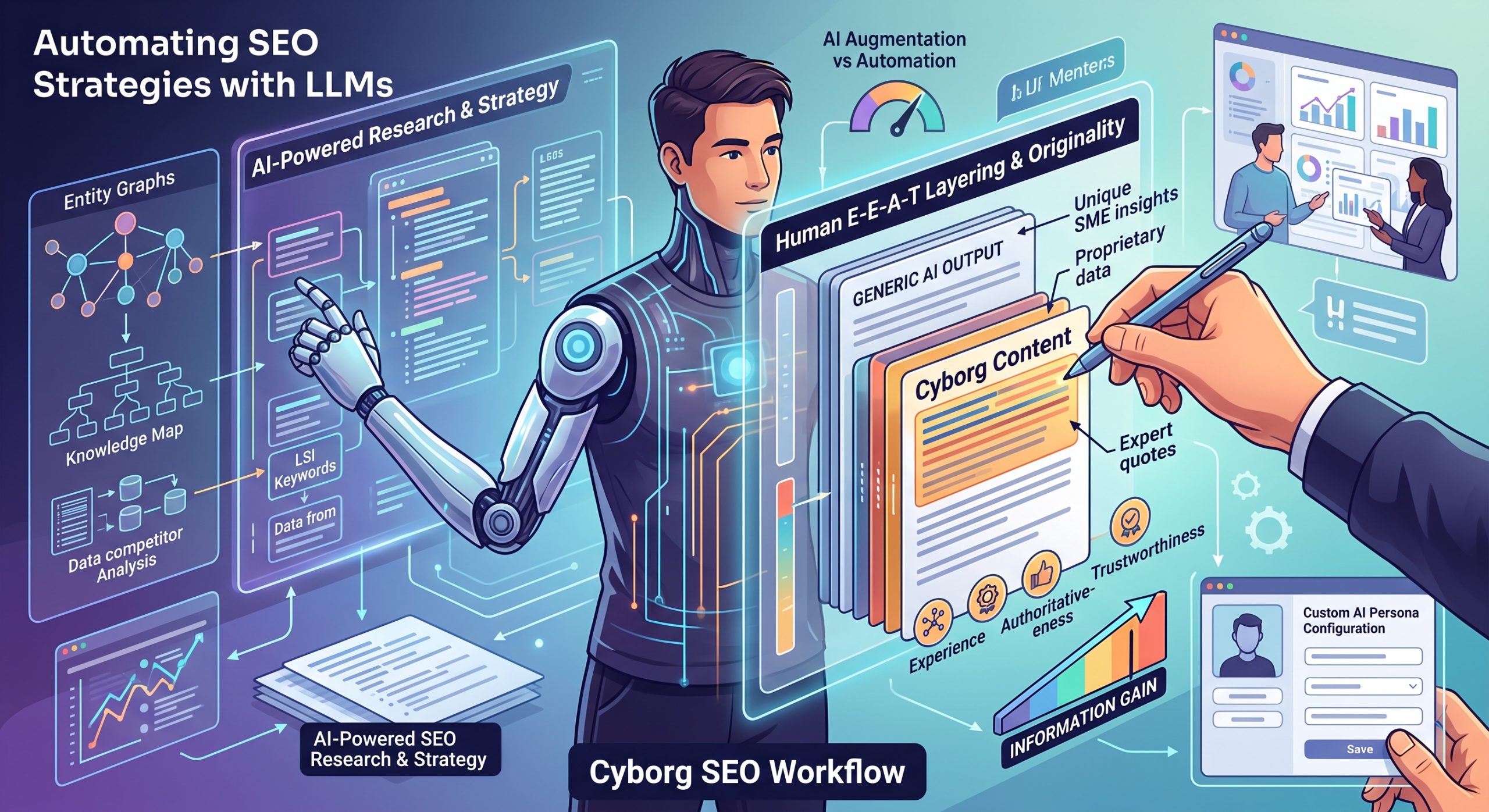
The goal is to use Large Language Models (LLMs) to automate the heavy lifting—like keyword research, briefs, and structured outlines. That way, your writers can spend 100% of their time doing what AI can’t: injecting unique value.
Here is exactly how to do it.
The Information Gain Mandate (Why Generic AI Fails)
In 2026, SEO revolves around one core concept: Information Gain.
What is Information Gain?
It’s a measure of how much new value your article adds to the internet compared to the hundreds of other articles already ranking.
Think about it. If an LLM can generate your exact article in 10 seconds using existing data, your content brings absolutely zero new value to the table.
And AI Overviews will completely ignore it. They don’t cite copycats.
To win today, you have to fundamentally shift your mindset. You must move away from “AI Automation” (letting the bot do everything) and embrace “AI Augmentation” (letting the bot assist the human).
Content production is just one piece of the puzzle.
When you step back and look at [how artificial intelligence is redefining digital marketing and SEO], it’s clear that raw output is out, and strategic, data-backed execution is in.
The “Cyborg” SEO Workflow: Briefs, Outlines, and Entities
So, how do you actually use LLMs for SEO without getting slapped with an algorithmic penalty?
Enter: The “Cyborg” SEO Workflow.
This is where you combine machine efficiency with human creativity.
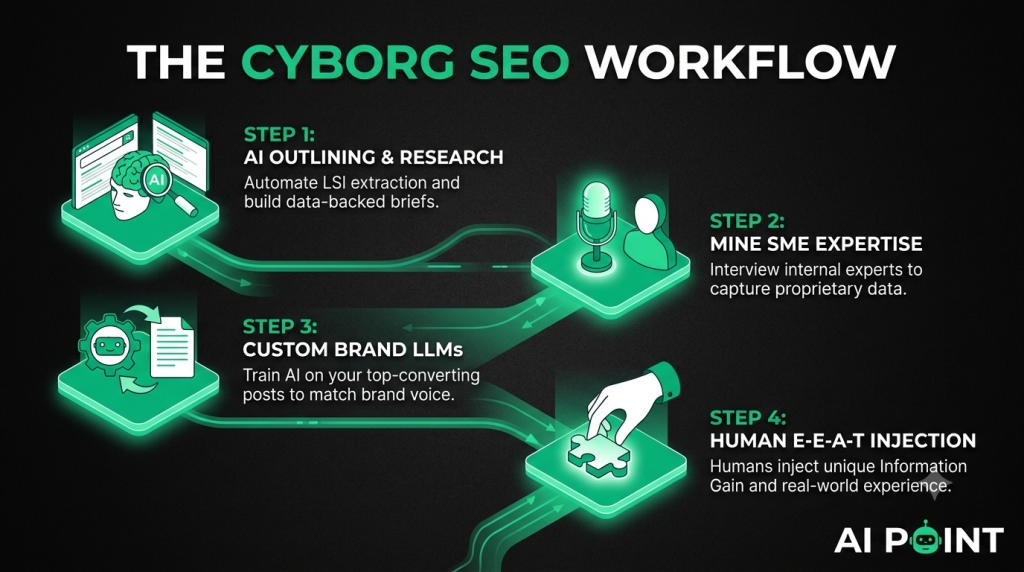
Instead of asking ChatGPT to write an article from scratch, you use it to build a highly structured, 2,000-word content brief.
You use AI to scrape the top-ranking SERPs to see exactly what Google currently rewards. You use it to extract latent semantic indexing (LSI) keywords. And you use it to map out Knowledge Graph entities that search engines expect to see in a comprehensive guide.
Here is the exact prompt formula we use:
“Act as a senior SEO strategist. Analyze these top 3 URLs [Insert URLs] and extract the core entities and LSI keywords. Then, generate a comprehensive content outline optimized for Semantic Search that covers gaps these competitors missed.”
Boom.
In seconds, you have a data-backed skeleton.
From there, a human steps in to write the actual prose. The AI builds the blueprint, and the human builds the house.
Mining Internal SMEs for Real E-E-A-T
Here is the dirty little secret about ChatGPT:
It has absolutely zero real-world experience.
It doesn’t have E-E-A-T (Experience, Expertise, Authoritativeness, Trustworthiness). And Google’s Quality Raters are looking for E-E-A-T more than ever before.
Your secret weapon? Your internal Subject Matter Experts (SMEs).
You need to mine the brains of your team to uncover the proprietary data and insights that aren’t available anywhere else online.
Here is the exact workflow:
First, record a 15-minute Zoom interview with an internal expert about your topic.
Next, generate a transcript of that call.
Finally, feed that raw transcript into an LLM and prompt it to extract unique quotes, contrarian opinions, and highly specific examples.
Take those golden nuggets and inject them directly into your AI-outlined draft. This guarantees a massive spike in Information Gain that no AI could ever hallucinate on its own.
Training Custom LLMs on Your Brand Voice
Out-of-the-box AI writing sounds like a robot.
It constantly uses dead-giveaway words like “delve,” “moreover,” and “in conclusion.” Readers spot it instantly, and they bounce.
The fix?
Build a custom GPT or AI persona specifically trained on your brand voice.
Take your top 5 highest-converting articles and feed them into the model. Tell the LLM to analyze the cadence, the paragraph length, and the tone. When the AI understands your unique voice, your first drafts go from generic to genuinely engaging.
But remember: Getting high-quality traffic from your new content engine is only half the battle.
Once those visitors land on your site, you need to convert them by using AI to optimize user acquisition funnels and conversion rates.
Conclusion
Here’s the bottom line.
Large Language Models are the ultimate SEO assistants. But they are terrible solo authors.
Use them to scale your research, but rely on human experts to scale your value.
Now I want to hear from you.
Are you still writing SEO outlines manually, or have you built a custom GPT to do the heavy lifting?
Let me know by leaving a comment below right now.
