

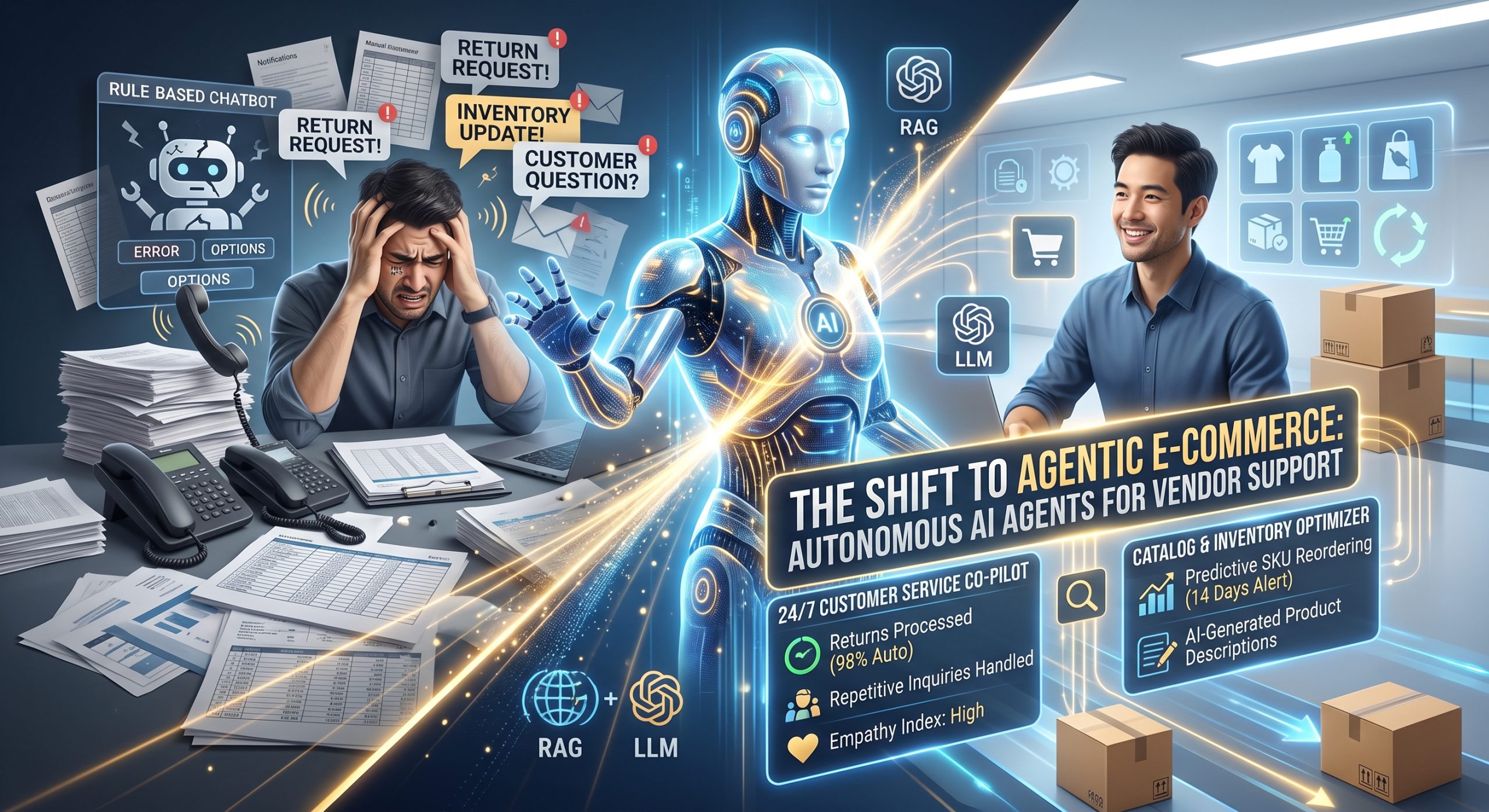
Vendor burnout is the silent killer of growing e-commerce platforms.
You hustle to onboard great sellers. You build a beautiful, high-converting UI.
But then?
Your vendors get completely crushed by the daily grind.
They are drowning in repetitive buyer questions. They are spending hours manually updating inventory lists. They are losing their minds processing standard returns and refunds.
This operational friction limits their growth. And if your vendors can’t grow, your platform can’t grow.
Traditional “help desk” chatbots aren’t the answer. They are rigid, robotic, and endlessly frustrate buyers.
Passive vendor dashboards aren’t much better. They require way too much manual input from busy sellers.
The solution is something entirely different.
I’m talking about autonomous AI agents.
Powered by Large Language Models (LLMs), these agents act as 24/7 co-pilots. They actively manage storefronts and resolve complex customer interactions on complete autopilot.
In this guide, I’m going to show you exactly how to integrate these AI agents into your platform to supercharge your vendor support.
Let’s dive in.
The Shift from Passive Storefronts to Active Ecosystems
We are in the middle of a massive architectural shift in e-commerce.
As we explored in our master guide on integrating AI into modern marketplaces, the most successful platforms are evolving from passive digital directories into active, autonomous ecosystems.
Let me explain.
In the old days of Web2, e-commerce automation was built entirely on simple if/then rules.
“If a customer clicks ‘track order’, then show them this specific link.”
That is legacy automation. It is dumb, it is rigid, and it breaks the second a customer asks a highly specific or complex question.
Today, we are entering the era of agentic workflows.
AI agents do not follow rigid, pre-programmed paths. They can actually reason. They can plan. They can execute multi-step tasks across your entire platform database.
For example, imagine a buyer says: “I need to change the shipping address on my order, but only if it hasn’t shipped yet.”
A legacy chatbot crashes. An AI agent understands that request perfectly.
It checks your database. It evaluates the current shipping status. It updates the address via API. Finally, it emails the customer a confirmation.
Zero human intervention required.
This technological shift is massive. It turns your platform from a simple hosting provider into a highly valuable, indispensable business partner for your vendors.
Automating Customer Support with RAG and LLMs
So, how do you actually build this?
Let’s look under the hood at the technical architecture.
The secret to building a world-class support agent is a framework called Retrieval-Augmented Generation (RAG).
If you just plug a raw LLM (like GPT-4) into your customer service chat, you are going to have a massive disaster on your hands. The AI will hallucinate. It will confidently promise customers free refunds that don’t actually exist.
RAG solves this problem completely.
Here is how it works on the backend:
First, you connect the LLM exclusively to a specific vendor’s internal knowledge base. I’m talking about their unique return policies, their specific shipping delays, and their highly detailed product specs.
When a customer asks a question, the agent doesn’t just guess.
It retrieves the exact, factual data from your vector database first. Then, it uses the LLM to generate a conversational, perfectly accurate, and highly empathetic reply.
Zero hallucinations.
But it gets even better.
Because you are building this in a modern Node.js or Python backend environment, your agents can execute actions via API.
They aren’t just talking. They are doing.
Let’s say a customer asks for a return. The AI agent authenticates the user. It checks the 30-day return policy window via API. It generates a return shipping label. And finally, it automatically initiates the refund sequence in your payment gateway.
The vendor literally wakes up, logs into their dashboard, and sees that the entire complex interaction was handled perfectly while they were sleeping.
That is the true power of RAG in an e-commerce environment. It eliminates the customer support bottleneck entirely.
AI Co-Pilots for Inventory and Catalog Management
Customer support is huge.
But AI agents do a lot more than just talk to angry buyers.
They also operate deep on the backend to optimize the vendor catalog.
Let’s face it. Vendors hate manual data entry. Uploading 500 new dropshipping products? Writing SEO-optimized titles for every single one? Formatting the images?
It is a complete nightmare.
Enter the AI Co-Pilot.
When a vendor uploads a raw CSV file or a folder of basic smartphone pictures, the AI takes over.
Using advanced computer vision, the agent scans the images. It instantly identifies the product, removes the messy background, and enhances the lighting.
Then, using LLMs, it automatically generates highly optimized SEO product titles and writes compelling descriptions tailored to your platform’s exact target demographic. It automatically categorizes the item into the correct platform taxonomy.
But what about inventory?
AI agents act as predictive supply chain managers.
By analyzing historical sales velocity and seasonal trends, the agent can predict exactly when a vendor is going to run out of a top-selling item.
It sends the vendor an automated alert: “You will run out of this SKU in 14 days. Click here to auto-reorder from your supplier.”
And thanks to modern development frameworks, you can leverage rapid “vibe coding” to deploy these bespoke agent tools. You can spin up a custom Python script in a matter of hours to serve a highly niche vendor need.
Your platform becomes an operational powerhouse.
Conclusion & Next Steps
Let’s wrap this up.
AI agents are completely redefining the e-commerce landscape.
They turn a stressed-out, single-person vendor operation into a massive, enterprise-grade storefront.
By implementing RAG architectures for flawless customer support and deploying AI co-pilots for catalog management, you completely eliminate the operational friction that stalls platform growth.
Now, I want to turn it over to you.
Which vendor workflow are you going to automate first on your platform?
Are you going to build a support agent to handle returns, or tackle predictive inventory management?
Let me know by leaving a quick comment below right now.
