

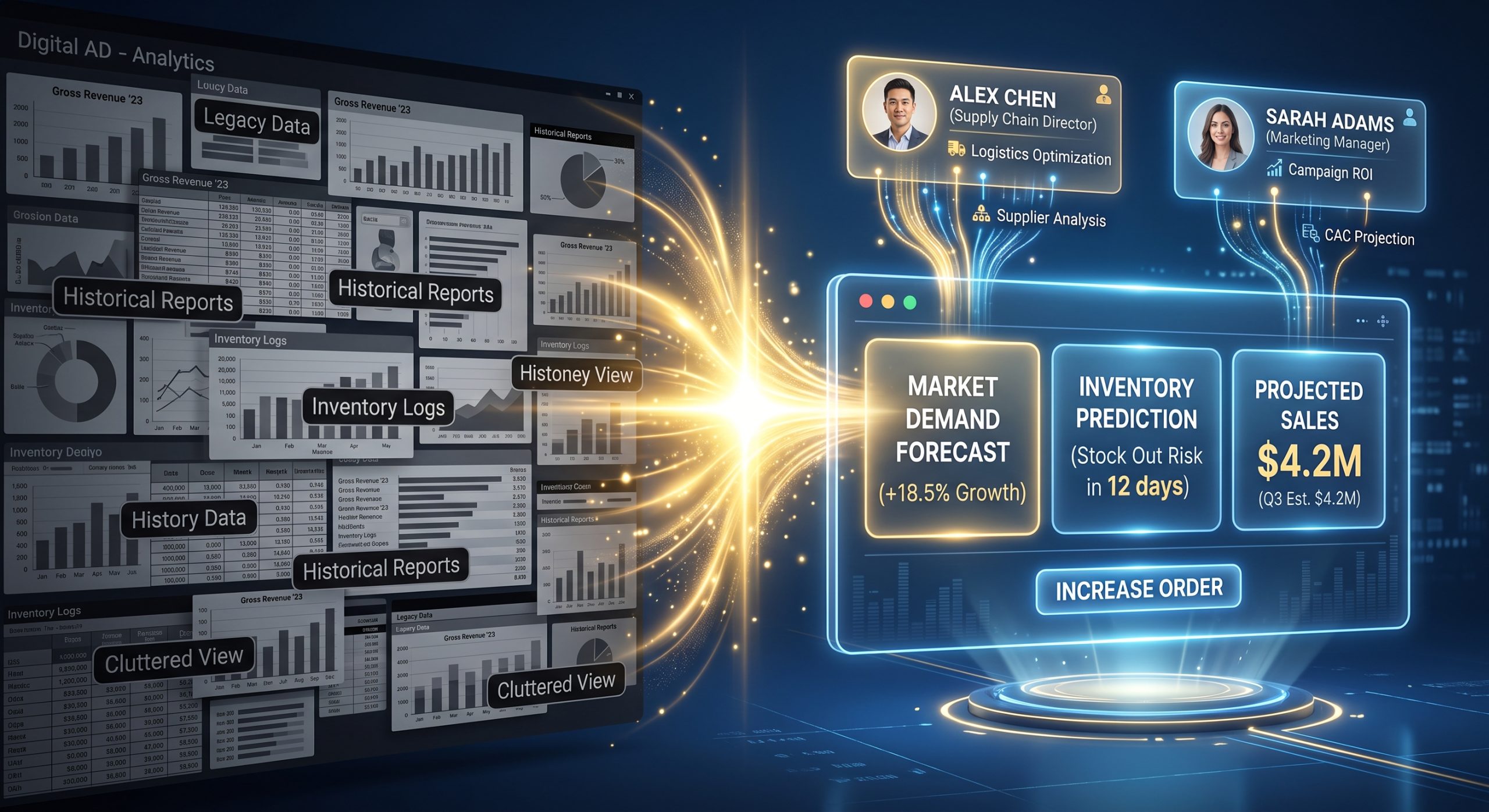
Data overload is completely paralyzing your users.
You might think you are doing your users a massive favor by giving them a highly detailed analytics dashboard loaded with 50 different charts, graphs, and tables.
But you aren’t.
You are actually creating massive decision fatigue.
Here is the problem with traditional analytics platforms: they treat every single user exactly the same.
They force busy professionals to manually dig through endless, retroactive reports just to find one single actionable insight. It’s exhausting. And in 2026, users simply won’t tolerate it.
The solution?
You need to implement machine learning models that actually anticipate user intent.
You need an interface that predicts exactly what data your user needs to see, before they even type a single keystroke into a query bar.
In this guide, I’m going to show you exactly how to transform a static, boring analytics dashboard into a hyper-personalized, predictive powerhouse.
Let’s dive right in.

Moving from Reactive Dashboards to Proactive Insights
Let’s talk about the fundamental flaw of legacy analytics.
Almost every dashboard built before 2024 is completely reactive.
What does that mean? It means the platform only tells your user what happened yesterday. It reports on past sales, past clicks, and past churn.
That data is useful. But it’s not game-changing.
To win today, you must shift to proactive forecasting.
This shift from reactive reporting to proactive forecasting is the final frontier of Integrating AI into Modern Marketplaces and Social Networks, allowing platforms to deliver unprecedented value.
Instead of waiting for a user to run a historical report, your platform’s AI needs to constantly analyze the user’s historical behavior and compare it against massive industry cohorts.
Then, it surfaces the insight automatically.
Imagine a user logging in and seeing this pop-up:
“Based on current market velocity, your top-selling product will stock out in 8 days. Click here to increase your manufacturing order by 15%.”
The platform didn’t just show them a chart of declining inventory. It identified the future problem. It calculated the optimal solution. And it served it to the user on a silver platter.
That is proactive insight.
When your platform starts doing the heavy analytical lifting for your users, they stop treating you like a simple software tool.
They start treating you like an indispensable business partner.
Dynamic UI/UX Adaptation Powered by Machine Learning
So, how do we push this personalization even further?
We move beyond just changing the data on the screen. We actually change the screen itself.
We are talking about Dynamic UI/UX Adaptation.
Here is the technical breakdown of how this works.
Normally, an interface is static. But with machine learning, your frontend frameworks (like React or Vue.js) constantly listen to your backend ML models.
The AI monitors the user’s real-time intent, scroll depth, and click patterns. Then, it physically alters the layout, the navigation menus, and the data visualizations to perfectly match that specific user.
Let me give you a real-world use case.
Imagine two different users logging into the exact same B2B e-commerce platform.
User A is a Supply Chain Director. User B is a Marketing Manager.
When the Supply Chain Director logs in, the machine learning model instantly recognizes their behavioral cohort. It dynamically rebuilds the homepage. It pushes supply-chain forecast widgets, inventory alerts, and logistics maps straight to the top of the screen.
When the Marketing Manager logs in seconds later?
The UI shifts entirely. The inventory maps disappear. Instead, the AI pushes a predictive Customer Acquisition Cost (CAC) chart and a ROAS (Return on Ad Spend) forecasting module front and center.
The navigation bar literally rewrites itself to prioritize marketing tools over warehouse tools.
Two users. One platform. Two completely bespoke, hyper-personalized experiences.
This level of dynamic adaptation destroys friction. It gets your users to their “aha!” moment in record time, skyrocketing your daily active user (DAU) retention metrics.
Privacy-Preserving Personalization and Federated Learning
Now, I know exactly what you are thinking.
“Brian, this sounds amazing. But what about privacy laws? Won’t tracking all this data violate GDPR or CCPA?”
It’s a great question. You absolutely cannot play fast and loose with compliance.
The massive hurdle in predictive analytics is training your models without hoarding sensitive, personally identifiable information (PII) on your central servers.
The solution is a technical architecture called Federated Learning.
Here is how it works in plain English:
Instead of sucking all of your users’ raw data into your massive central database to train your AI, the AI model is actually sent to the user.
The model trains locally on the user’s “edge device” (their smartphone or their local web browser). It learns their habits right there on their own machine.
Then, it encrypts just the learnings—the mathematical weight updates—and sends those anonymous numbers back to your central server.
Your global AI model gets smarter, but the user’s personal data never actually leaves their device. It stays completely sovereign.
You can also jumpstart this entire process safely by using Zero-Party Data.
This is data that a user explicitly and willingly shares with you during onboarding (e.g., “I am a marketing manager interested in CAC”).
By combining Zero-Party Data with Federated Learning, you get all the massive benefits of predictive personalization with zero regulatory nightmares.
Conclusion & Next Steps
Let’s wrap this up.
The future of analytics is predictive, fully adaptable, and privacy-first.
If you are still serving your users static, one-size-fits-all dashboards that only look backward, you are going to be left in the dust by AI-native competitors.
By integrating proactive ML models and dynamic UI adaptation, you can build a platform that truly feels alive.
Now, I want to hear from you.
I want you to audit your current platform dashboard today. What is one static element you can make dynamic using machine learning this quarter?
Let me know by leaving a quick comment below right now.
