

Let me ask you a quick question.
Why do some modern marketplaces seem to know exactly what you want to buy, while others feel like a digital ghost town?
The answer isn’t a bigger marketing budget. And it’s definitely not a better logo.
It’s Artificial Intelligence.
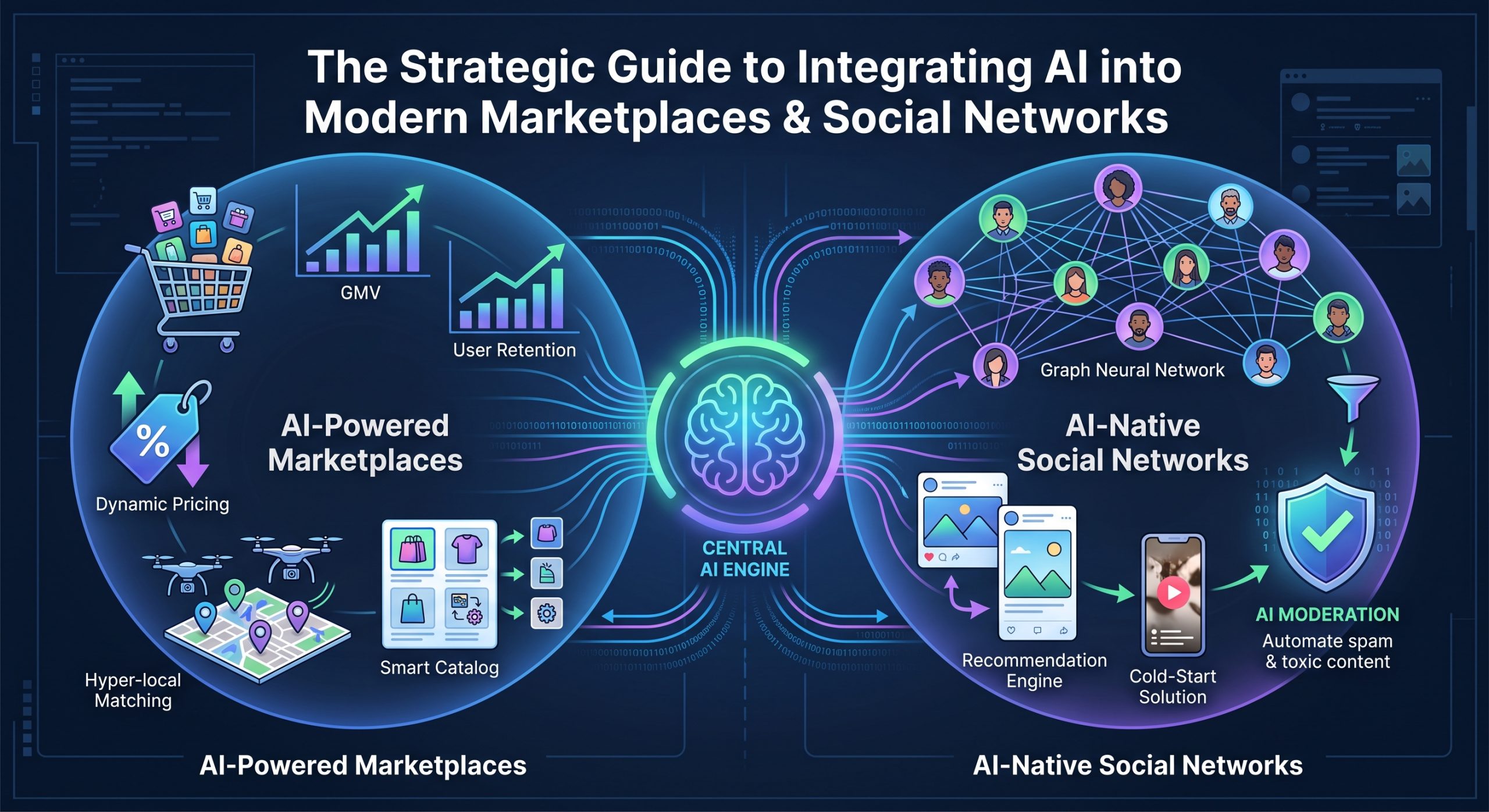
Here’s the deal: In 2026, AI-native platforms are completely dominating the market. We’re talking about massive shifts in user retention, sky-high Gross Merchandise Value (GMV), and operational overhead that’s a fraction of what it used to be.
But let’s be real. If you’re running a growing platform right now, you’re probably facing the classic “Platform Growth Dilemma.”
When you scale manually, things break.
Your human moderation team becomes a massive bottleneck. Your product catalog turns into a chaotic mess of duplicate listings. And your users? They bounce because your chronological feed is showing them irrelevant junk.
It’s exhausting.
But there is a silver lining. AI is no longer just a “nice-to-have” feature or a trendy buzzword you slap on a pitch deck. It is the fundamental infrastructure required to build, scale, and monetize modern digital ecosystems.
In this comprehensive guide, I’m going to pull back the curtain.
Whether you’re a CTO, a product leader, or a growth marketer, you’re going to learn exactly how to architect your marketplace or social network for the AI era.
We’re going to cover everything from hyper-local matching algorithms to automated moderation systems that actually work.
Ready? Let’s dive in.
Table of Contents
- Introduction: The Ultimate Strategic Guide
- The AI Paradigm Shift: From Static Rule Engines to Autonomous Ecosystems
- Revolutionizing E-commerce and Vendor Ecosystems
- Bridging the Distance: Hyper-Local Marketplaces & Real-Time Logistics
- Cultivating Connection: Building Recommendation Engines
- Maintaining Brand Safety & Platform Integrity at Scale
- The Next Frontier: Predictive Analytics and Hyper-Personalization
- Implementation Blueprint: Technical and Operational Considerations
- Conclusion & Strategic Roadmap for Platform Leaders
The AI Paradigm Shift: From Static Rule Engines to Autonomous Ecosystems
Let’s travel back in time for a second.
Remember the “Web2” days? Platforms were built on static, if/then rule engines.
If a user clicks “sports,” show them the “sports” category. If a vendor uploads a product without a picture, flag it.
It was simple. But it was also incredibly dumb.
The Evolution of Platform Architecture
Static tagging simply doesn’t cut it anymore.
Today’s users expect platforms to read their minds. They want contextual relevance. And to deliver that, you need to move from rule-based databases to continuous machine learning pipelines.
Modern platforms use transformer models and deep neural networks. Instead of looking at rigid categories, they look at relationships. They analyze the context of a search, the time of day, and the user’s historical behavior—all in milliseconds.
Which means?
Your platform isn’t just a container for content. It’s an autonomous ecosystem that learns and optimizes itself with every single click.
The Core Pillars of AI-Native Platforms
So, what does this new multi-layered tech stack actually look like?
It breaks down into four core pillars:
- Data Ingestion: Gathering massive streams of unstructured data (clicks, scrolls, dwell time, video views) in real-time.
- Real-Time Embeddings: Translating that human behavior into mathematical vectors that an AI can instantly understand and compare.
- Autonomous Agents: Bots that act on behalf of the platform or the user (think automated customer service or dynamic pricing algorithms).
- Dynamic User Interfaces: Front-end experiences that literally shift and change shape based on who is looking at the screen.
Business Impact: Quantifying ROI Across CAC and LTV
Now for the fun part: the numbers.
Why are platform leaders obsessed with this architectural shift? Because the ROI is absolutely insane.
When you implement AI correctly, your Customer Acquisition Cost (CAC) drops like a rock. Why? Because hyper-targeted discovery means users find their “aha!” moment faster. They convert sooner. They share the platform with their friends.
On the flip side, your Customer Lifetime Value (LTV) skyrockets.
When a social network’s feed is flawlessly curated by machine learning, users don’t churn. They stay engaged for years. When a marketplace recommends the exact product a buyer was looking for, they buy more often.
Bottom line: AI isn’t just an IT upgrade. It’s the ultimate growth lever.
Revolutionizing E-commerce and Vendor Ecosystems
If you run a multi-vendor marketplace, listen up.
The vendor experience is changing fast. In the old days, you just gave merchants a digital storefront and wished them luck.
Today? Vendors demand active assistance. If your platform doesn’t help them sell, they will pack up and move to a competitor that does.
Empowering Merchants with Autonomous Vendor Tools
Here’s the truth: passive catalog management is dead.
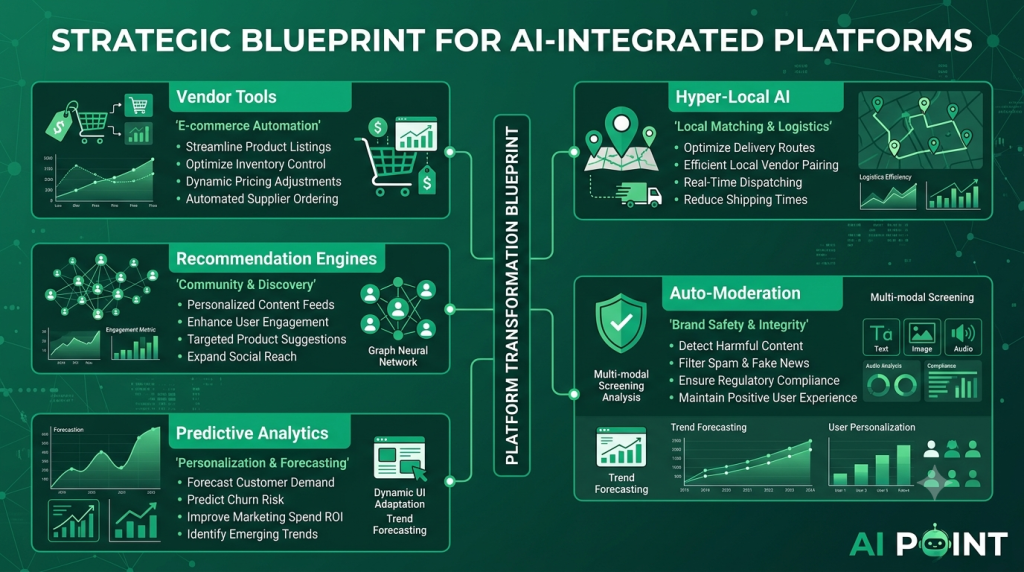
Modern e-commerce platforms are equipping their sellers with AI-assisted superpowers. We’re talking about dynamic pricing engines that adjust costs based on real-time competitor data and supply chain fluctuations.
We’re talking about automated inventory forecasting. (No more guessing how many units to stock for Q4).
And perhaps most importantly, smart asset creation. A vendor can upload a crappy smartphone picture of a pair of shoes, and the platform’s AI will instantly remove the background, enhance the lighting, and drop it onto a professional lifestyle backdrop.
It’s a win-win. Vendors get more sales. The platform gets higher quality listings.
The Rise of Agentic Workflows in Merchant Operations
But the real game-changer? Agentic workflows.
AI agents are acting as 24/7 co-pilots for merchants.
Imagine a vendor on your platform waking up to find that an AI agent has already handled 50 routine buyer queries, processed three standard returns, and flagged a supply chain dispute for human review.
It completely removes the operational friction of selling online.
To explore exactly how these autonomous workflows are transforming seller operations, read our deep dive on using AI agents for enhancing e-commerce and vendor support.
Scaling Merchant Onboarding and Catalog Quality
Let’s talk about onboarding.
If it takes a new merchant two weeks to upload their catalog and format it to your platform’s standards, you’ve already lost them.
AI crushes this bottleneck.
When a merchant uploads a massive CSV file, machine learning techniques take over. The AI handles automatic product categorization so items end up in the right taxonomy.
It scans for and flags duplicate listings to keep your search results clean. It even auto-generates SEO-optimized titles and product descriptions based on a single product image.
The result? Vendors go from sign-up to making their first sale in record time. And your catalog quality stays pristine, no matter how fast you grow.
Bridging the Distance: Hyper-Local Marketplaces & Real-Time Logistics
Let’s shift gears.
E-commerce is great, but consumer demand is rapidly shifting toward “near me” services.
People want rapid delivery, community-supported agriculture, and localized retail. But matching local supply with local demand in real-time?
That is incredibly hard.
The Complexity of Real-Time Local Matching
Hyper-local commerce is a logistical nightmare.
You aren’t just matching a buyer and a seller. You have to factor in micro-geographies, traffic patterns, variable delivery windows, and constantly fluctuating inventory.
A static database will crash and burn trying to process this.
If a user searches for “plumber” or “fresh sourdough,” they need to see who is available right now, within a 3-mile radius, with a strong reputation.
Geospatial Embeddings and Predictive Routing Algorithms
This is where the heavy technical lifting comes in.
Modern hyper-local platforms rely on geospatial embeddings. In plain English? The AI turns physical locations and user intents into mathematical maps.
Using vector search and spatial clustering algorithms, the platform can instantly calculate the optimal match. It predicts routing efficiency, factoring in peak hours and driver availability, to ensure the transaction actually happens.
For a complete breakdown of geospatial ML architectures and how they power localized commerce, read our guide on matching consumers with local vendors efficiently through hyper-local AI.
Building Trust in Neighborhood-Driven Ecosystems
But speed isn’t everything. In local marketplaces, trust is the ultimate currency.
If I’m hiring a local contractor off your platform, I need to know they aren’t going to scam me.
AI solves this by generating dynamic community reputation scores. The algorithm factors in verified reviews, response times, dispute histories, and even neighborhood validation.
It automatically elevates the most reliable local merchants to the top of the search results, while quietly suppressing bad actors.
Plus, localized ML models help optimize neighborhood fulfillment hubs—predicting exactly which goods need to be stocked in specific zip codes before users even order them.
Cultivating Connection: Building Recommendation Engines for Community Platforms
Let’s talk about social networks and community platforms.
If your platform relies on user-generated content, you are fighting a massive battle against one specific enemy:
Content shock.
Overcoming Content Shock in Niche Networks
Content shock is what happens when a user logs in and is completely overwhelmed by irrelevant noise.
In the early days of a network, a chronological feed works fine. Everyone sees everything.
But as your network scales to thousands or millions of users, that chronological feed becomes a firehose of garbage. Users experience platform fatigue. They can’t find their tribe. So they close the app and never come back.
To survive, you need an algorithm that curates connection.
Collaborative Filtering vs. Graph Neural Networks (GNNs)
Historically, platforms used Collaborative Filtering. (Think: “Users who liked X also liked Y”).
It worked okay, but it was limited.
Enter Graph Neural Networks (GNNs). This is the cutting edge of recommendation systems.
GNNs don’t just look at isolated clicks. They map complex social relationships. They look at shared interests, multi-modal interactions (like how long you watched a video versus if you commented on a text post), and the hidden connections between different sub-communities.
It’s the difference between a platform guessing what you like, and a platform knowing who you are.
Solving the “Cold-Start” Problem for New Users and Content
But there’s a catch.
How do you recommend content to a brand-new user who has zero history on your platform? This is the dreaded “Cold-Start” problem.
Modern AI tackles this using content-based embeddings and zero-shot learning.
Instead of waiting for the user to click on 50 things, the AI analyzes the actual content of the posts (reading the text, analyzing the video frames) and maps it to the onboarding preferences the user selected.
Day-one users get a highly relevant feed instantly, skyrocketing your day-one retention rates.
To discover the exact algorithmic frameworks behind this, read our comprehensive guide on building AI recommendation engines for community-driven platforms.
Maintaining Brand Safety & Platform Integrity at Scale
We need to talk about the dark side of scaling a platform.
Spam. Toxicity. Scams. Inappropriate content.
If you let this stuff run rampant, your community will die, and your advertisers will flee.
The Hidden Costs of Manual Content Moderation
Here’s a hard truth: human moderation alone is no longer viable.
Relying exclusively on human review teams is a massive financial burden. But worse than that, it’s slow. By the time a human reviews a toxic post, 10,000 people might have already seen it.
And let’s not forget the human trauma associated with reviewing horrible user-generated content all day.
You need a scalable, automated first line of defense.
Multimodal Moderation: Text, Audio, Video, and Context
Enter AI moderation.
And I’m not talking about simple keyword blocklists. Users easily bypass those by misspelling words or using emojis.
I’m talking about multimodal moderation.
Modern Large Language Models (LLMs) and computer vision models can identify nuance. They understand sarcasm. They can detect hate speech disguised as a joke, spot illegal transaction patterns in DMs, and even identify synthetic deepfakes in real-time video uploads.
The AI looks at the context of the entire post, not just isolated words.
Implementing a “Human-in-the-Loop” (HITL) Moderation Stack
But AI isn’t perfect. If you let it run wild, it might ban innocent users (false positives).
The secret sauce is a “Human-in-the-Loop” (HITL) architecture.
Here’s how it works: The AI processes 100% of the content. It automatically deletes the obvious trash (spam bots, explicit imagery) with 99.9% confidence.
For the gray areas—content that scores a 70% confidence rating—the AI automatically routes it to a human reviewer dashboard, complete with highlighted context on why it was flagged.
You keep your community safe, slash your moderation costs, and maintain pinpoint accuracy.
To learn exactly how to configure these automated rule sets, check out our guide on using automated AI moderation in niche social networks.
The Next Frontier: Predictive Analytics and Hyper-Personalization
So, what happens when you’ve mastered recommendations, logistics, and moderation?
You look to the future.
The most advanced applications of AI in modern platforms aren’t just reacting to user behavior. They are predicting it.
Moving from Reactive Dashboards to Predictive User Interfaces
Traditional analytics platforms are retroactive. They tell you what happened last week.
That’s useful, but it’s not game-changing.
Forward-thinking platforms use AI to anticipate user queries before they even happen. Imagine a B2B SaaS marketplace where the dashboard auto-generates a tailored supply chain report because it knows the user is about to run out of a key material based on historical data.
It surfaces proactive insights. It solves problems before the user even realizes a problem exists.
Dynamic UI/UX Adaptation Powered by Machine Learning
This goes beyond just recommending different products.
We are entering the era of dynamic UI/UX adaptation.
Using machine learning, platforms can actually alter their layout structures based on user behavior cohorts.
If the AI notices a user always goes straight to the “deals” section, it will automatically reconstruct the navigation menu for that specific user, putting deals front and center. It will change the color of call-to-actions based on what converts best for that specific demographic.
The platform physically molds itself to the user.
Privacy-Preserving Personalization
Now, I know what you’re thinking.
“What about privacy laws like GDPR and CCPA?”
You absolutely cannot play fast and loose with user data.
The good news? You don’t have to.
Modern AI allows for privacy-preserving personalization. Using techniques like Federated Learning, models can train on user devices without ever sending personal data back to your central servers.
You can also rely on “Zero-Party Data”—preferences the user explicitly and willingly shares with you—to drive these models. You get hyper-personalization without compromising user data sovereignty.
To uncover the technical architecture making this possible, read our breakdown on personalizing the user experience in prediction and analytics platforms.
Implementation Blueprint: Technical and Operational Considerations
Okay, you know the what and the why.
Now let’s talk about the how.
Implementing AI isn’t just a matter of installing a plugin. You need a solid technical blueprint.
Build vs. Buy vs. Fine-Tune: Strategic Framework
The first decision you have to make is your foundation.
Do you build from scratch? Buy off the shelf? Or fine-tune?
- Buy (APIs): For most platforms, plugging into off-the-shelf APIs (like OpenAI or Anthropic) is the fastest way to get basic text and agentic features running.
- Fine-Tune: If you have highly specific, proprietary platform data (like a niche marketplace for vintage car parts), you should fine-tune open-source models like Llama. This gives you industry-specific accuracy.
- Build: Only enterprise giants (think Amazon or Meta) should be training models entirely from scratch. The compute cost is simply too high.
Managing Latency, Infrastructure Costs, and API Rate Limits
Here’s the trap most CTOs fall into: they build a brilliant AI feature, deploy it, and watch their server costs explode.
AI requires heavy compute.
To survive, you need aggressive caching strategies. If 1,000 users ask your AI search bar the exact same question, you shouldn’t be pinging the LLM 1,000 times. Cache the answer.
You also need to optimize your vector databases (tools like Pinecone, Qdrant, or Milvus) for high-throughput platforms.
Mastering model distillation—making large models smaller and faster without losing accuracy—is how you keep latency under 100 milliseconds and keep your CFO happy.
Conclusion & Strategic Roadmap for Platform Leaders
Let’s wrap this up.
Integrating AI into your marketplace or social network is no longer a luxury. It is the ultimate competitive moat.
From matching local vendors in real-time, to empowering merchants with autonomous agents, to deploying multimodal moderation that scales—AI is the engine of the modern digital platform.
Execution Checklist
If you are ready to start building, here is your 5-step roadmap:
- Audit Your Data: AI is only as good as the data you feed it. Clean up your product catalogs and user interaction logs.
- Pick One Bottleneck: Don’t try to boil the ocean. Start with your biggest friction point (e.g., search relevance or content moderation).
- Choose Your Model: Decide between an off-the-shelf API for speed or fine-tuning an open-source model for accuracy.
- Implement HITL: Always keep a “Human-in-the-Loop” for quality control during your initial rollout.
- Measure and Iterate: Track your CAC, LTV, and latency relentlessly.
Next Steps
The platform economy is moving fast. If you want to dive deeper into the technical weeds, I highly recommend exploring the five spoke guides linked throughout this post.
Now I want to hear from you.
Which AI integration strategy are you going to test first on your platform? Are you leaning toward hyper-local matching, or revamping your recommendation engine?
