

We live in an immediate gratification economy.
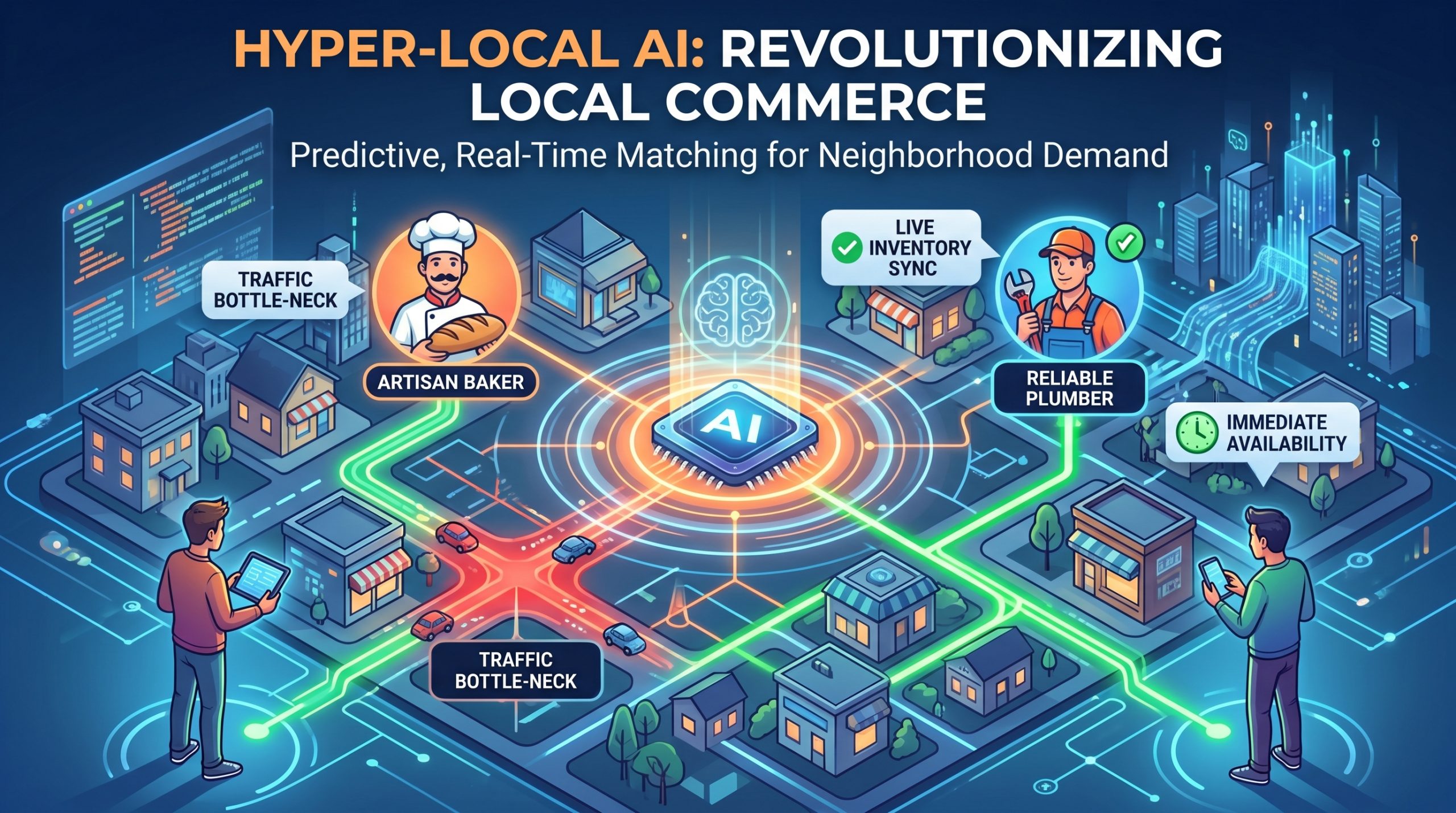
Today, users don’t want to wait three days for a delivery. They want to find an artisan baker, a reliable plumber, or a local contractor in seconds.
And they want it now.
But here’s the problem:
Traditional database queries flat-out fail at this. They cannot map real-time variables like rush-hour traffic, fluctuating local inventory, and immediate availability.
If your platform relies on old-school search, your users are bouncing.
The solution?
Geospatial AI.
Geospatial AI is the ultimate bridge between neighborhood supply and local demand. It is the secret weapon that top platforms use to dominate the local market.
In this guide, I’m going to show you exactly how hyper-local AI is transforming commerce, and how developers can use it to build a predictive, real-time matching engine.
Let’s dive in.
The Technical Challenge of Hyper-Local Matching
Let’s get technical for a second.
Why is matching a local buyer with a local seller so difficult?
In the past, developers relied on simple radius-based SQL queries. You know the type: “Find vendors within a 5-mile radius.”
Sure, that worked in 2015. But today? It’s completely outdated.
Why? Because a strict 5-mile radius doesn’t care about a massive traffic jam on the highway. It doesn’t care if a river cuts right through that radius, turning a “2-mile trip” into a 45-minute drive.
Plus, you have to factor in dynamic micro-geographies and variable delivery windows.
If a user searches for an emergency leak repair, showing them a top-rated plumber who is technically 2 miles away but currently booked solid for the next six hours is a terrible user experience.
Your database needs to be smarter. It needs to look at time, availability, and physical friction—not just a straight line on a map.
How Geospatial AI Models Solve the Distance Gap
This is where things get really interesting.
When integrating AI into modern marketplaces, geospatial models become the critical infrastructure that turns a localized database into a real-time predictive engine.
Instead of basic SQL queries, modern platforms are using vector embeddings.
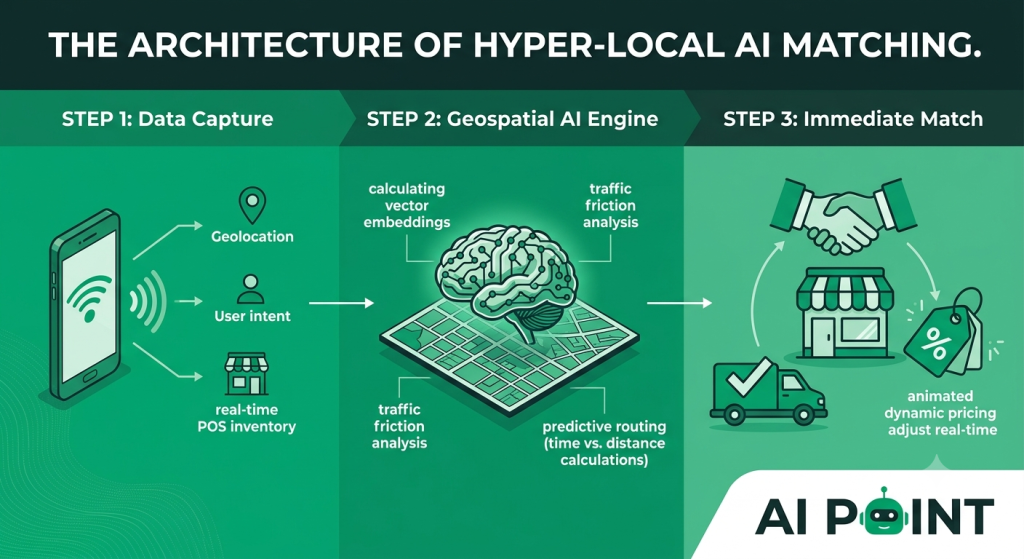
In plain English? The AI takes a physical location, real-time traffic data, and a user’s exact intent, and transforms all of that into mathematical maps.
It calculates the friction of a transaction in milliseconds.
Here is a high-level look at the backend architecture:
First, your platform captures geolocation data via a Node.js API.
But instead of just querying a database, that data is fed into a spatial clustering algorithm. The algorithm groups available vendors based on real-time logistical feasibility, not just static zip codes.
Next, it overlays predictive routing.
The AI knows that at 5:00 PM on a Friday, a vendor 1 mile south is actually “farther away” in travel time than a vendor 3 miles north.
It doesn’t stop there. Machine learning models continuously learn from every transaction. If a specific delivery route always takes 10 minutes longer than Google Maps predicts, the AI adjusts its future recommendations automatically.
The result?
Your user gets matched with the exact vendor who can fulfill their request the fastest. It completely eliminates the distance gap.
Dynamic Pricing and Real-Time Inventory Sync
Speed isn’t the only factor in hyper-local commerce.
You also have to nail pricing and inventory.
Let’s talk about dynamic pricing first.
With machine learning, local vendor pricing isn’t static. It adjusts dynamically based on neighborhood demand surges, competitor proximity, and even local weather patterns.
If a storm is rolling in, the AI can automatically bump up the price (and visibility) of local vendors selling umbrellas or emergency supplies.
But for this to work perfectly, your inventory data has to be flawless.
If a user buys the last artisan sourdough loaf on your app, but the bakery just sold it over the counter a second ago… you have a massive problem.
That’s why you need robust API pipelines.
Your platform must keep physical vendor inventory synced with your digital storefront in absolute real-time. By connecting POS (Point of Sale) systems directly to your AI matching engine, you ensure that what users see on their screen is exactly what is sitting on the local shelf.
This level of synchronization builds massive trust. And in hyper-local markets, trust is everything. When users know your app is 100% accurate every single time, they stop using search engines. They start using you.
Conclusion & Next Steps
There you have it.
Hyper-local AI isn’t just a fancy feature. It is the core engine that drives foot traffic, boosts local conversions, and keeps users coming back.
By moving away from static radius searches and embracing geospatial machine learning, you create a platform that actually understands the physical world.
Now I want to hear from you.
How are you currently handling local search algorithms on your platform? Are you sticking with traditional databases, or are you making the leap to AI?
Let me know by leaving a comment below right now.
