

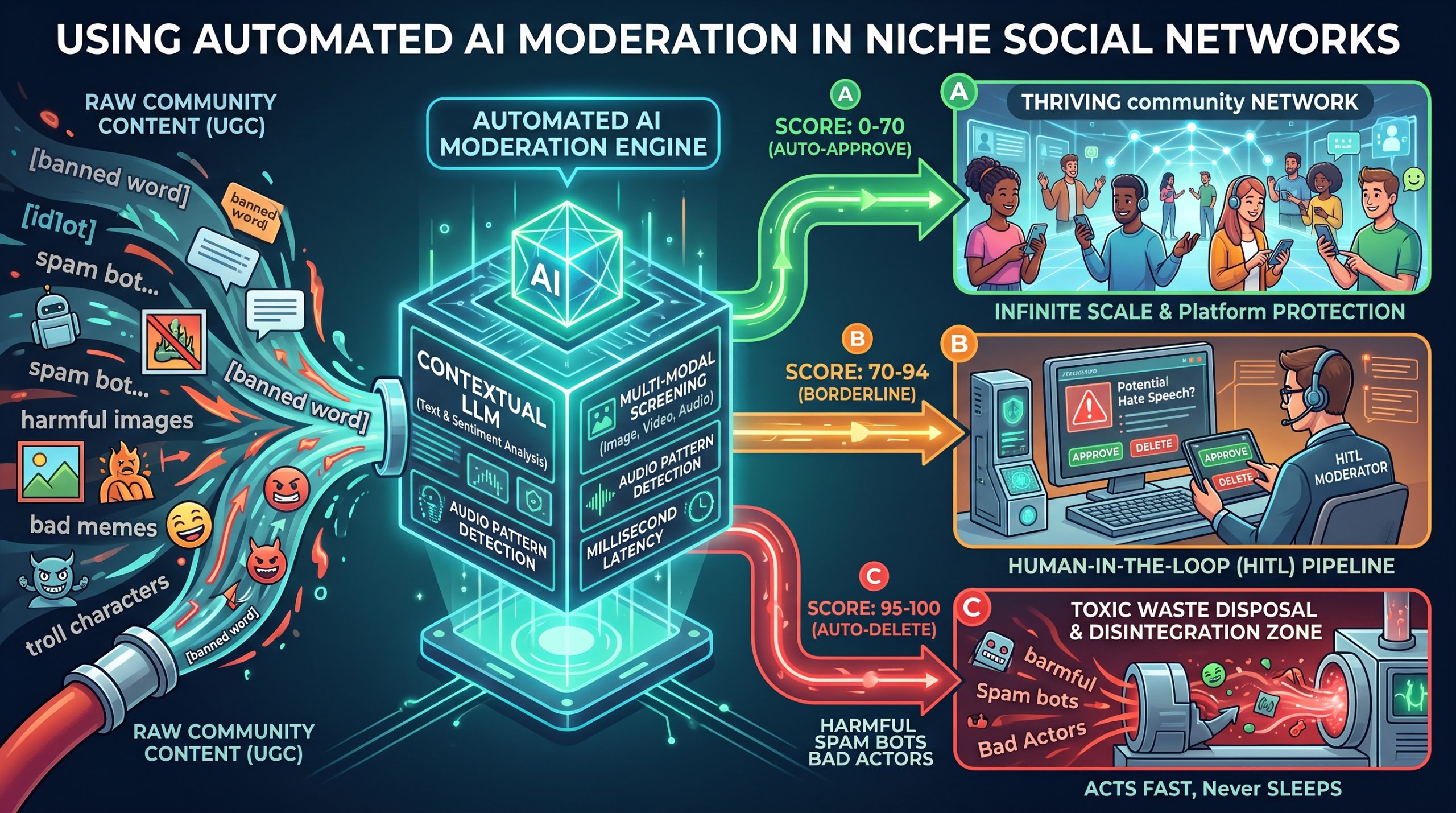
Toxic content can kill a niche community overnight.
You spend months—maybe even years—building a thriving network. Your user engagement is finally up. Your community members are happy and actively posting.
Then, it happens.
Spam bots, bad actors, and organized trolls flood your feed.
Suddenly, your best, most loyal users log out. And they never come back.
The traditional solution to this problem? Hire a massive team of human moderators to watch the feed 24/7.
But let’s be real for a second.
Manual moderation is too slow, incredibly expensive, and mentally draining to scale alongside a rapidly growing user base. If you rely on humans to catch every single bad post, you’ve already lost the battle.
In this guide, I’m going to show you exactly how to protect your platform using automated AI moderation.
Let’s dive right in.

Why Human Moderation Fails at Scale
Let me share a hard truth about scaling social platforms today.
As outlined in our master guide on integrating AI into modern marketplaces and social networks, relying exclusively on human review teams is a massive financial and operational bottleneck.
When your community is small, human moderation works perfectly. Having a few admins manually checking a few hundred posts a day is completely manageable.
But what happens when you hit 10,000 active users? Or 100,000?
Human reviewers simply cannot keep up with the sheer volume of user-generated content.
First, this creates a massive latency issue.
Think about it. If a user posts something highly toxic, and it takes your human team two hours to find it, review it, and delete it… the damage is already done. Hundreds of your most loyal members have already seen it on their timeline.
That two-hour delay directly causes user churn.
Second, human moderation simply doesn’t scale financially.
You cannot hire enough people to watch a 24/7 global feed without completely destroying your profit margins. A 24-hour moderation team requires multiple shifts, weekends, and holidays. It burns through your runway fast.
Finally, we have to talk about the human cost.
Reviewing flagged, toxic, or explicit content for eight hours a day takes a severe psychological toll on human workers. The turnover rate for moderation teams is astronomical.
You cannot build a sustainable technology business on the backs of an exhausted, traumatized moderation team.
You need a system that acts in milliseconds. You need a system that never sleeps. You need a system that scales infinitely without costing you an extra dime per post.
You need AI.
Leveraging Large Language Models (LLMs) for Contextual Screening
For years, platforms tried to automate moderation using basic keyword blocklists.
You probably know exactly how this works: If a post contains a bad word from your database, block it.
But trolls are incredibly smart.
They easily bypass these basic regex (regular expression) filters. Let’s say your blocklist bans the word “idiot.” A bad actor simply writes, “You are such an 1-d-i-0-t.”
Your keyword filter completely misses it. The toxic post goes live.
Keyword lists are completely useless in 2026.
Instead, the top platforms are leveraging fine-tuned Large Language Models (LLMs).
LLMs don’t just blindly scan a database for bad words. They analyze the context and the sentiment of an entire sentence.
This is a complete game changer.
An advanced AI model can accurately detect sarcasm. It can flag veiled hate speech that doesn’t use a single “banned” word. It catches the subtle, toxic nuance that basic filters miss entirely.
But it doesn’t stop at text.
Modern niche communities are highly visual. Users are uploading memes, GIFs, and videos constantly. That’s why you must implement multi-modal moderation.
What does that mean?
By combining text-based LLMs with advanced computer vision APIs, your platform can screen everything at once.
When a user hits upload, the AI instantly scans the live video frames for inappropriate imagery. It reads the text in the caption. It even listens to the audio track for flagged audio patterns.
It processes all of this in a fraction of a second.
It instantly blocks explicit pictures, spam links, and synthetic deepfakes before they ever hit the live feed.
It keeps your community pristine.
Building a “Human-in-the-Loop” (HITL) Pipeline
Now, you might be thinking:
“If I let AI delete posts automatically, won’t it accidentally ban innocent users?”
Yes. If you rely 100% on AI with zero oversight, you will eventually get false positives. You will accidentally ban a user for making an innocent joke.
That is why you absolutely must build a “Human-in-the-Loop” (HITL) pipeline.
Here is exactly how this technical workflow operates on the backend:
When a user hits “publish,” the AI instantly scores the content on a scale from 0 to 100 based on toxicity.
Scenario A: The Obvious Trash If a post scores a 95 or higher (obvious spam bots, explicit imagery, blatant hate speech), the AI auto-deletes it. Boom. Gone. No human needed.
Scenario B: The Good Stuff If a post scores under a 70, it goes straight to the live feed. Zero friction for your good users.
Scenario C: The Gray Area But what about the posts that score between 70 and 94?
This is where the magic happens.
The AI automatically routes those borderline posts via webhooks directly to a secure admin dashboard.
Your human moderation team logs in, sees the flagged post, and—most importantly—reads the exact reason the AI flagged it. The human makes the final call with one click: Approve or Delete.
This HITL architecture preserves 100% accuracy.
Even better? It reduces your human team’s actual workload by 90%.
Conclusion
Bottom line?
Automated AI moderation is no longer optional for growing platforms. It is the only guaranteed way to protect both the positive vibe of your community and your company’s bottom line.
By implementing contextual LLMs and a rock-solid HITL pipeline, you can scale infinitely without ever sacrificing brand safety.
Now I want to turn it over to you.
What does your current community moderation tech stack look like today? Are you still relying on keyword blocklists, or are you transitioning to AI models?
Let me know by leaving a quick comment below right now.
