

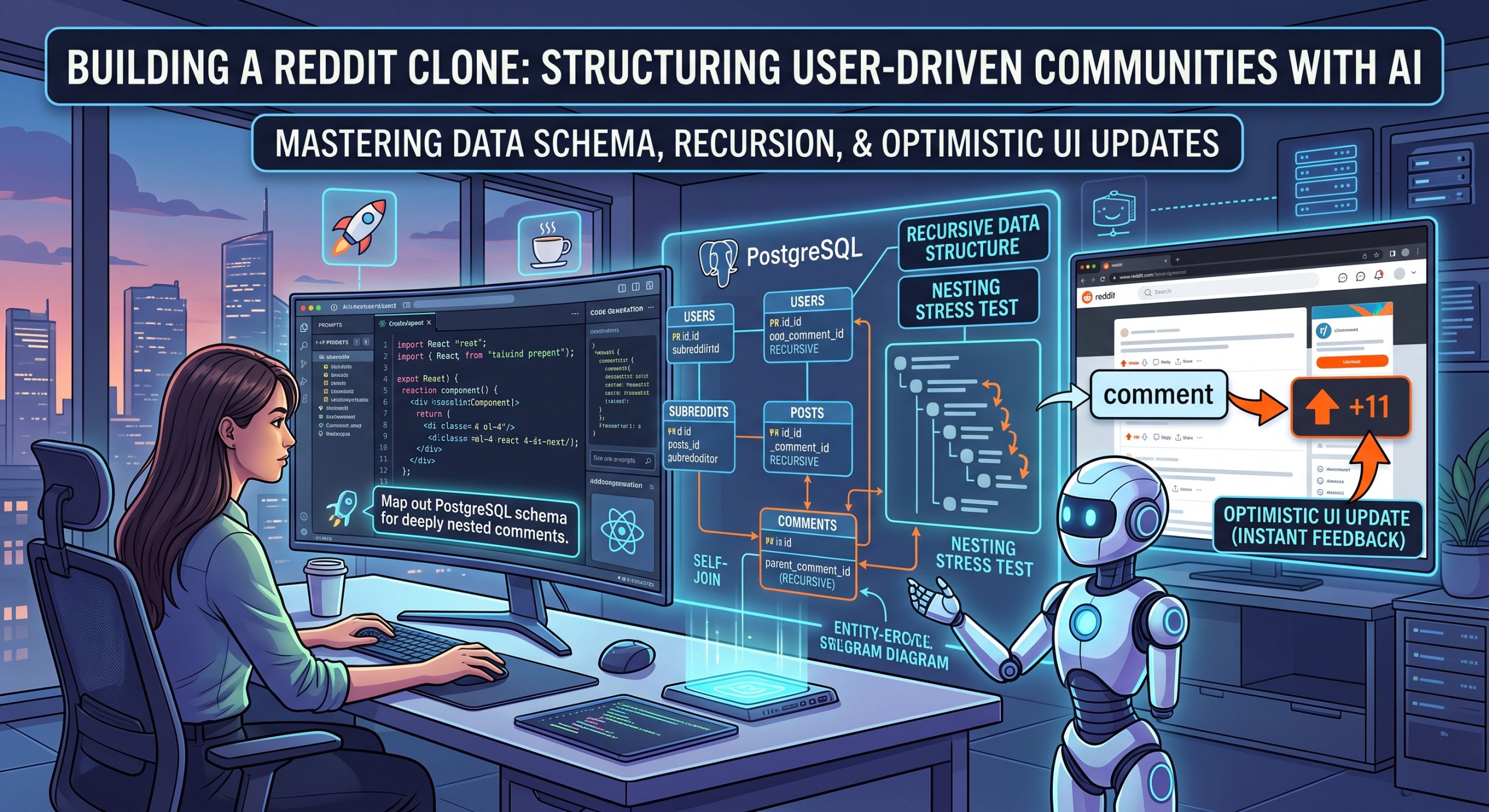
Want to test the absolute limits of your AI coding agent?
Try building a Reddit clone.
It sounds simple on paper. You have users, subreddits, posts, and comments. How hard could it be?
The truth? It is the ultimate stress test for vibe coding.
Most autonomous agents completely fall apart when they encounter deep nesting, recursive data structures, and real-time UI updates. If you just prompt an AI to “build a Reddit clone,” you are going to get a clunky, broken mess.
But when you structure your prompts correctly?
You can vibe code a flawless, highly interactive community platform in record time.
Today, I’m going to show you exactly how to do it.
Establishing the Foundation: Relational Data for Social Apps
When building a user-driven community, your database is everything.
If you get this wrong, your app will be slow, buggy, and impossible to scale.
A lot of developers let the AI default to a NoSQL database like MongoDB. For a simple blog, that’s fine. But for a Reddit clone? NoSQL can become an absolute nightmare for deeply nested comment threads.
You need a relational database. I highly recommend PostgreSQL.
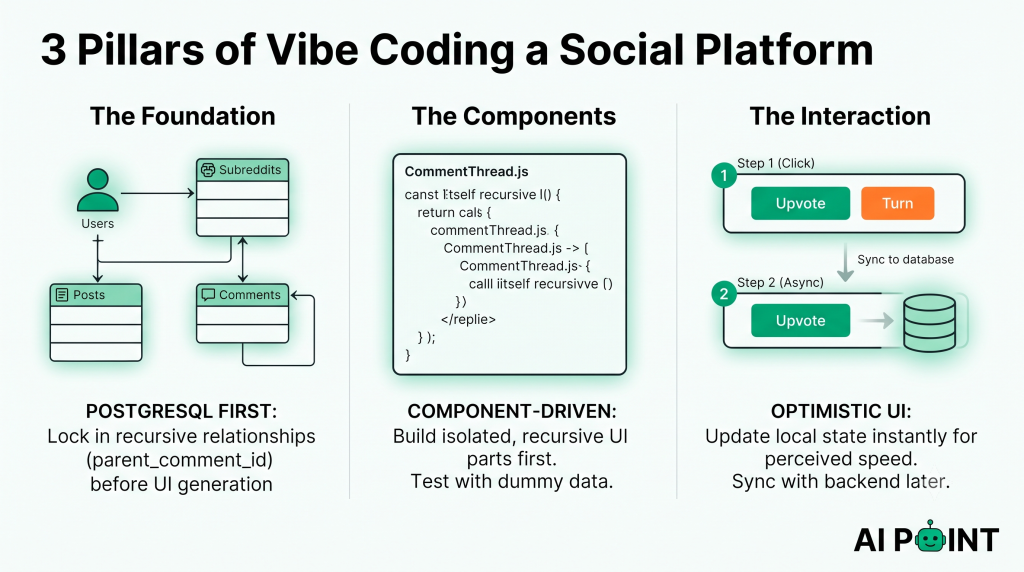
In fact, before you start generating the UI, you must lock in your database schema, which is the golden rule for vibe coding complex, production-ready platforms.
You need to force the AI to map out the exact relationships before it writes a single line of application code.
Here is the exact prompt you should use:
“Map out a PostgreSQL database schema for a Reddit-style application. We need tables for Users, Subreddits, Posts, and Comments. Crucially, the Comments table must support recursive relationships (comments can have parent comments). Output the Entity-Relationship Diagram in Mermaid.js.”
Why is this so important?
Because “recursive relationships” are notoriously tricky. A comment isn’t just attached to a post. It can be attached to another comment.
By making the AI visualize this in an ERD first, you lock in the logic. The AI now understands that parent_comment_id is a required field.
Once the schema is perfect, prompt the AI to generate your ORM models (like Prisma or Drizzle).
Now, your foundation is bulletproof.
Prompting for Recursive UI Components
Now for the hard part: The UI.
Here is a massive trap most developers fall into when vibe coding.
They give the AI one giant prompt: “Build the main feed with posts, and when I click a post, show all the nested comments and replies.”
This is the fastest way to break the AI’s context window. The agent will get confused, lose track of the state, and write messy, spaghetti code.
To win, you need to use Component-Driven Prompting.
You don’t ask the AI to build the whole feed. You ask it to build a single, isolated recursive component first.
Let’s say you are using Next.js and Tailwind CSS.
You need to prompt the AI to build the CommentThread component in total isolation.
Use this prompt:
“Build a recursive React component called
CommentThread. It should take acommentobject as a prop. If thecommentobject contains arepliesarray, the component should render itself again for each reply, slightly indented using Tailwind’sml-4class. Do not build anything else. Just this isolated component.”
Boom.
The AI focuses 100% of its brainpower on nailing the recursive loop.
Once it generates the code, test it with dummy JSON data. Does it indent properly? Do the collapse/expand toggles work?
If it breaks, prompt the AI to fix the isolated component.
Only after the CommentThread works perfectly do you prompt the AI to integrate it into the PostDetails page.
By building from the inside out, you completely eliminate AI hallucinations.
Optimistic UI Updates & State Management
Nothing kills a community platform faster than lag.
When a user clicks the “Upvote” button, they expect instant feedback. If they have to wait 1.5 seconds for the database to respond before the arrow turns orange, your app will feel cheap.
To fix this, you need Optimistic UI Updates.
But AI agents don’t write optimistic UI by default. They write standard, synchronous API calls.
You have to explicitly prompt for it.
Here is how you handle state management for an upvote button:
“Update the
UpvoteButtoncomponent to use optimistic UI. When the user clicks upvote, immediately update the local React state to increment the vote count and turn the icon orange. Then, fire the async API call to the backend. If the API call fails, revert the local state back to the original number and trigger an error toast notification.”
This single prompt changes everything.
It forces the AI to separate the visual state from the server state.
Your app instantly feels snappy, modern, and production-ready.
And you need to apply this exact same logic to comments. When a user submits a reply, prompt the AI to inject the new comment directly into the local state array instantly, rather than forcing a page reload to fetch the updated thread.
Mastering this state management prompt is the secret sauce to vibe coding social apps.
Conclusion
Vibe coding a Reddit clone isn’t just about building a social network.
It’s about mastering state, recursive logic, and real-time interactions.
When you establish a rock-solid PostgreSQL foundation, build your recursive components in complete isolation, and force the AI to use optimistic UI updates, you can build enterprise-grade community platforms in a fraction of the time.
The days of struggling with AI context windows are over.
Ready to get started?
Open your code editor, spin up your AI agent, and drop in that database schema prompt today.
