

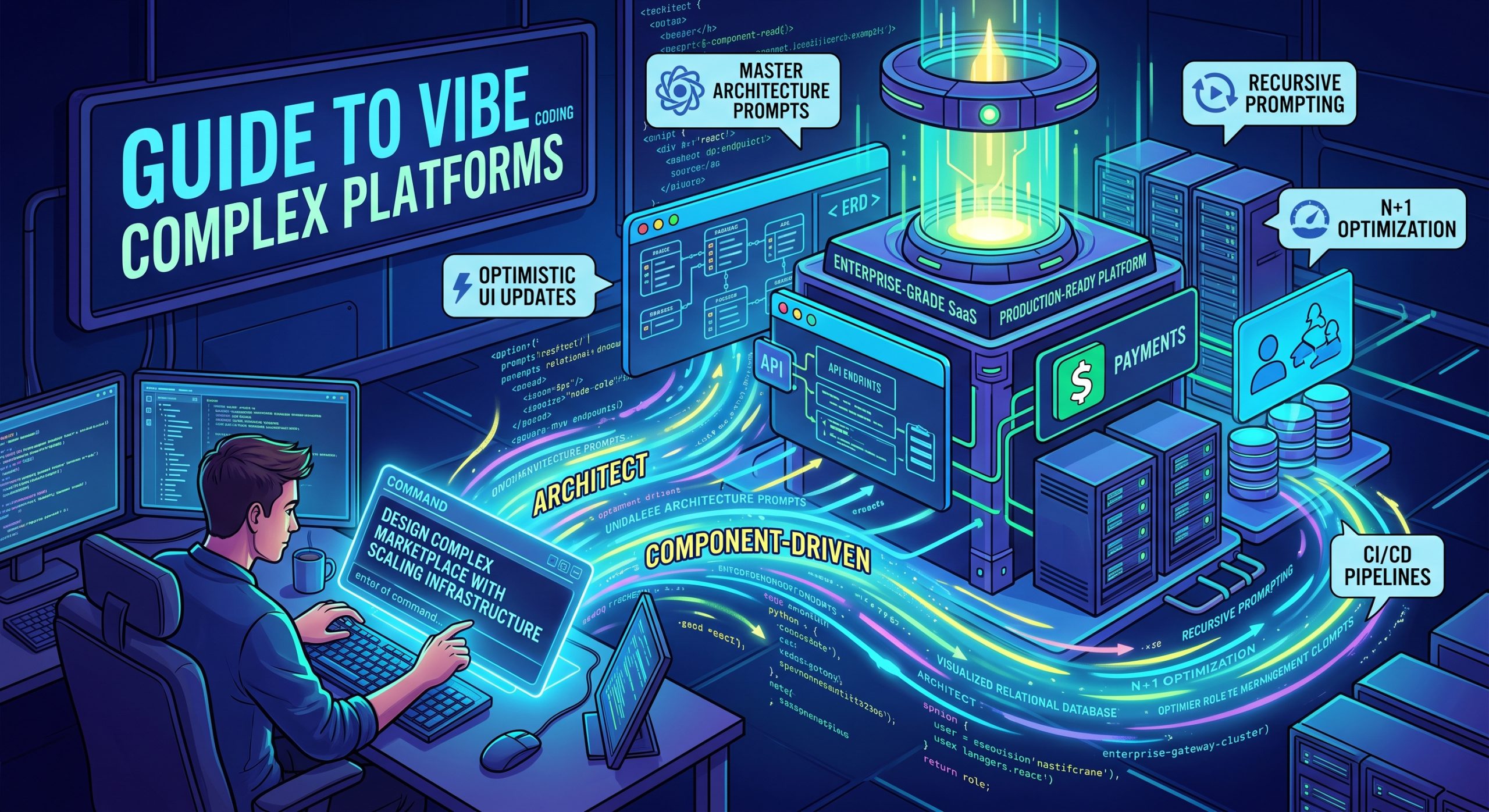
“Vibe coding” has taken the software development world by storm.
But let’s be brutally honest.
Right now, most people are using AI coding agents to build basic calculators. Or simple to-do lists. Or static HTML and CSS landing pages.
Which is cool.
But it’s not going to disrupt an industry.
If you want to build a real, profitable platform? A system that handles complex relational databases, secure authentication, and heavy traffic?
You can’t just type “build me a SaaS” into an AI agent and hope for the best.
You need a proven system.
Today, I’m going to show you exactly how to vibe code complex, production-ready platforms from scratch.
No fluff. No high-level theory.
Just the exact prompt architectures, development workflows, and scaling strategies you need to turn natural language into enterprise-grade software.
Let’s dive right in.
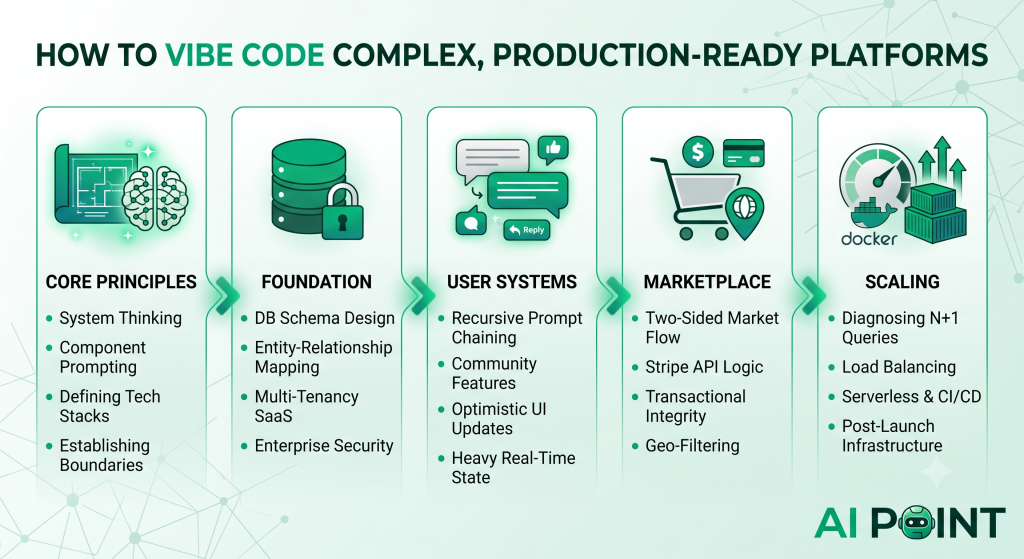
The Core Principles of Production-Level Vibe Coding
When you transition from generating single-page scripts to architecting full-stack platforms, the game completely changes.
You are no longer just writing code.
You are managing a system.
And the biggest bottleneck you are going to face?
The AI’s Context Window.
Here is the truth. Large Language Models (LLMs) and autonomous coding agents are incredibly smart. But they have a limited memory.
If you ask an AI to build a massive Python and Node.js backend while simultaneously styling a React frontend, it’s going to get confused. It will hallucinate dependencies. It will forget the database schema you agreed on an hour ago.
To fix this, you need to master Component-Driven Prompting.
Instead of treating the AI like a magic wand, you need to treat it like a junior developer. You don’t give a junior dev the entire project at once. You break it down into modular, bite-sized tasks.
But before you write a single line of application code, you need a Master Architecture Prompt.
This is the most important step in the entire process.
A Master Architecture Prompt locks in your tech stack, your coding standards, and your project boundaries before the AI starts hallucinating.
Here is exactly what a Master Architecture Prompt should include:
-
The exact tech stack: (e.g., “Use Next.js for the frontend, Node.js for the API, and PostgreSQL for the database.”)
-
Styling rules: (e.g., “Strictly use Tailwind CSS. No custom CSS files.”)
-
State management: (e.g., “Use Redux for global state.”)
-
Error handling: (e.g., “Wrap all async API calls in try/catch blocks and return standardized JSON error messages.”)
When you establish these rules on day one, you prevent the AI from spontaneously deciding to use MongoDB halfway through your SQL project.
Bottom line: Production-level vibe coding requires systems thinking. You are the architect. The AI is the typist.
Architecting the Foundation
Before you ask the AI to generate a beautiful UI or write complex business logic, you need to build the foundation.
And in software development, the foundation is your database.
If your data model is flawed, your entire platform will collapse. And here is the catch with vibe coding: AI struggles massively with huge architectural refactors later on.
If you realize your database schema is wrong three weeks into the build, prompting the AI to fix it across 50 different files is an absolute nightmare.
Your data model must be perfect on day one.
So, how do you do it?
You prompt the AI to generate Entity-Relationship Diagrams (ERDs) and schema migrations before it writes any actual application code.
You want to force the AI to think through the relationships.
For example, your prompt should look like this:
“Before we write any code, map out the database schema for this application. We have four user roles: Admin, Standard User, Vendor, and Moderator. Detail the exact tables, foreign keys, and relationships. Output this as a Mermaid.js diagram so I can visualize it.”
Why does this matter?
Because it forces the AI to acknowledge that a “Vendor” has different database permissions than a “Standard User.”
Once the schema is locked in, you have the AI write the raw SQL migrations or the ORM models (like Prisma or Mongoose).
Only after the database is successfully spun up do you move on to the backend logic.
Now, things get incredibly complicated when you aren’t just building an app for individual users, but for entire organizations.
When your platform requires strict data isolation between different client organizations (like a B2B SaaS), your prompt engineering must reflect enterprise-grade security. A single hallucinated line of code could leak one company’s data to another.
For a deep dive into designing these robust, secure systems, read our definitive guide on Prompting AI for Complex Multi-Tenancy SaaS Architectures.
Get the foundation right, and the rest of the build becomes exponentially easier.
Engineering Social & User-Driven Systems
So your database is rock solid.
Now it’s time to move from static data to dynamic, user-generated content networks.
Building a social platform or a community-driven app is one of the hardest things to vibe code. Why? Because the state of the application is constantly changing.
Users are upvoting, commenting, deleting, and sharing—all in real-time.
To pull this off, you have to master prompting for Complex State Management.
If you just tell an AI, “add a comment section,” it will likely give you a clunky, page-refreshing 1990s-style form.
Instead, you need to prompt for Optimistic UI Updates.
Here is how you frame it:
“When a user clicks the ‘Like’ button, update the UI state immediately to show the heart icon as active, before waiting for the Node.js backend response. If the API call fails, revert the UI state and show a toast notification error.”
This is how you get that snappy, modern, production-ready feel.
But there is another massive hurdle when vibe coding social systems: Deep Nesting.
Think about a platform like Reddit. You have a post. Under that post, you have a comment. Under that comment, a reply. And a reply to that reply.
AI coding agents notoriously struggle with deeply nested recursive data structures. They get confused about where one component ends and another begins.
The secret?
Prompt the AI to build a single, isolated recursive component first. Test it thoroughly in isolation. Once it works perfectly, then prompt the AI to integrate it into the main feed.
Managing threaded state and real-time interactions requires meticulous prompt chaining. You can’t do it in one shot.
To see exactly how to structure the prompts for a heavily nested, community-driven application, check out our step-by-step walkthrough on Building a Reddit Clone: Structuring User-Driven Communities with AI.
When you master recursive prompting, building social networks becomes second nature.
Navigating Two-Sided Marketplaces & Transactions
Let’s take things up a notch.
Social apps are complex, but two-sided marketplaces (think Uber, Airbnb, or dropshipping platforms) introduce extremely high-stakes logic.
We are talking about real money, payment gateways, geographic filtering, and dual-user flows.
When vibe coding a marketplace, the biggest risk is security. You are going to be prompting the AI to integrate with third-party APIs like Stripe (for payments), Mapbox (for routing), or Twilio (for SMS).
Here is a massive mistake beginners make:
They paste their actual API keys into the prompt.
Never do this.
Instead, prompt the AI to build the infrastructure using environment variables.
“Integrate Stripe Checkout for this transaction. Use a placeholder environment variable
process.env.STRIPE_SECRET_KEY. Do not hardcode any keys. Build a secure webhook endpoint in Python to listen for thecheckout.session.completedevent.”
But API integration is just the tip of the iceberg.
Marketplaces require incredibly complex conditional logic.
If you run an e-commerce platform or a delivery app, the rules are constantly shifting.
You need to structure your prompts to handle edge cases explicitly. AI is bad at guessing edge cases unless you point them out.
You need to feed the AI prompts like this:
“Write the logic for the vendor dashboard. Implement the following conditional rules: 1. If the vendor sets their status to ‘offline’, immediately hide their products from the consumer feed. 2. If the consumer’s delivery location is greater than 5 miles from the vendor, disable the ‘Checkout’ button and show an ‘Out of Range’ error.”
Connecting physical locations with digital transactions introduces a whole new layer of complexity to your AI prompts. You are bridging the digital and physical worlds.
We break down the exact geospatial and payment logic flows, prompt by prompt, in our advanced tutorial on Architecting a Hyper-Local Marketplace App to Connect Consumers with Vendors.
Nail the marketplace logic, and you have a platform that can actually generate revenue.
The Day After Launch: Infrastructure & Scaling
Congratulations. You vibe coded a beautiful, functional platform.
You launch it.
It gets featured on a major tech blog. Thousands of users flood the site.
And then… it crashes.
Welcome to the day after launch.
Here is the harsh reality of vibe coding: AI-generated code is often unoptimized for scale by default.
AI models are trained to find the most direct solution to a problem, not necessarily the most performant one.
The number one culprit? The N+1 Query Problem.
If you vibe code a feed that shows 50 users, and each user has 10 posts, a poorly prompted AI might write code that pings your database 501 times just to load a single page.
When you have 10 users, it’s fine. When you have 10,000 users, your database will literally melt down.
You must proactively prompt the AI to audit its own code.
“Review the data fetching logic in the
FeedController. Identify any N+1 query problems. Refactor the code to use SQL JOINs or eager loading to ensure we are hitting the database as few times as possible.”
But optimizing the code is only half the battle. You also need to scale the infrastructure.
You can’t just run a production app on a basic shared server anymore.
You need to guide the AI to set up professional, scalable deployment pipelines.
Prompt the agent to write Dockerfile configurations for your frontend and backend. Have it generate GitHub Actions workflows for CI/CD (Continuous Integration/Continuous Deployment) so that every time you vibe code a new feature, it is automatically tested and deployed.
AI will often write the most direct solution, not the most performant one. When your traffic spikes, those unoptimized queries will take you offline.
Learn how to diagnose database bottlenecks, set up load balancers, and containerize your application in our technical guide on Handling Heavy Traffic: Scaling AI-Built Apps Past the First 10,000 Users.
Scaling isn’t an afterthought. It’s built into the prompts.
Conclusion
Vibe coding a production-ready platform is entirely possible today.
But it requires a total mindset shift.
You can’t treat the AI like a magical black box that just “knows” what you want. You have to treat it like a brilliant, incredibly fast junior developer who desperately needs architectural supervision, clear boundaries, and constant, iterative feedback.
Plan your database first. Master component-driven prompting. Handle your state management with care, and aggressively optimize for scale before the traffic hits.
Ready to put this into practice?
I highly recommend starting with the foundational architecture. Read Prompting AI for Complex Multi-Tenancy SaaS Architectures to get your backend skills up to par.
Or, if you want to get your hands dirty with real-time state and UI, jump straight into the Building a Reddit Clone: Structuring User-Driven Communities with AI build.
The tools are here. The agents are ready.
Now it’s time to build.
