

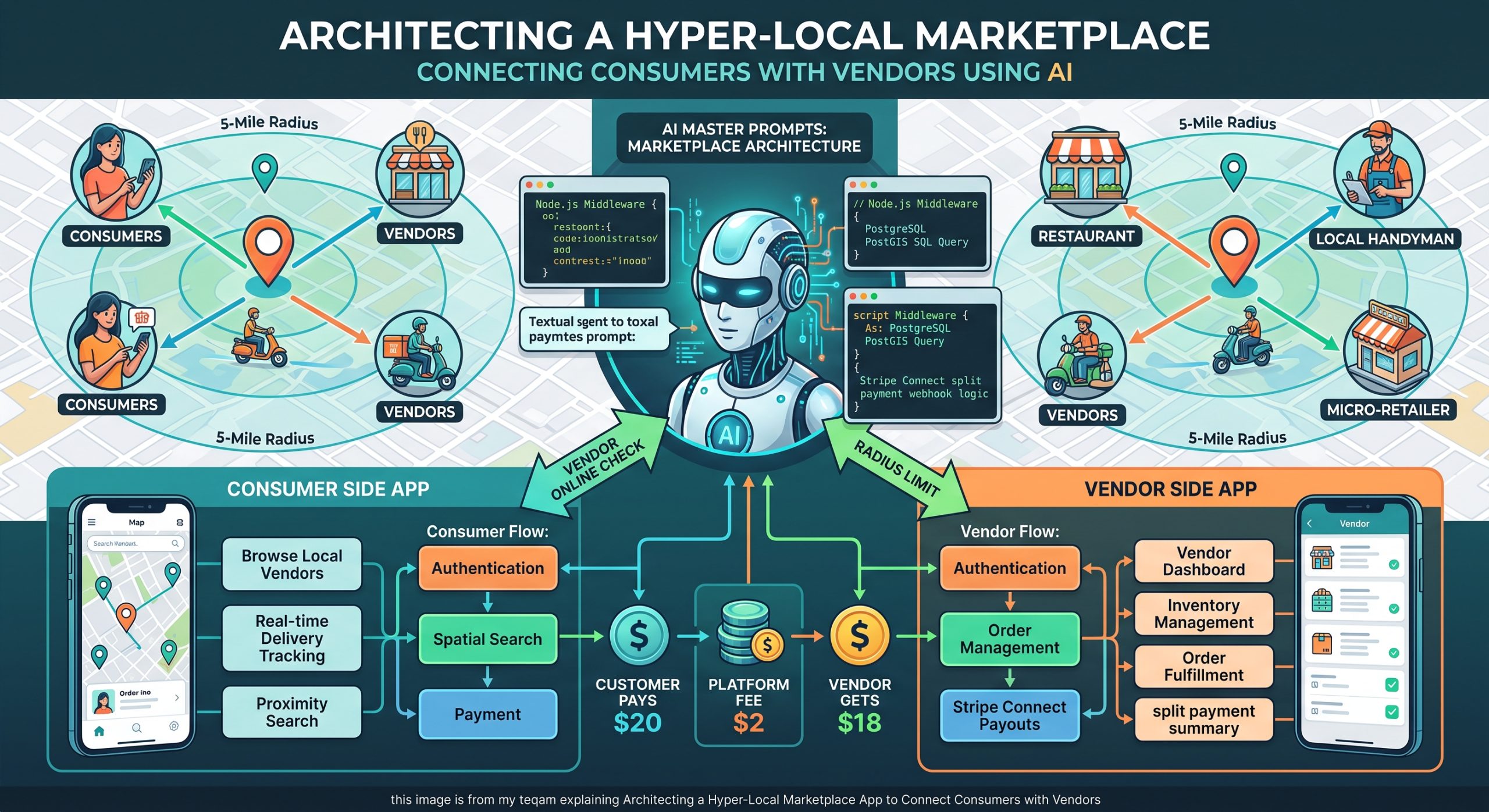
Building a standard e-commerce store with AI is incredibly easy.
You can vibe code a simple storefront in an afternoon.
But building a hyper-local, two-sided marketplace? Like Uber, DoorDash, or TaskRabbit?
That is a completely different beast.
You aren’t just listing products on a page. You are bridging the digital and physical worlds. You have geospatial data, dual dashboards, complex payment routing, and real-time inventory that shifts based on user location.
If you just tell an AI, “build a local delivery app,” it will crash and burn.
Today, I’m going to show you exactly how to structure your prompts to architect a hyper-local marketplace that actually works.
Let’s dive in.
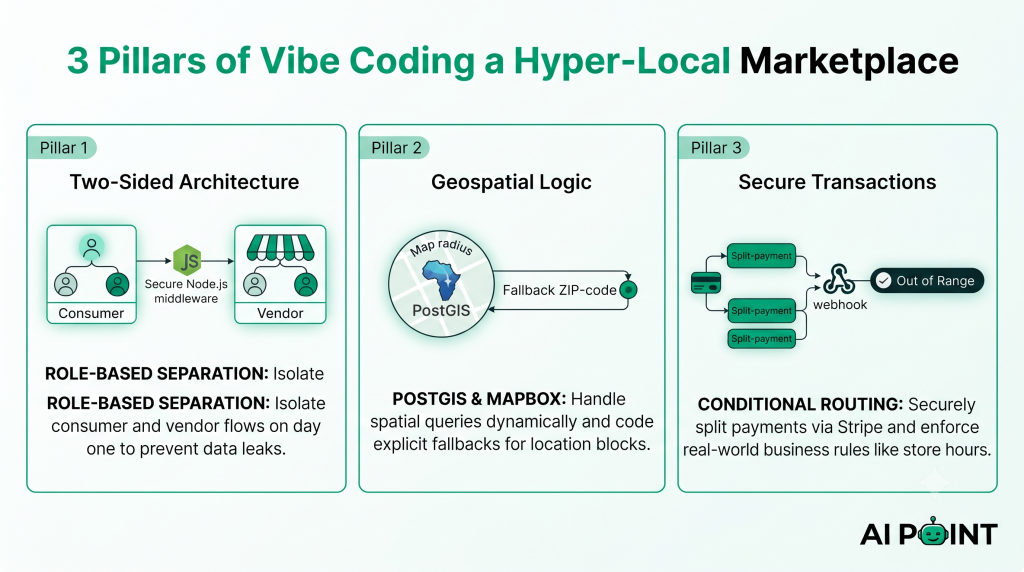
Setting Up the Two-Sided Architecture
Here is the biggest mistake developers make when vibe coding a marketplace.
They treat it like a single application.
It isn’t. A marketplace is actually two completely separate apps sharing one database. You have the Consumer side (browsing, buying, tracking) and the Vendor side (managing inventory, accepting orders, checking payouts).
If you let the AI mix these up, your application logic will turn into a massive plate of spaghetti code.
Because a marketplace handles two completely different user flows simultaneously, architecting a production-ready platform requires a master prompt that strictly separates vendor logic from consumer logic.
You must establish role-based architecture on day one.
Here is the exact prompt you should use to set the rules:
“We are building a two-sided marketplace. Before writing the UI, design the authentication flows and dashboards. We need a strict separation between a ‘Consumer’ role and a ‘Vendor’ role. Write the middleware logic in Node.js to ensure a Consumer can never access the
/vendor/dashboardroutes. Output the routing structure first.”
By forcing the AI to think in terms of distinct roles, you prevent data leaks.
The AI now understands that a database query for “active orders” looks entirely different for a vendor than it does for a consumer.
Get this separation right, and everything else falls into place.
Mastering Geospatial Logic & APIs
So your dual architecture is locked in.
Now, you have to tackle the hardest part of a hyper-local app: Location data.
Connecting consumers with vendors based on physical proximity requires integrating third-party mapping APIs like Mapbox or Google Maps.
But here is the catch.
AI coding agents are notorious for hallucinating geospatial coordinates. If you aren’t careful, your AI will hardcode a fake GPS location in the middle of the ocean.
You have to prompt the AI to handle spatial queries dynamically.
If you are using PostgreSQL, you should instruct the AI to use PostGIS (the spatial database extender).
Use a prompt like this:
“Integrate the Mapbox API to handle location data. Do not hardcode any coordinates. Set up a PostgreSQL database query using PostGIS to find all ‘Vendors’ within a 5-mile radius of the ‘Consumer’s’ current longitude and latitude. Output the SQL query and the Node.js controller function.”
Boom.
Now your AI is writing mathematically accurate geographic queries.
But you can’t stop there. You have to account for edge cases.
What happens if a consumer denies browser location permissions? The AI won’t build a fallback unless you explicitly tell it to.
“If the consumer blocks location services, the API query will fail. Write the error-handling logic for the frontend React component. If location is disabled, automatically prompt the user to manually enter their ZIP code, and pass that ZIP code to the Mapbox Geocoding API to retrieve the coordinates.”
This is how you vibe code a production-ready experience. You don’t just build the happy path. You prompt for the edge cases.
Secure Transactions and Conditional Routing
Location is handled. Now, it’s time to handle the money.
Marketplaces don’t just take payments. They split them. When a consumer buys a $20 meal, your app might keep a $2 platform fee and route $18 to the vendor.
To do this, you need to integrate a service like Stripe Connect.
But this introduces a massive security risk when vibe coding. Never paste your actual Stripe API keys into an AI chat.
Instead, firmly instruct the AI to use environment variables.
“We are integrating Stripe Connect for split payments. Use
process.env.STRIPE_SECRET_KEY. Do not output real API keys. Write a Python webhook endpoint to listen for thecheckout.session.completedevent, and then trigger the logic to transfer 90% of the funds to the connected vendor’s Stripe account.”
Once the payment infrastructure is secure, you need to handle complex conditional routing.
In a local marketplace, availability changes by the minute. If a vendor closes their shop, a consumer shouldn’t be able to buy from them.
AI won’t guess these business rules. You must dictate them.
“Write the frontend conditional logic for the Vendor profile page. 1. If the vendor sets
is_onlineto false in the database, disable the ‘Order Now’ button and display a ‘Currently Closed’ badge. 2. If the consumer’s delivery address is outside the vendor’s maximum delivery radius, gray out the cart and show an ‘Out of Range’ warning.”
By explicitly detailing these conditional rules, you guarantee that your digital marketplace perfectly mirrors physical reality.
Conclusion
Building a hyper-local marketplace is complex.
You are dealing with real-world maps, live inventory, split payments, and dual user experiences.
But by structuring your AI prompts correctly, you can cut development time down from months to weeks.
Remember: strictly separate your consumer and vendor logic from day one. Force the AI to use proper spatial queries like PostGIS. Always handle location edge cases. And explicitly prompt your complex transactional rules.
When you stop treating the AI like a magic wand and start treating it like a junior engineer that needs exact specifications, your marketplace will become unstoppable.
Make sure you test your payment webhooks thoroughly, and get ready to launch.
