


Let’s be honest.
Unstructured text from an AI is virtually useless in modern software engineering.
If you are building production applications, you don’t need the model to write a polite essay.
You need clean, predictable, structured data.
You need JSON objects that your backend can instantly parse, validate, and store in your database without breaking your production pipeline.
Here is the problem:
Getting an LLM to reliably return valid JSON without draining your API credits is surprisingly difficult.
Most developers make a critical mistake. They try to coerce the AI into returning JSON using brute-force system prompts.
The result?
Spiking token costs, constant runtime syntax errors, and broken application workflows.
In this guide, I will show you how to master structured outputs.
We will break down the real cost of JSON formatting, compare prompt coercion against native tool calling, and build a type-safe parser in Node.js that never crashes.
Let’s get right into it.
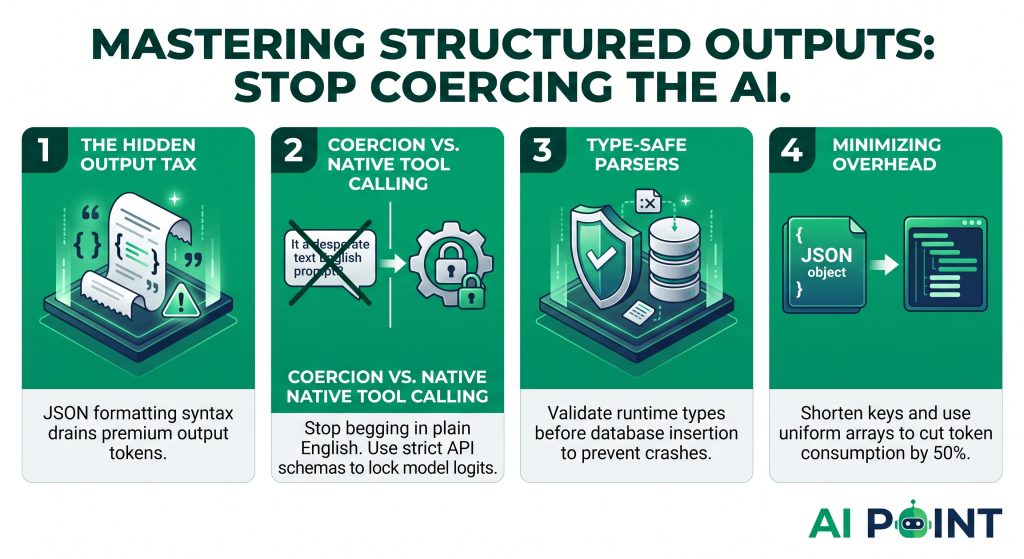
The Hidden Output Token Tax
When developers try to optimize their API bills, they almost always focus on reducing input tokens.
They minify system prompts. They trim conversation history. They implement lean RAG architectures.
That is great practice.
However, they completely ignore the most expensive half of the equation: output tokens.
Output tokens are typically 3x to 5x more expensive than input tokens across all major providers.
And standard JSON formatting is a massive output token drain.
Every opening bracket {.
Every closing bracket }.
Every quotation mark ".
Every single whitespace indent and newline.
All of them are counted and billed as premium output tokens.
If you ask a model to return an array of 50 items with 10 descriptive keys each, the model often spends more tokens generating the JSON schema syntax than it does generating the actual data you care about.
This compounding formatting cost is one of the primary drivers of hidden output token usage.
If you are not careful with how you structure your schemas, formatting syntax alone can easily double your monthly API bill.
Coercion vs. Native Tool Calling
So, how do most developers request JSON?
They use prompt coercion.
They add a desperate instruction to their system prompt that looks something like this:
“Respond ONLY with a valid JSON object. Do not include markdown code fences, backticks, or explanatory text. Follow this exact schema: {…}”
This approach is an architectural disaster waiting to happen.
Here is why:
-
Wasted Input Tokens: You are forced to describe the entire schema in natural English inside your prompt.
-
Wasted Output Tokens: Language models frequently ignore negative constraints and prepend polite conversational text (e.g., “Sure, here is the JSON you requested:”).
-
High Failure Rates: If the model drops a single comma or hallucinates a trailing bracket, standard parsing functions like
JSON.parse()will throw a fatal syntax error and crash your user’s request.
The modern engineering solution is Native Structured Outputs and Tool Calling.
Instead of begging the model to behave in plain English, you supply a strict JSON Schema directly to the API endpoint configuration (such as OpenAI’s Structured Outputs or Gemini’s responseSchema).
Under the hood, the API provider constrains the model’s token decoding logits.
The model is mathematically prevented from generating any token that violates your schema.
No preamble. No backticks. No syntax errors. You get 100% schema reliability with zero wasted tokens.
Building Type-Safe Parsers in Production
Once the model returns a structured payload, you still need a robust way to validate the data in your backend.
Even when using native structured output features, you should never blindly trust raw LLM data before inserting it into your database.
The industry standard for runtime type validation in TypeScript and Node.js is Zod.
Here is a clean, production-ready pattern for validating structured data from language models:
TypeScript
import { z } from "zod";

// 1. Define your strict schema with Zod
const UserSummarySchema = z.object({
  userId: z.string(),
  sentiment: z.enum(["positive", "neutral", "negative"]),
  keyInsights: z.array(z.string()).max(3),
  churnRiskScore: z.number().min(0).max(100),
});

type UserSummary = z.infer<typeof UserSummarySchema>;

// 2. Parse and validate the incoming LLM output safely
export function parseLLMOutput(rawJsonString: string): UserSummary | null {
  try {
    // Strip accidental markdown fences if using legacy fallback endpoints
    const cleaned = rawJsonString.replace(/```json|```/g, "").trim();
    const parsed = JSON.parse(cleaned);

    // Validate structure and types at runtime
    const validatedData = UserSummarySchema.parse(parsed);
    return validatedData;
  } catch (error) {
    console.error("Schema validation failed:", error);
    // Implement fallback handling, alerts, or retry logic here
    return null;
  }
}
By combining native structured outputs at the API level with runtime validation via Zod, your data pipeline becomes completely resilient against unexpected model variations.
Strategies to Minimize JSON Token Overhead
If you want to push your token optimization even further, here are three high-impact tactics you can deploy immediately:
1. Shorten Key Names
Instead of naming a key user_billing_subscription_status, name it status or sub_stat. When you extract data across hundreds of records in an array, shorter key names save thousands of output tokens per batch.
2. Use Arrays for Uniform Data
If you are extracting tabular or list-based data, do not return an array of objects where the schema keys are repeated on every single row. Return a nested array with a single header index.
Bloated Object Syntax:
JSON
[
  {"name": "Alice", "role": "admin"},
  {"name": "Bob", "role": "editor"}
]
Optimized Array Syntax:
JSON
[["Alice", "admin"], ["Bob", "editor"]]
This simple schema adjustment cuts your output token count by up to 50% on massive datasets.
3. Enforce Compact Payloads
Ensure your API configurations and system parameters disable pretty-printing whitespace on generated outputs. Removing unnecessary newlines and tabs from the response translates directly into server budget savings.
Final Thoughts
Structured data is the foundation of programmatic AI.
Stop relying on brittle prompt coercion and hoping the AI outputs valid syntax.
Switch to native structured output parameters, validate payloads with type-safe schemas like Zod, and streamline your JSON key architecture.
You will eliminate runtime errors, increase execution speed, and keep your API budget protected.
