

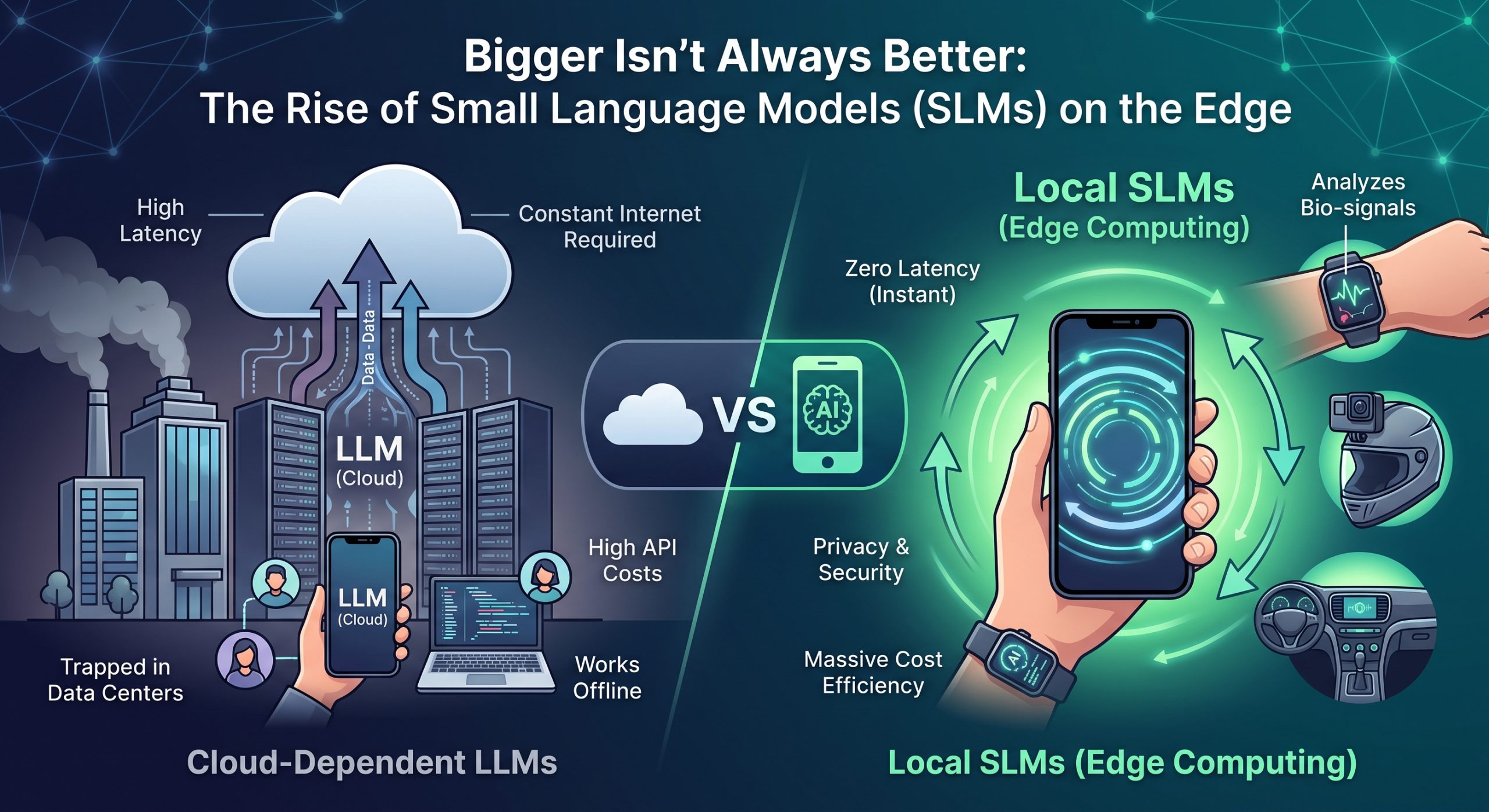
Bigger isn’t always better.
While massive models like GPT-4 dominate the headlines, a silent revolution is happening right under our noses.
Actually, it’s happening right in our pockets.
Enter: Edge Computing.
Instead of sending every single piece of data to a distant cloud server, edge computing processes information locally. Right on the device.
But deploying AI to the edge requires a completely different class of models. You can’t fit a massive LLM on a smartphone. You need Small Language Models (SLMs).
Understanding where to deploy these lightweight models is a critical architectural decision in 2026. For a broader look at how these infrastructure choices fit together, read our ultimate guide to AI-assisted software development.
Ready to see how SLMs are changing the game?
Let’s dive in.

The Core Difference: Cloud-Dependent LLMs vs. Local SLMs
So, what is the actual difference between a massive LLM and a lean SLM?
It all comes down to physics and location.
Large Language Models (LLMs) are incredibly smart. But they are physically trapped inside massive, million-dollar data centres.
Because they boast hundreds of billions of parameters, they require constant internet access, massive bandwidth, and expensive API calls just to function. If your Wi-Fi drops, your app dies.
Now, if you are just getting started, leveraging cloud-based APIs is still the fastest route to market—a strategy we covered deeply in our guide on building and launching MVPs using AI code assistants.
But once you need real local execution, SLMs become the absolute go-to solution.
Small Language Models (SLMs) like Phi-3, Llama 3 (8B), or Mistral flip the script entirely.
They are highly optimised. They are aggressively quantized. And most importantly? They are small.
We are talking under 5GB in most cases.
This means you can run them directly on a smartphone, a standard laptop, or a smart home device. No cloud required. No lag. Just pure, local compute power right in the palm of your hand.
Why Edge Computing Needs Small Language Models
Why are top developers suddenly obsessed with running SLMs on the edge?
It boils down to four massive, game-changing advantages.
1. Zero Latency
When you use a cloud-based AI, you are always waiting. You send a request to a remote server, wait for the processing to finish, and wait for the answer to bounce back. With an SLM running on the edge, the responses are instantaneous. There is zero lag because the data never travels.
2. Total Offline Functionality
Imagine your application working flawlessly on a commercial flight. Or out in the remote wilderness. Or inside a secure concrete bunker. SLMs don’t need a cell tower to function. Because the model lives directly on the hardware, your software works perfectly in completely air-gapped, offline environments.
3. Bulletproof Privacy and Data Security
Data breaches are a founder’s worst nightmare. But with edge computing, sensitive user data never actually leaves the physical device. You can easily bypass complex compliance hurdles like HIPAA or GDPR. Why? Because you aren’t broadcasting personal health information or private messages to a third-party server.
4. Massive Cost Efficiency
Cloud APIs will slowly drain your wallet. Every single token generated costs you money. But with an SLM? There are absolutely zero recurring API fees. You are using the user’s local hardware—their phone or laptop—to process the compute. Your server overhead practically drops to zero.
Real-World Use Cases for SLMs on the Edge
Let’s look at what this actually looks like in the real world.
We aren’t talking about boring text summarisation. We are talking about next-level hardware integration.
High-Adrenaline POV Cameras
Think about wearable action cameras recording high-intensity rescue footage or extreme sports. An on-device SLM can analyse that live video feed in real-time. It can auto-frame the action, stabilise erratic movement, and instantly tag the best adrenaline spikes for social media edits. And it does all of this without needing a 5G connection on the side of a mountain.
Healthcare Wearables
Smartwatches are getting insanely smart. With SLMs, these devices can analyse your bio-signals—like heart rate variability or blood oxygen—instantly. The best part? It detects anomalies immediately without broadcasting your private medical data to a server in another country.
Automotive Tech
Ever tried talking to your car’s voice assistant while driving through a cellular dead zone? It fails. But with an SLM built into the dashboard, your in-car assistant can control vehicle functions, adjust navigation, and process complex voice commands instantly, no matter where you are driving.
The Trade-Offs: When NOT to use an SLM
Time for a quick reality check.
Small Language Models are incredible pieces of technology. But let’s be clear: they are not AGI.
Because of their dramatically reduced parameter count, they simply lack the deep, nuanced worldly knowledge found in frontier models like GPT-4. They do not have the same complex reasoning capabilities, and they will struggle with highly abstract problems.
So, how do you actually decide which route to take?
I use this simple rule of thumb:
If your software requires deep analytical reasoning, complex multi-file code generation, or highly creative writing, stay in the cloud. You absolutely need the heavy hitters.
But if your application requires fast, localised classification, quick text summarisation, or simple data routing? Move it to the edge.
Always pick the right tool for the exact job you are doing.
Conclusion
Here is the bottom line.
The future of AI isn’t just massive, expensive cloud brains sitting in data centres.
It is millions of lightweight, highly specialised models running silently on the everyday devices in our pockets. Edge computing is the next frontier of software development.
So here is your actionable takeaway for today:
Don’t just take my word for it. Download a local runtime environment like LM Studio or Ollama. Load up a small model like Phi-3 directly on your own laptop.
Turn off your Wi-Fi, type a prompt, and feel the blistering speed of local execution for yourself.
