

Here is a costly mistake I see developers make every single day.
They pick one flagship model and use it for absolutely everything.
They use it to write complex application code.
They use it to analyze massive datasets.
And they use it to format basic JSON strings.
This is a massive architectural flaw.
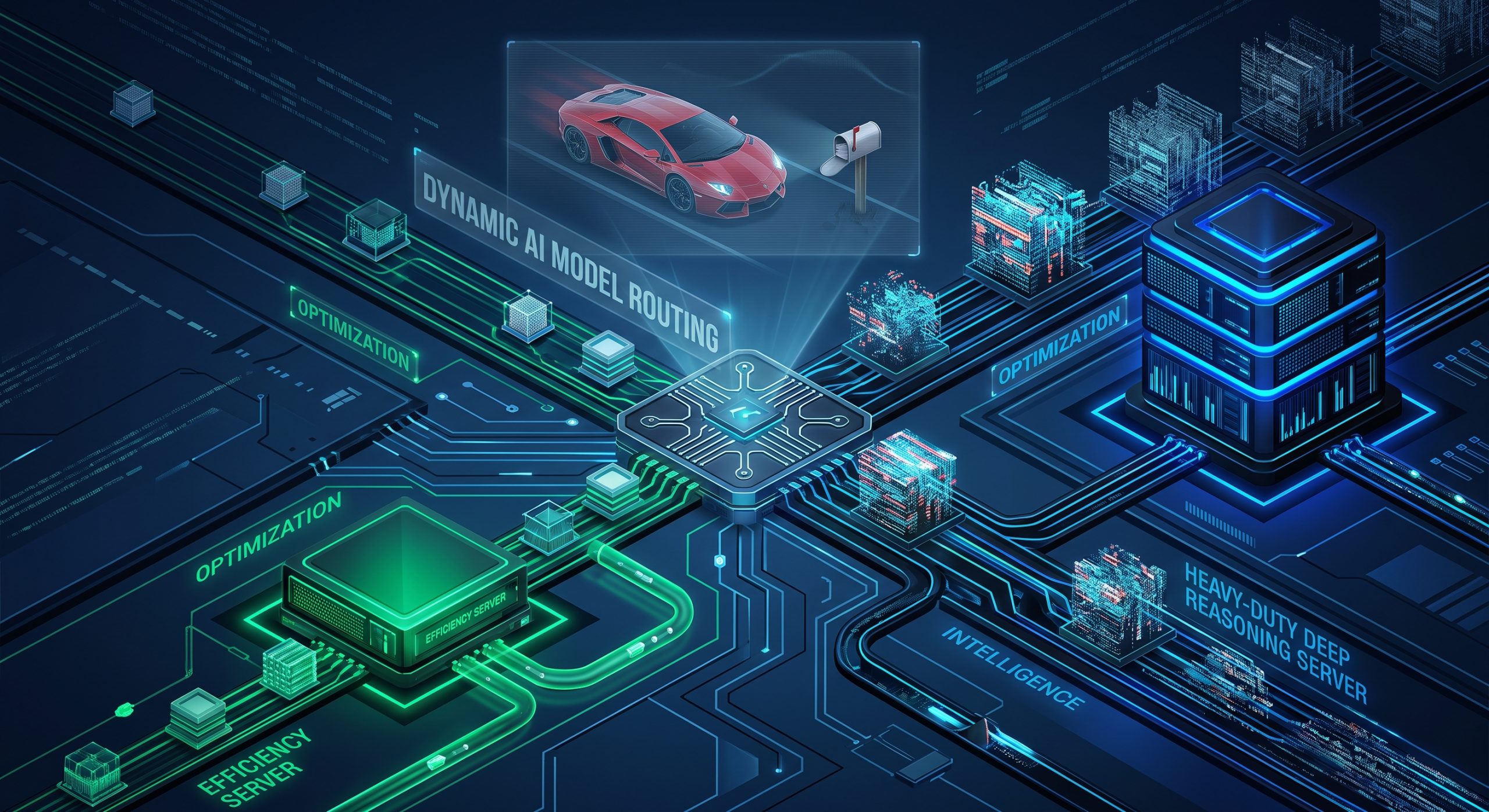
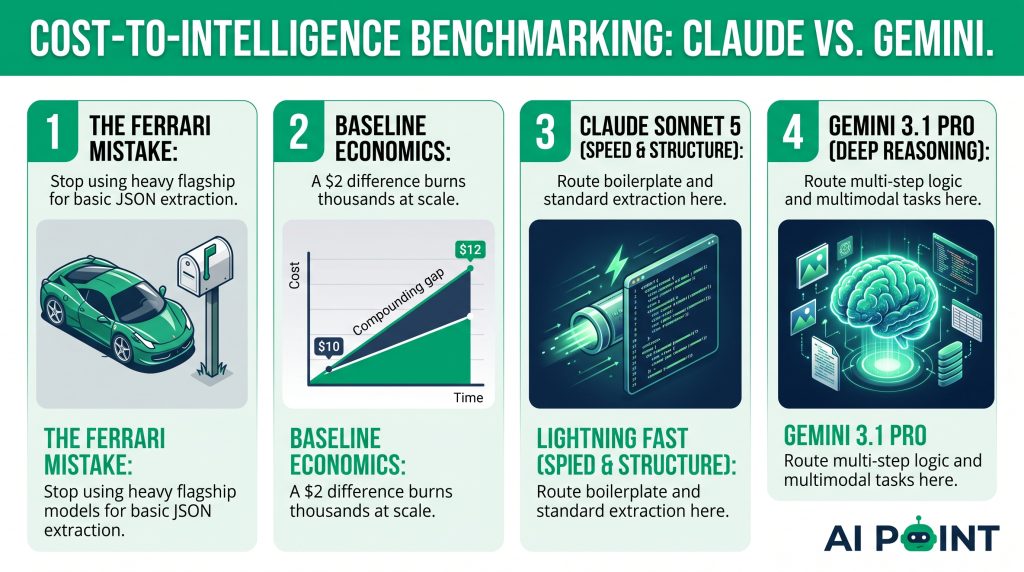
It’s like using a Ferrari to drive down your driveway just to check your mailbox.
Sure, it works. But the gas bill is going to completely destroy you.
The secret to scaling an AI application without going bankrupt is cost-to-intelligence benchmarking.
You need to stop treating your language models like a one-size-fits-all magic bullet. Instead, you must route tasks dynamically based on exactly what the user is asking.
Today, I am going to show you how to pit the two biggest heavyweights against each other: Claude Sonnet 5 and Gemini 3.1 Pro.
We are going to break down their credit consumption, analyze where each model actually shines, and build a dynamic model router that slashes your monthly bill.
Let’s get right into it.
Baseline Economics Breakdown
Before we write a single line of code, we need to look at the hard numbers.
The AI pricing landscape changes incredibly fast. But right now, we have a clear duopoly when it comes to the “sweet spot” of high performance and reasonable enterprise pricing.
Let’s look at the baseline economics of our two contenders.
First up: Claude Sonnet 5.
Anthropic has aggressively priced Sonnet 5 to dominate the developer market.
Currently, Claude Sonnet 5 charges $2.00 per million input tokens.
For output tokens, you are looking at $10.00 per million tokens.
Now, let’s look at Google’s flagship model: Gemini 3.1 Pro.
Google has positioned Gemini 3.1 Pro to compete directly in that exact same enterprise bracket.
Gemini 3.1 Pro charges the exact same $2.00 per million input tokens.
However, for output tokens, the price jumps to $12.00 per million tokens.
On the surface, a $2.00 difference in output tokens might not sound like a huge deal.
You might be thinking, “Who cares? I’ll just use whichever one I like better.”
But when you are scaling an application to thousands of active users, that $2.00 difference compounds rapidly.
If your app generates 50 million output tokens a day (which is incredibly easy to hit if you are generating long-form content or heavy data analysis), that price gap means you are burning an extra $100 every single day.
That’s $3,000 a month in completely unnecessary server costs, just because you didn’t check the pricing tier.
You need to be absolutely ruthless about where you spend your output tokens.
Performance vs. Price
So, if Claude Sonnet 5 is technically cheaper on output, should you just route everything to Anthropic?
Absolutely not.
Because price is only half of the equation. The other half is performance.
If a cheaper model hallucinates, fails to follow your system instructions, or returns broken data, you have to run the prompt a second time.
And the second you run a prompt twice, any cost savings you had are completely wiped out.
Here is exactly where each model shines, and where you should deploy them in your codebase.
Where Claude Sonnet 5 Wins
Claude Sonnet 5 is a speed and reliability monster.
When it comes to standard coding tasks, generating boilerplate, writing standard copy, or executing strict JSON formatting, Sonnet 5 is almost impossible to beat.
It follows formatting constraints brilliantly.
Because it excels at structured data and costs 16% less on output tokens, Sonnet 5 should be your default workhorse.
If a user wants to summarize a short text or extract entities into a clean JSON object, route it to Claude. You get elite speed and keep your margins intact.
Where Gemini 3.1 Pro Wins
Gemini 3.1 Pro is a deep reasoning powerhouse.
While you pay a slight premium on output tokens, Gemini handles complex, multi-step logic puzzles significantly better than Sonnet.
If your user asks the AI to analyze a massive, messy dataset, cross-reference multiple documents, or perform deep mathematical reasoning, Gemini is your guy.
Furthermore, Gemini 3.1 Pro is natively multimodal.
If your workflow involves feeding the AI images, video frames, or audio files, Gemini’s architecture processes these inputs with far greater native understanding.
The takeaway?
You don’t choose between them. You use them both.
Building a Dynamic Model Router
This brings us to the core engineering solution.
To get the best of both worlds, you need to build a Dynamic Model Router.
A router is a lightweight function in your backend that reads the user’s incoming prompt, evaluates how complex the task is, and dynamically assigns it to the most cost-efficient model.
This is the ultimate secret weapon for optimizing overall LLM API costs.
Instead of hardcoding a single provider into your frontend, you build an abstraction layer.
Here is exactly how you can structure a basic dynamic router in a Next.js API route using Node.js:
JavaScript
export async function POST(req) {
  const { userPrompt, taskType, requiresDeepLogic } = await req.json();

  // 1. Evaluate Task Complexity
  // If the task is simple data extraction or standard coding, use the cheaper model.
  if (taskType === 'json_extraction' || !requiresDeepLogic) {
    console.log("Routing to Claude Sonnet 5 for cost-efficient output...");

    // Call your Anthropic wrapper function
    const response = await callAnthropicAPI(userPrompt, "claude-sonnet-5");

    return new Response(JSON.stringify(response));
  }

  // 2. Route Complex Tasks to the Heavy Hitter
  // If the task involves deep reasoning or multimodal inputs, pay the premium.
  if (requiresDeepLogic || taskType === 'complex_analysis') {
    console.log("Routing to Gemini 3.1 Pro for deep reasoning...");

    // Call your Google wrapper function
    const response = await callGoogleAPI(userPrompt, "gemini-3.1-pro");

    return new Response(JSON.stringify(response));
  }
}
Notice what is happening here?
Your frontend client doesn’t care which AI actually generates the response. It just wants the formatted data.
Your backend is acting like a highly intelligent traffic cop.
By tagging incoming requests with metadata (like taskType or requiresDeepLogic), your application automatically pushes high-volume, low-complexity tasks to the cheaper output model.
But when a power user requests a deep data analysis, the router seamlessly flips the switch.
It leverages Gemini 3.1 Pro to ensure the answer is perfectly reasoned, happily paying the extra two dollars per million tokens because the task actually demands it.
Final Thoughts
Building a dynamic router might take you an extra afternoon of development time.
But that single afternoon will save you thousands of dollars in API credits over the lifespan of your application.
Stop relying on vendor loyalty.
The AI landscape is moving far too fast for you to lock yourself into a single provider.
Today, Claude Sonnet 5 and Gemini 3.1 Pro are the heavyweights. Next month, there might be a new model that completely undercuts them both on price.
By building an abstraction layer and dynamically routing your prompts based on task complexity, you future-proof your application.
You insulate yourself from pricing hikes.
And you guarantee that your users always get the smartest possible answer at the absolute lowest possible cost.
