


Here is the brutal truth about the future of SEO.
Typing queries into a search box is dying.
For the last twenty years, we’ve optimized our websites for screens. We built ten-blue-link strategies. We tracked click-through rates. We obsessed over above-the-fold real estate.
That era is officially over.
Today, the most important search engine isn’t a webpage. It’s a voice in your user’s ear.
Search is evolving from lexical keyword matching to generative semantic retrieval. And the ultimate battleground is now completely screenless.
Welcome to the era of Voice-First Generative Engine Optimization (Voice GEO).
Voice GEO is the practice of structuring your digital ecosystem so that Large Language Models (LLMs)—like Gemini, ChatGPT, and Apple Intelligence—cite your brand as the single, definitive answer to a spoken query.
If you aren’t optimizing for the machine’s voice, you are optimizing for a ghost town.
In this master guide, I’m going to show you exactly how this shift is breaking traditional SEO, and the exact step-by-step frameworks you need to make your content the “One True Answer.”
Let’s get into it.
Why Voice GEO is the New SEO Frontier
Look at how you search today.
When you want a quick answer, do you open a new tab, type a query, scroll past four sponsored ads, and click a link?
Probably not.
You just ask your phone. You ask your smart speaker. You ask the AI assistant running in the background of your OS.
This behavior shift has fundamentally broken the old mechanics of search.
The Zero-Click Reality
Traditional SEO has one goal: Rank a page high enough in the SERPs to earn a click.
Voice GEO has a completely different goal: Make your brand the actual AI-generated answer.
Why? Because voice search is a winner-take-all game.
“In voice search, there is no Page 2. There isn’t even a Position 2. If you aren’t the primary source, you get zero traffic and zero brand awareness.”
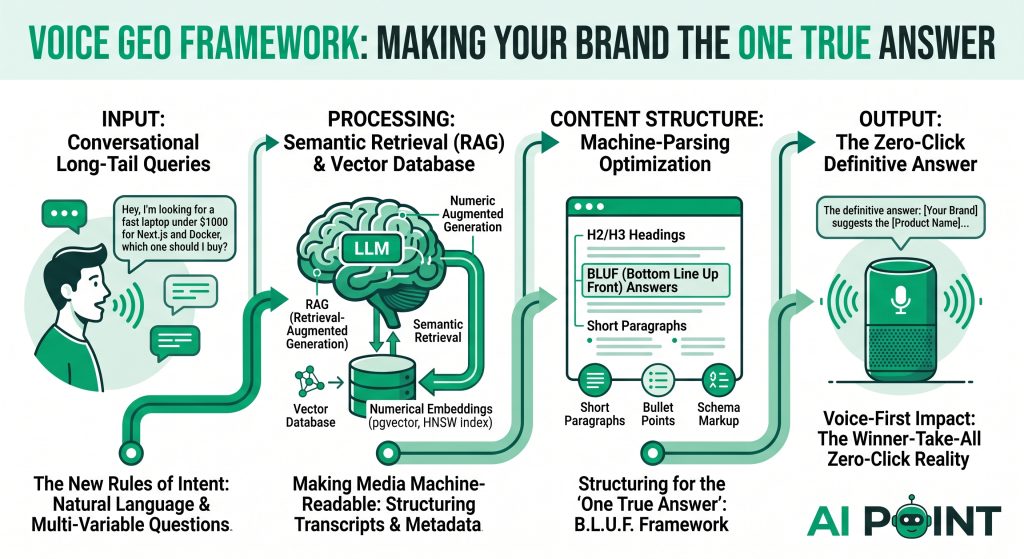
When a user speaks to an AI assistant, they only get a single response. The LLM synthesizes the best data it can find, reads it aloud, and the interaction ends.
This is the new Zero-Click reality.
If your website isn’t structured to feed that specific LLM, your competitor gets the citation. You get nothing.
RAG and Semantic Retrieval
To win at Voice GEO, you have to understand how these AI models actually fetch their answers.
They don’t read websites like humans do. They use Retrieval-Augmented Generation (RAG).
When a user asks a voice assistant a question, the AI doesn’t just guess. It actively retrieves live web data to ground its answer in facts.
But how does it find those facts so fast?
By converting your content into numerical embeddings.
[Image Placeholder: A technical diagram showing a voice query being processed by an LLM, pulling numerical embeddings from a pgvector database with HNSW indexing to generate a spoken answer. Ensure the design strictly utilizes a #00A86B primary green color theme and prominently features the AI POINT logo (where the 'O' is replaced with a robotic AI bot head) in the top right corner.]Modern search systems take your paragraphs, chunk them down, and store them in vector databases. When you optimize for Voice GEO, you are literally formatting your text so that it can be cleanly sliced, indexed in a vector space, and instantly retrieved when a user’s spoken intent matches your content’s mathematical vector.
If your content is a massive wall of unstructured text, the RAG system skips it.
The New Rules of Long-Tail Intent
Let’s talk about keywords.
In the old days, keyword research was pretty straightforward. You found a term with high search volume and low competition, like “best laptop programming.”
Then, you stuffed that exact phrase into your URL, your H1, and your meta description.
That strategy doesn’t work for voice search.
From Keywords to Conversations
When humans talk to machines, they don’t use caveman speak. They use natural, highly complex language.
They don’t say: “best laptop programming.”
They say: “Hey, I’m starting a computer science degree next month and I need a laptop under a thousand dollars that won’t lag when I’m running Next.js and Docker. What should I get?”
This is a massive paradigm shift.
Search queries have gone from two-word fragments to multi-variable, highly contextual paragraphs.
Users are now having continuous, multi-turn conversations with AI. Because of this, search intent is deeper and far more complex than it has ever been.
You can no longer target a single keyword. You have to target the entire semantic entity and all the conversational branches that stem from it.
To learn exactly how to capture these complex, multi-step queries and dominate the new conversational SERPs, read our masterclass on How Conversational AI is Changing Long-Tail Search Intent.
Structuring Content for the “One True Answer”
So, how do you actually feed these LLMs?
How do you guarantee that when Gemini or ChatGPT searches its vector database, your content is the piece it decides to read out loud?
It all comes down to rigid, machine-friendly formatting.
Scannability as a Ranking Factor
AI bots are smart, but they are incredibly lazy readers.
If your website is full of massive, 500-word blocks of text, the AI crawler will bounce. It takes too much computational power to parse the context out of a giant wall of words.
AI crawlers prioritize highly structured data.
In fact, restructuring your content to be highly scannable can increase your visibility in AI-generated responses by 30-40%.
Here is exactly how to format your text for maximum AI extraction:
-
Use incredibly short paragraphs: One to two sentences, maximum.
-
Leverage bullet points: AI models love extracting lists.
-
Use bolding for entities: Highlight core technical terms, brand names, and locations so the NLP parser immediately recognizes their importance.
-
Implement rigid heading hierarchies: Never skip from an H2 directly to an H4.
Leading with the Answer
This is the most important Voice GEO tactic you will learn today.
It’s called the B.L.U.F. framework (Bottom Line Up Front).
When you are writing an H2 or an H3 that targets a specific user question, you must place a concise, 40-50 word answer directly beneath that heading.
Do not start with a winding introduction. Do not tell a story.
Give the machine the exact factual string it needs to answer the user’s voice query.
Example of what NOT to do:
H3: What is Next.js?
“Well, back in the early days of web development, building React applications was a bit of a headache…”
Example of what TO do:
H3: What is Next.js?
“Next.js is a React framework that enables server-side rendering and static site generation for web applications. It allows developers to build fast, SEO-friendly websites by pre-rendering pages on the server rather than the client.”
Boom.
You just handed the LLM a perfect, isolated chunk of text that it can easily store in its vector database and read aloud to a user.
The highest-converting Voice GEO traffic happens right at the bottom of the funnel—specifically on your product and landing pages. If you want your brand recommended by voice assistants when users are ready to buy, follow our exact blueprint for Structuring Landing Page FAQs for Voice Assistant Retrieval.
Making Multimedia Machine-Readable
We have covered text. But text is only one piece of the digital marketing pie.
What happens to your YouTube videos? Your podcasts? Your webinars?
The Blind Spot of AI Bots
Here is a massive vulnerability in modern search:
Despite their incredible intelligence, AI systems still struggle to natively “watch” or “listen” to media.
An LLM cannot easily watch your 45-minute YouTube video on software architecture, understand the visual nuances of the diagrams, and instantly extract a specific voice-search answer from the 12-minute mark.
It takes too much processing power.
Instead, AI relies heavily on the text metadata surrounding your media. It reads the HTML. It parses the JSON-LD schema markup. And most importantly, it reads the transcripts.
If you want LLMs to pull facts from your video content to answer voice queries, your text metadata must be completely flawless.
You cannot rely on auto-generated captions. They are full of errors, lack punctuation, and destroy the semantic meaning of your content.
You need highly structured, time-stamped text that explicitly tells the AI what is happening in the media file. We break down the exact formatting rules, chunking strategies, and schema injections you need in Optimizing Audio and Video Transcripts for AI Ingestion.
The Synthetic Media Revolution
Voice GEO isn’t just about optimizing the content you already have.
It’s about anticipating the tidal wave of new content formats that AI is enabling right now.
We are entering the synthetic media revolution.
Automated Audio Workflows
Smart brands are no longer just writing blog posts. They are building automated media architectures.
Using modern synthetic voice APIs, you can take a text-based blog post and instantly generate a hyper-realistic, human-sounding podcast episode.
[Image Placeholder: A sleek workflow diagram showing a programmatic SEO pipeline converting text articles into synthetic voice audio files. Use the #00A86B hex color strictly for all connector lines and highlight boxes. Include the custom AI POINT bot head logo acting as the 'O' in the title text of the diagram.]Think about the implications of this.
You can scale your content operations exponentially. You can plug your daily industry news updates into a text-to-speech endpoint, render it, and automatically publish a daily audio briefing to Spotify, Apple Podcasts, and your own website.
And AI search bots absolutely love scraping this structured audio ecosystem.
Voice generation is creating an entirely new ecosystem of audio content. It’s fresh, it’s highly engaging, and it’s perfectly suited for screenless consumption.
If you want to establish first-mover advantage and learn how to rank these new automated formats, dive into The Rise of Synthetic Audio: SEO Tactics for AI-Generated Podcasts.
Conclusion: Build for the Machine, Write for the Human
Let’s wrap this up.
The transition to Voice-First Generative Engine Optimization is not a fad. It is a fundamental rewiring of how humans interact with information.
As digital marketers and SEOs, our job has changed.
We are no longer just competing against other websites for clicks. We are competing to be the single source of truth in a machine’s vector database.
To win, you must rigorously structure your data. You must embrace B.L.U.F. formatting, strict heading hierarchies, and comprehensive schema markup. You have to build your architecture for the machine.
But never forget the end user.
If your content reads like a robotic Wikipedia entry, it might get cited, but it won’t convert.
Your ultimate brand voice must remain uniquely human, deeply opinionated, and highly engaging.
Build for the machine. Write for the human.
That is how you dominate the new era of search.
What is your current strategy for capturing generative AI traffic? Are you updating your legacy content to be more scannable for LLMs?
