

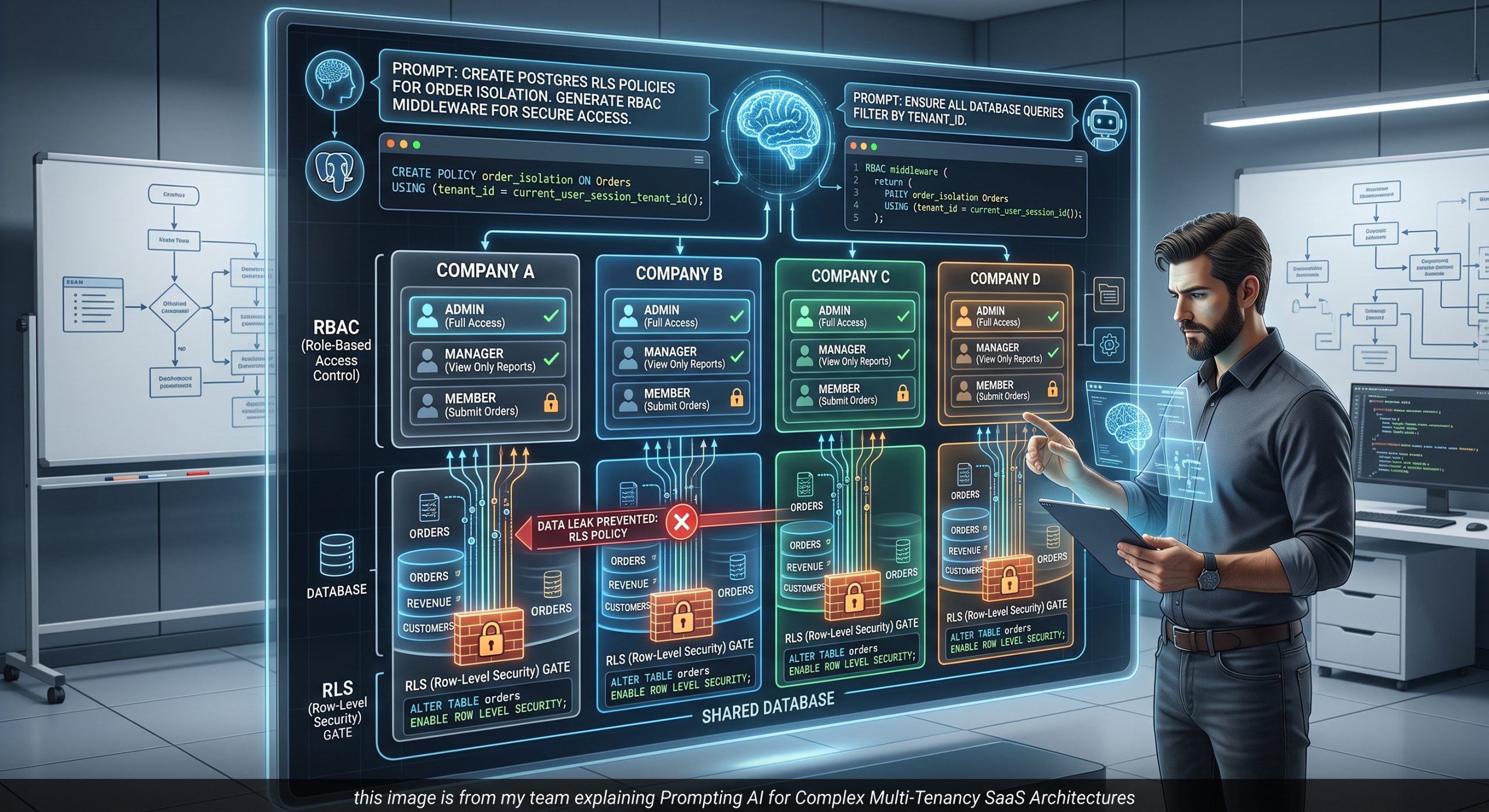
Building a single-user app with an AI coding agent is easy.
Building a B2B SaaS platform where dozens of different companies share the exact same database?
That is a completely different ballgame.
Welcome to the world of multi-tenancy.
When you vibe code a multi-tenant application, the stakes are incredibly high. If your AI makes one wrong assumption, or hallucinates a single line of backend logic, you don’t just get a bug.
You get a catastrophic data leak. Company A suddenly sees Company B’s private financial dashboards.
Game over.
If you want to build enterprise-grade SaaS using AI, you cannot leave data security up to chance. You have to engineer it directly into your prompts.
Today, I am going to show you the exact step-by-step process for prompting AI to build secure, complex, multi-tenant architectures.
Let’s dive right in.
Choosing the Right Multi-Tenancy Model
Before you write a single prompt, you have a massive decision to make.
How are you going to separate the data?
When building a B2B SaaS, you generally have three ways to handle multi-tenancy:
-
Database-per-tenant: Every company gets their own isolated database. (Extremely secure, but highly expensive and hard to scale).
-
Schema-per-tenant: Everyone shares a database, but each company gets their own schema. (A solid middle ground).
-
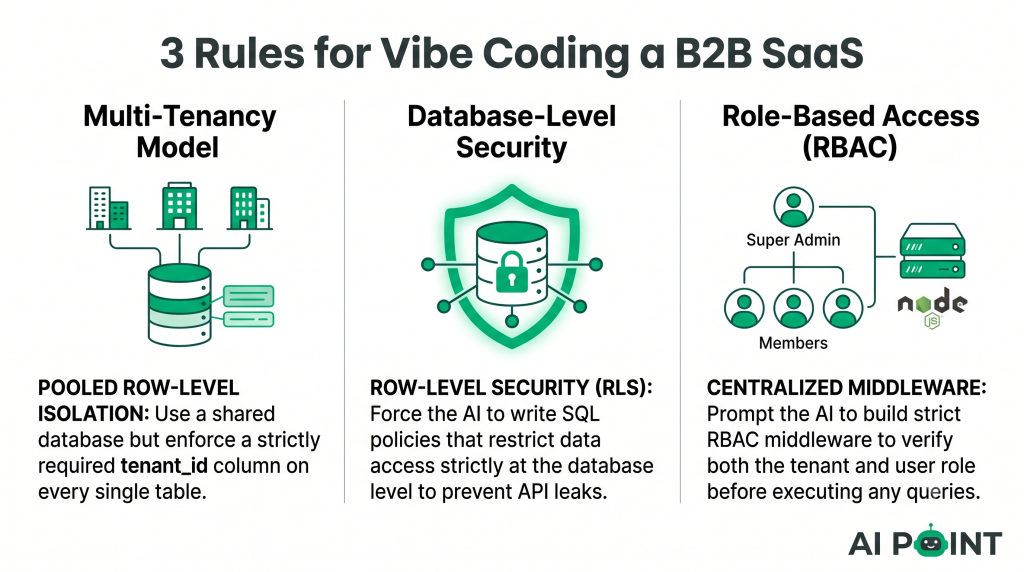
Row-Level Isolation (Pooled): Everyone shares the exact same database and tables, but every single row has a
tenant_idcolumn.
For 90% of AI-built SaaS apps, you are going to use Row-Level Isolation. It is fast, scalable, and cost-effective.
But here is the catch.
AI agents are terrible at remembering to append that tenant_id to every single query. If it forgets just once, you leak data.
You cannot let the AI guess your architecture. You have to explain your exact multi-tenancy model in plain English before it touches your database.
Here is how you frame it:
“We are building a multi-tenant B2B SaaS application. We are using a Pooled Row-Level Isolation model in PostgreSQL. This means EVERY single table (except the core Tenants table) must include a
tenant_idforeign key. No exceptions. Do not generate any database migrations until you have verified thattenant_idis present on all relational data.”
When you set this boundary immediately, the AI understands the rules of the game.
The “Master Prompt” for Data Security
So, your database is structured correctly.
Now, how do you guarantee the AI doesn’t accidentally query the wrong data when writing your backend logic?
You use a Master Prompt.
Because, just as we outlined in our guide on architecting complex, production-ready platforms, establishing your security boundaries in a master prompt prevents the AI from making catastrophic assumptions later on.
You need to force the AI to implement security at the lowest possible level: The database itself.
Do not rely on your Node.js or Python application code to filter the data. If a junior developer (or your AI agent) writes a bad API endpoint, the data leaks.
Instead, prompt the AI to use Row-Level Security (RLS) directly in SQL.
Here is the exact Master Prompt to lock down your data:
*”Configure Row-Level Security (RLS) policies in PostgreSQL for this multi-tenant architecture.
Write the SQL scripts to enable RLS on the
OrdersandCustomerstables.Create a policy that strictly ensures a user can ONLY
SELECT,INSERT,UPDATE, orDELETErows where thetenant_idexactly matches thetenant_idof the currently authenticated user session.Provide the middleware logic in Node.js (using Express) that injects the current user’s
tenant_idinto the database context before executing any query.”*
Crazy, right?
You aren’t just asking the AI to “build a secure app.” You are giving it the exact architectural blueprint to lock down the database rows.
By pushing the security logic down to the database level via RLS, you create a fail-safe.
Even if the AI later hallucinates an API endpoint like SELECT * FROM Orders; without a WHERE clause, the database will intercept the query and only return the orders belonging to that specific tenant.
This one prompt is the difference between a toy app and enterprise-grade software.
Role-Based Access Control (RBAC) within Organizations
Now that your tenants are completely isolated from each other, you have a new problem.
What happens inside the tenant?
In a true B2B SaaS, not all users are created equal. You have a nested hierarchy.
-
Super Admin: Can manage billing and delete the workspace.
-
Organization Admin: Can invite users and change settings.
-
Member: Can only view dashboards and edit personal data.
Vibe coding this level of Role-Based Access Control (RBAC) is incredibly tricky. The AI has to check two things simultaneously: Does this user belong to the correct company (tenant_id)? AND do they have the right permission (role)?
To solve this, you need to prompt the AI to build robust middleware.
Do not let the AI scatter permission checks randomly throughout your controllers.
Use this prompt to centralize your logic:
*”Write an RBAC middleware function in Node.js. The middleware should extract the user’s JWT payload to verify both their
tenant_idand theirrole. Create a strict guard function calledrequireRole.Example usage: If an endpoint is wrapped in
requireRole(['SuperAdmin', 'OrgAdmin']), the middleware must reject ‘Members’ with a 403 Forbidden error before the database is ever queried. Output the middleware code and one example of applying it to a protected route.”*
By forcing the AI to centralize the logic into a reusable middleware function, you keep your codebase perfectly clean.
Every time you prompt the AI to build a new feature, you simply remind it: “Wrap this new route in the requireRole middleware.”
Conclusion
Here is the bottom line.
AI coding agents do not understand “enterprise security” by default.
They are designed to write the fastest, simplest code possible to make the application run. It is completely up to you to explicitly engineer security, isolation, and access controls into your prompts.
When building a multi-tenant SaaS, always define your isolation model first. Force the AI to use Row-Level Security at the database level to create a fail-safe. And use centralized middleware to handle complex user roles.
Never skip the architectural planning phase. Audit every single database query your AI generates.
Master these prompts, and you can vibe code secure, B2B SaaS platforms that are ready for the real world.
