

Let’s be honest about how most marketers use data today.
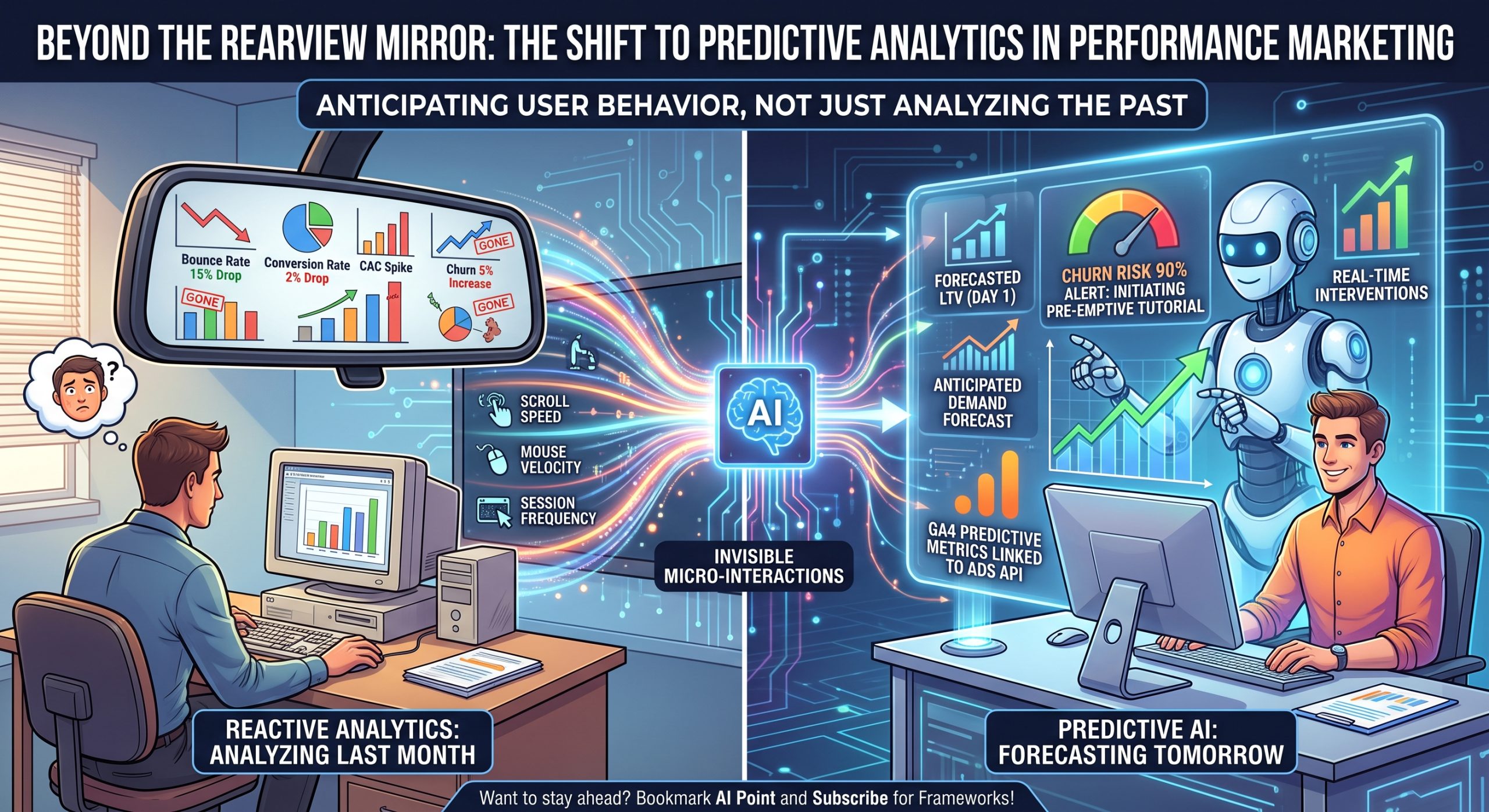
You launch a campaign. You wait 30 days. You log into Google Analytics or Mixpanel. You pull up a colorful dashboard, and you spend hours analyzing last month’s traffic.
You look at your bounce rate. You look at your conversion rate. You look at your Customer Acquisition Cost (CAC).
But there is a massive, fatal flaw in this approach.
It is exactly like driving a Ferrari on the highway while staring exclusively into the rearview mirror.
By the time you see a 15% drop in conversions on your dashboard… the revenue is already gone. By the time you notice a spike in churn… those customers have already cancelled.
Traditional analytics are 100% reactive. They only tell you what happened yesterday.
But in 2026, there is a better way.
Predictive AI flips this traditional model upside down. Instead of analyzing the past, machine learning models analyze invisible, real-time behavioral cues to tell you exactly what will happen tomorrow.
And more importantly, it allows you to intervene before it does.
Here is exactly how the smartest growth teams are using predictive analytics to dominate performance marketing.
From Historical Data to Predictive Modeling
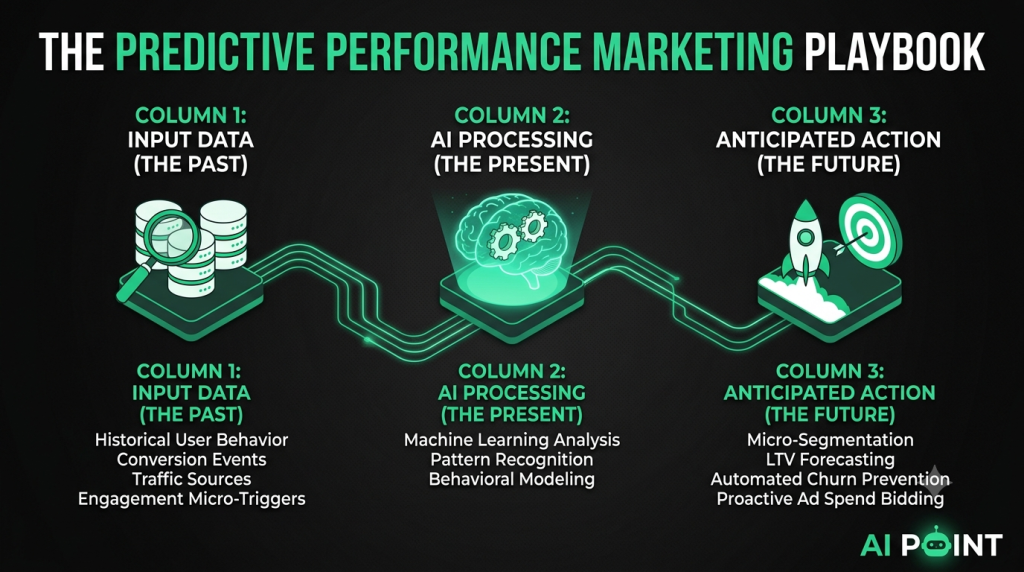
To understand why predictive analytics is so powerful, you have to understand how AI processes data compared to a human.
When a single user lands on your website, they generate thousands of micro-interactions in a matter of seconds.
We are talking about granular data points. Scroll speed. Mouse velocity. Cursor hesitation. Session frequency. Dwell time on specific pricing tiers versus feature pages.
A human brain simply cannot process this volume of data. A human looks at “Pageviews.”
But an AI model? It thrives on this granular data. It processes it in real-time.
The AI maps these current micro-behaviors against millions of historical data points from past users to predict this specific user’s exact next move.
We are officially moving the industry away from “capturing demand” and moving toward “anticipating demand.”
This transition from reactive reporting to proactive forecasting is a massive part of how artificial intelligence is redefining digital marketing and SEO, allowing brands to act on intent before the user even realizes they are ready to buy.
Forecasting Customer Lifetime Value (LTV) on Day One
Here is a scenario every performance marketer hates.
You launch a new Google Ads campaign. You get 100 new signups. The CAC looks great.
But are these actually good customers?
In the past, figuring out Customer Lifetime Value (LTV) was a massive waiting game. You acquired a user, tracked them for 6 to 12 months, and just hoped they stuck around long enough to be profitable.
You were flying blind.
Predictive AI changes the game entirely.
Today, machine learning models can analyze a user’s very first interaction with your brand and predict their ultimate value instantly.
The AI looks at their device type. It looks at their referral source. It looks at their geographic location, their IP firmographics, and their initial click sequence on your homepage.
Within milliseconds, the algorithm assigns a predicted LTV to that specific user.
The Execution Strategy:
How do you actually use this? You link your predictive LTV data directly to your ad platforms via API.
If the AI predicts a new visitor is a high-value enterprise prospect based on their initial behavior, you tell Google Ads to bid aggressively to acquire them.
If the AI predicts they are a low-value “tire-kicker” who will likely churn in 30 days? You instantly throttle your ad spend for that user.
You stop wasting budget on bad leads, and you double down heavily on your future best customers.
Pre-emptive Churn Prevention
Churn is the silent killer of SaaS, subscription, and e-commerce businesses.
And let’s face the hard truth: those automated “We miss you! Come back for 10% off!” emails sent after a user cancels?
They rarely work.
By the time a user navigates to your settings page and hits the cancel button, they have already made their emotional decision to leave. You are too late.
The AI Upgrade:
Predictive models flag users with a 90% probability of churning before they even look for the cancel button.
The AI acts as an invisible watchdog. It notices subtle behavioral drops that a human would miss.
Maybe the user logged in 10% less this week. Maybe they ignored a core feature they used to use daily. Maybe their average session duration dropped by 45 seconds.
The AI detects this friction in real-time.
(Note: Add your link in the sentence below!)
When you pair this predictive data with a dynamic system that is using AI to optimize user acquisition funnels and conversion rates, you can trigger highly personalized retention offers the exact moment frustration is detected.
If the AI senses a high churn risk, it can instantly surface an in-app tutorial, offer a free 1-on-1 coaching call, or automatically downgrade them to a cheaper plan so you don’t lose the account entirely.
You save the customer before they ever decide to leave.
Actionable Steps to Implement Predictive AI Today
You might be reading this and thinking, “This sounds incredible, but I don’t have a massive budget or an in-house team of Python data scientists.”
Here is the best news of 2026.
You don’t need one.
The tech stack for predictive analytics has been completely democratized. Platforms like Pecan AI, Mixpanel, and even Google Analytics 4 (GA4) now have predictive machine learning models built right into their core software.
You can start using this today.
Your 3-Step Action Plan:
- Step 1: Activate GA4 Predictive Metrics. Go into your Google Analytics 4 property. Ensure you have enough purchase/conversion data (usually 1,000 positive events in 28 days). Navigate to the “Audiences” builder, and select the “Predictive” tab.
- Step 2: Build the “Likely Purchaser” Audience. Select the pre-built audience for “Users likely to purchase in the next 7 days.” Google’s AI will automatically populate this list based on behavioral signals.
- Step 3: Link and Retarget. Link this specific GA4 predictive audience to your Google Ads account. Allocate a small test budget to a retargeting campaign that only shows ads to this AI-selected group.
Monitor the results. You will likely see your Return on Ad Spend (ROAS) completely skyrocket compared to your standard retargeting lists.
Conclusion
Looking backwards is a massive waste of your marketing team’s time.
If you are only reacting to historical data, you will always be one step behind your competitors.
The future of performance marketing belongs to the brands that act on the future, not the past.
Now I want to hear from you.
Are you currently using predictive audiences in your ad campaigns, or are you still relying on traditional historical retargeting?
Let me know in the comments below.
