

Let’s face it.
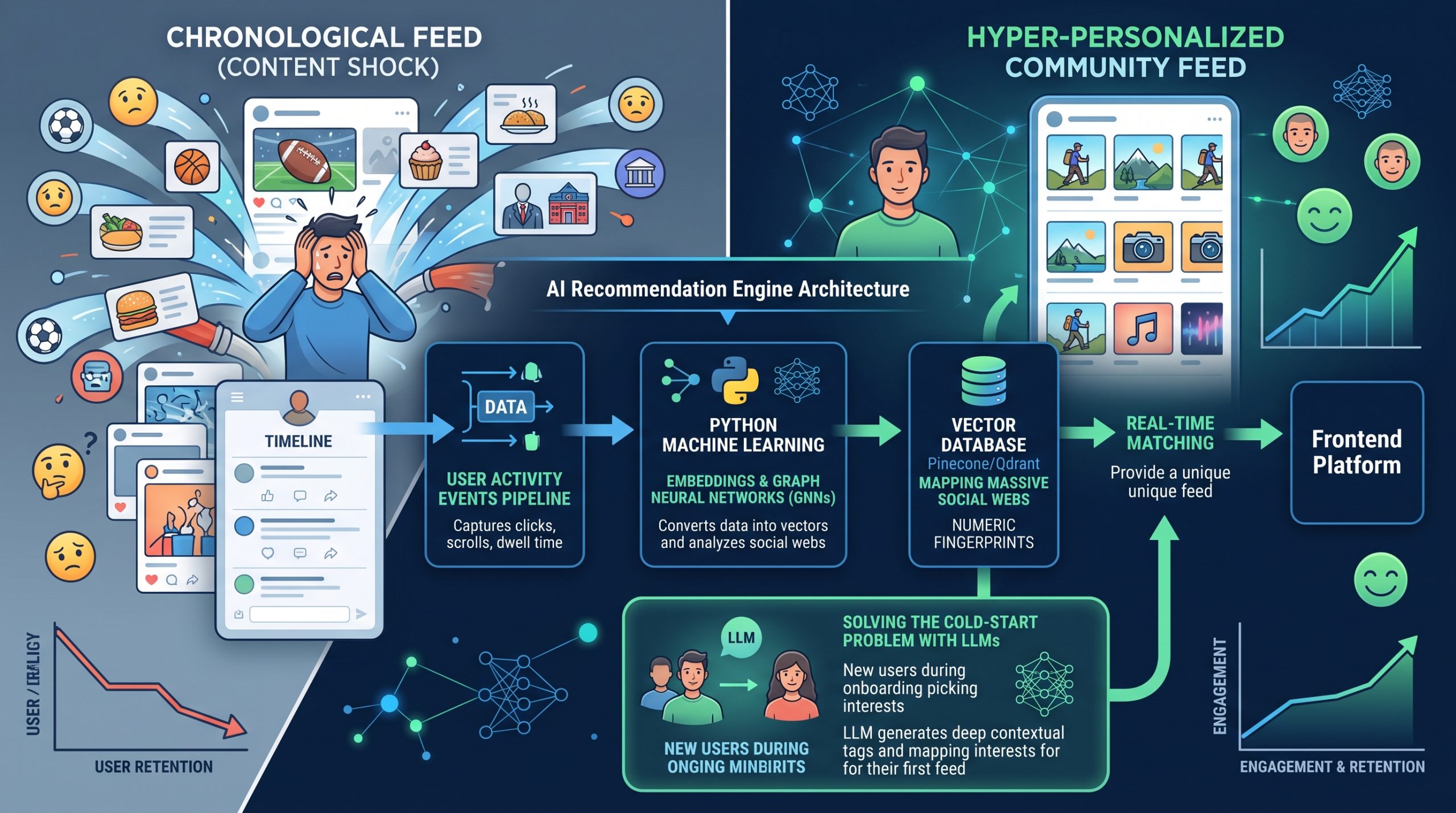
The chronological feed is officially dead.
If your community platform still relies on showing users the newest posts first, you are bleeding active users.
Why? It’s called “content shock.”
When a network scales, the sheer volume of content becomes a firehose of noise. Users log in, get overwhelmed by irrelevant posts, and bounce. They can’t find their tribe.
Engagement tanks.
The truth is, user retention today relies entirely on one thing: surfacing the exact right community discussion to the exact right user at the exact right time.
In this guide, I’m going to show you how to build the ultimate community retention tool: an AI-driven recommendation engine.
Let’s dive in.
The Evolution of Content Discovery Algorithms
Back in the day, content discovery was simple.
Platforms used something called Collaborative Filtering. You’ve probably seen it in action: “Users who liked this post also liked that post.”
It worked okay. But it had a massive ceiling.
Collaborative filtering only looks at basic, one-to-one interactions. It completely misses the nuance of human connection.
Today’s modern platforms are doing something completely different.
They are using Graph Neural Networks (GNNs).
GNNs don’t just look at isolated clicks. They map massive, complex social webs. They analyze shared interests, multi-modal interactions (like watching a video vs. typing a comment), and hidden relationships between entirely different sub-communities.
It is the difference between guessing what a user might click, and deeply understanding their social graph.
To truly scale community engagement and stop users from churning, developers must look beyond simple tagging and embrace the full potential of AI for social networks.
Architectural Blueprint of a Modern Recommendation Engine
So, how do you actually build one of these engines?
Let’s pop the hood and look at the backend architecture.
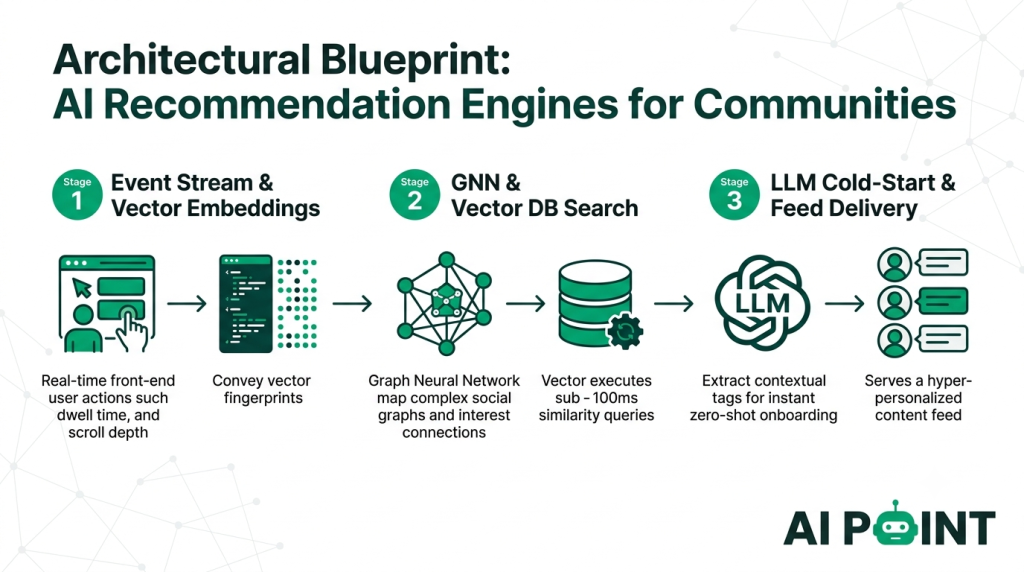
It all starts with data flow. Your front-end application needs to capture every single user event. We’re not just talking about “likes.” We’re talking about scroll depth, dwell time, and click-through rates.
Typically, developers use a JavaScript or Node.js pipeline to scoop up these real-time events.
But that data needs somewhere to go.
That’s where your Python-based machine learning pipeline takes over. Python processes this raw event data and translates it into mathematical vectors, or “embeddings.”
Think of an embedding as a numeric fingerprint of a user’s exact preferences at that specific moment.
Now, you need a place to store millions of these fingerprints so your app can retrieve them instantly. Traditional SQL databases will crash trying to do this at scale.
Enter the vector database.
Tools like Pinecone, Qdrant, or Milvus are custom-built for this exact job.
When a user refreshes their feed, your app pings the vector database. The database instantly compares the user’s “preference fingerprint” against the fingerprints of millions of fresh community posts.
It finds the perfect match and serves it to the front end.
All in under 100 milliseconds.
That is the blueprint for a hyper-personalized, sticky community feed.
Solving the “Cold-Start” Problem with Large Language Models
But here is the million-dollar question:
How do you recommend content to a brand-new user who has zero interaction history on your platform?
In the machine learning world, this is called the “Cold-Start” problem.
If a new user’s first feed is empty or filled with generic garbage, they will delete your app immediately. You have about three seconds to hook them.
This is where Large Language Models (LLMs) come to the rescue.
Instead of waiting for a user to click on 50 posts to learn what they like, modern platforms use LLMs to deeply analyze the content itself.
When a user publishes a new post in your community, you pass that text through an LLM. The AI automatically extracts deep contextual tags—identifying the exact sentiment, the niche topic, and the underlying emotion of the post.
Next, you use something called zero-shot classification.
When your new user signs up, you ask them to pick three broad interests during onboarding. Your AI then instantly maps those broad interests to the hyper-specific, LLM-generated tags on your community’s newest posts.
Boom.
The user gets a highly relevant, deeply engaging feed on their very first login. No clicking required.
Conclusion
Let’s recap.
Chronological feeds are a thing of the past. If you want to survive the era of content shock, recommendation engines are the absolute lifeblood of community retention.
By upgrading from basic collaborative filtering to modern Graph Neural Networks and vector databases, you can deliver a feed that feels like magic.
And by leveraging LLMs, you completely eliminate the cold-start problem, turning new sign-ups into long-term active users.
Now, I’d love to hear from you.
How are you currently structuring the feed logic on your platform? Are you using vector databases yet?
Let me know by leaving a quick comment below right now.
