

In 2023, software engineering was largely a manual, tedious grind.
Fast forward to 2026, and the landscape has completely flipped.
According to recent industry data, over 65% of enterprise engineering teams have officially transitioned from traditional coding practices to entirely agent-driven workflows. The days of hand-typing every single line of boilerplate code are completely dead. Today, it is all about intelligent orchestration. We have officially entered the era of the autonomous AI coding agent, and it is transforming everything.
This isn’t just a minor productivity bump. It is a massive paradigm shift. If your engineering team is still relying on basic, old-school autocomplete tools, you are already falling dangerously behind the curve.
So, what exactly is an autonomous AI coding agent?
It is absolutely not your grandfather’s GitHub Copilot. Early predictive text models simply guessed your next line of code based on immediate context. Modern autonomous agents have actual agency. They read your entire multi-file codebase, plan system architecture, execute terminal commands, run testing suites, and—most importantly—they self-correct when they hit an error. They do not just suggest code; they take action.
In this guide, I am going to break down exactly how this entire ecosystem works right now.
You are going to discover the three distinct tiers of AI developer tools currently dominating the market. I will show you exactly how to implement them, the hidden security protocols you absolutely must follow, and the exact integration strategies to 10x your team’s output. Let’s dive right in.
The Evolution from Copilots to Autonomous Agents
Let’s take a quick trip down memory lane.
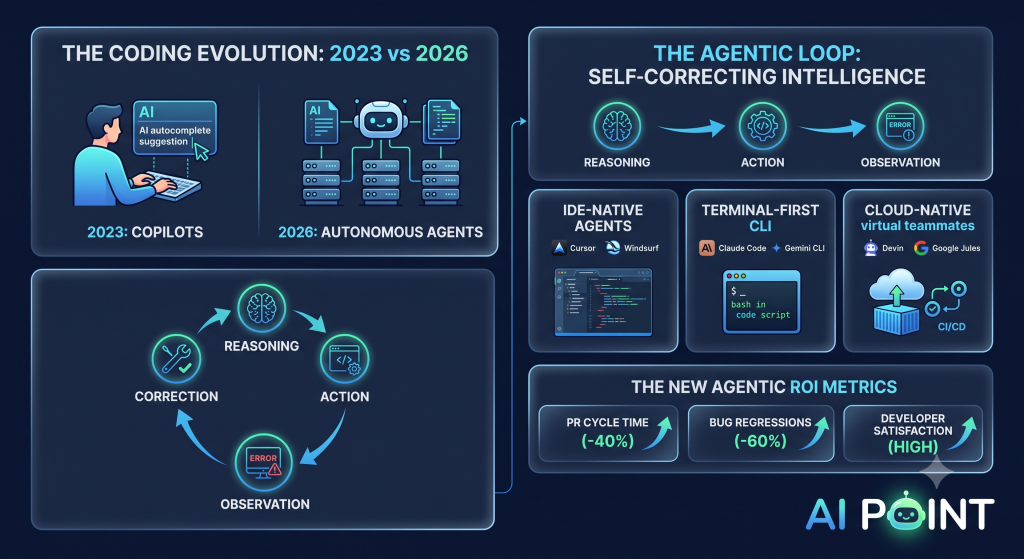
Just a few short years ago, integrating AI in coding meant dealing with basic LLM wrappers. You typed a comment, hit the tab key, and prayed the resulting code actually compiled. It was, for all intents and purposes, glorified autocomplete.
Then came context-aware copilots. These AI developer tools could read the active file you were currently working on and provide better suggestions.
Helpful? Absolutely.
Revolutionary? Not quite.
The real leap happened when developers collectively realized that simply generating code wasn’t enough. We needed intelligent systems that could actively verify that code. That core realization birthed today’s modern agentic frameworks. Now, we are no longer just prompting an AI for a specific function. We are prompting it for a final outcome. The AI handles the entire messy middle layer of implementation.
The secret sauce behind this incredible leap?
It’s called the Agentic Loop.
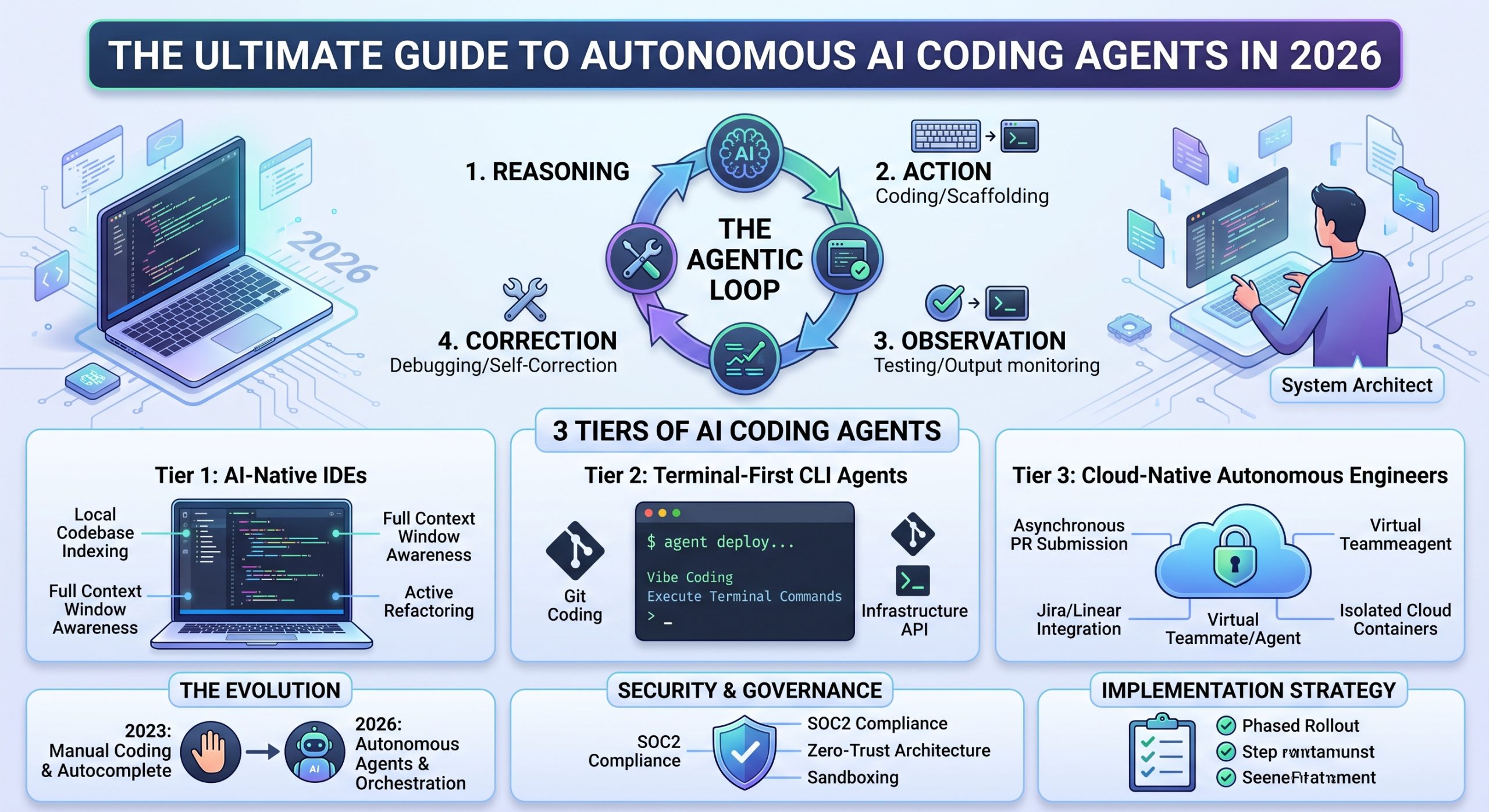
Here is exactly how it works in plain English. Older, legacy models used a simple linear process: you give it a prompt, and it gives you an output. Modern automated coding assistants use a cyclical, continuous architecture based on Reasoning, Action, Observation, and Correction.
First, the agent reasons through your complex request. Next, it takes action by actively writing the code. Then—and this is the absolute game-changer—it observes the output. If it runs the code and immediately gets a terminal error, it does not just stop and wait for a human. It reads the error log, realizes its mistake, and self-corrects on the fly. It loops through this entire process over and over again until the test passes.
What does this mean for you?
It completely changes your daily life as a software developer. You are no longer acting as a glorified “code typist.” You are now a system architect and a strategic reviewer. Instead of wasting hours writing boilerplate, your time is spent designing highly scalable architectures and reviewing agent-generated pull requests. It elevates your entire role, letting you focus purely on high-level logic.
The 3 Tiers of AI Coding Agents (The Core Ecosystem)
Here is the deal.
The market for best AI software engineers is incredibly noisy and confusing right now. To make sense of it all, you need to understand that the market has segmented into three distinct categories based entirely on where the agent lives and operates: the IDE, the Terminal, and the Cloud. Choosing the right tier for the exact right task is the secret to unlocking massive engineering velocity.
Tier 1: AI-Native IDEs (The Local Heavyweights)
Let’s kick things off with Tier 1: AI-native IDEs.
These are the highly advanced tools that integrate directly into your developer’s graphical workspace. They do not just bolt onto your legacy editor like an old plugin. Instead, the entire editor is built natively around the AI.
The real magic here comes down to local codebase indexing.
When you open a massive project, these local agents silently index your entire repository in the background. They map the complex relationships between hundreds of different files simultaneously.
Why does this matter so much?
Context windows.
When you ask the agent to “update the user authentication flow,” it knows exactly which database schema, which frontend React component, and which backend API route needs to change. It reads across your entire software architecture to understand the full, cohesive picture before it writes a single line of code. It operates with a localized brain that fully understands your custom types and linting rules.
So, when should you actually use an AI-native IDE?
This tier is going to be your absolute daily driver. It is perfect for the heavy lifting of active, day-to-day development. If you are building a complex new feature completely from scratch, this is exactly the tool you want in your arsenal.
It is also incredible for heavy refactoring across an active, sprawling branch. Need to migrate a massive component library? The local agent can map the changes and execute them visually. It is completely unmatched for visual debugging. You just highlight a block of failing code, open an inline chat, and have the agent fix it right before your eyes.
Right now, the market for this specific tier has consolidated incredibly fast. It essentially comes down to two major players dominating the local IDE space.
Choosing the right environment is critical. It all boils down to how these specific tools handle complex indexing and indexing speed. If your team is struggling to choose between the top contenders, read our comprehensive breakdown on Cursor vs. Windsurf: Which AI IDE Wins for Multi-File Projects?.
Tier 2: Terminal-First CLI Agents (The “Vibe Coding” Movement)
Next up, we have Tier 2: Terminal-First CLI Agents.
Welcome to the cutting edge of the “vibe coding” movement. This is where things get really interesting for power users.
Vibe coding is the massive 2026 trend of iterating rapidly through natural language directly in your command line, without ever opening a traditional, heavy graphical editor. These are strictly headless agents.
You give the AI direct, unfettered command-line access. It can seamlessly execute bash scripts, manage incredibly complex git trees, and scaffold entire backend databases—all prompted by simple, conversational English text.
It honestly feels like magic.
The agent actively reads your terminal environment, executes the commands, and seamlessly pipes the raw output right back into its reasoning engine. It completely removes the annoying friction of constantly jumping between different application windows. You just stay locked in the terminal.
Why is this specific tier exploding in popularity right now?
Because Senior, DevOps, and Platform engineers absolutely love it.
If you spend your entire day managing cloud infrastructure, you do not want a heavy, bloated GUI slowing down your machine. You want pure, unadulterated speed. CLI agents are incredibly lightweight and lightning-fast.
They are absolutely perfect for rapid infrastructure deployment, writing quick automation scripts, and daily server management tasks. Need to spin up a brand new Docker container, configure the complex networking, and seed a test database? Just type the command in plain English and let the headless agent do the rest. It keeps your hands glued to the keyboard.
Right now, there is a massive, ongoing battle for CLI supremacy.
The foundational models powering these specific terminal agents have entirely different strengths and weaknesses. Some excel heavily at deep bash scripting, while others are much better at parsing complex system logic.
For engineers who prefer the raw speed of the command line over a heavy GUI, the battle is currently between Anthropic and Google. Dive into our hands-on test of Terminal-First Vibe Coding: Claude Code vs. Gemini CLI to see exactly which agent handles bash workflows better.
Tier 3: Cloud-Native Autonomous Engineers (The Virtual Teammates)
Finally, we reach the absolute apex of this ecosystem: Tier 3.
Enter the Cloud-Native Autonomous Engineers.
These are not just helpful coding assistants; they are actual virtual teammates. They operate completely asynchronously, high up in the cloud. You do not host them locally. You do not install them in your IDE.
Instead, they dynamically spin up their own secure, isolated cloud containers. They automatically clone your repositories, authenticate securely into your systems, and immediately get to work.
The craziest part about this tier?
They can read your internal Jira or Linear tickets, fully understand the complex acceptance criteria, run your entire automated test suite, and submit perfectly formatted pull requests—entirely in the background. While your human engineering team sleeps, these cloud agents actively code.
This tier is specifically built for the modern enterprise.
It is where you achieve massive, unprecedented scale. Use cases include massive, company-wide legacy code migrations. Do you have a giant, monolithic codebase that desperately needs to be broken down into agile microservices? Assign that entire epic to a cloud agent.
They are also incredibly powerful for automated dependency updating and continuous, around-the-clock bug triaging. They constantly monitor your active issue tracker and knock out the low-hanging fruit before your human engineers even log on for their morning standup. It frees up your expensive human capital.
But here is the major catch you need to know.
While local agents assist an active developer, cloud agents act as parallel, independent contributors. Deploying a virtual teammate is a massive, high-stakes enterprise decision that requires careful consideration of your entire infrastructure.
To understand which enterprise solution is right for your infrastructure, check out our highly detailed guide on Cloud Agents Explained: When to Use Devin vs. Google Jules.
The Security & Governance Imperative
Let’s address the massive elephant in the room: Security.
Giving an autonomous AI system direct read and write access to your highly sensitive production codebase is undeniably terrifying. The threat landscape has evolved drastically in 2026. We are no longer just worried about an AI writing bad or buggy code.
We are actively worried about malicious prompt injection attacks.
A bad actor could easily hide a stealthy prompt inside an obscure open-source package that explicitly instructs your agent to exfiltrate proprietary data. There is also the massive, looming risk of automated credential leaks. If your agent is actively scraping system logs to fix a nasty bug, it might accidentally commit a live API key directly to a public repository. Add in severe supply chain vulnerabilities, and the risks multiply exponentially. You cannot blindly trust these systems.
This is exactly why CISOs and CTOs are rightfully hitting the brakes.
Before approving a single one of these tools, you have to deal directly with harsh enterprise realities. You absolutely need strict SOC2 compliance verified across the board. You need ironclad data retention policies so the AI provider isn’t secretly training their next foundation model on your company’s proprietary algorithms. Furthermore, you must aggressively implement a zero-trust architecture where the agent operates exclusively with the absolute minimum permissions necessary to complete the task.
Governance is no longer an afterthought. It is mandatory.
Giving an AI read/write access to your production codebase introduces unprecedented attack vectors that can cripple your company. Before deploying any of these tools across your engineering org, it is absolutely critical to understand The Security Risks of Autonomous Agents (And How to Sandbox Them).
How to Build an Agentic Workflow for Your Team
Ready to actually implement this?
Stop right there. Do not just roll these tools out all at once. You need a highly practical, phase-based implementation plan to ensure success.
Here is the exact step-by-step rollout I recommend.
- Step 1: Start exclusively with Tier 1 (AI-Native IDEs). Make it strictly opt-in for individual productivity. Let your early adopters naturally champion the tool within the company.
- Step 2: Introduce Tier 2 (CLI tools). Roll this out specifically to your elite DevOps and backend teams for targeted scripting tasks. Let them get comfortable with headless autonomy.
- Step 3: Graduate to Tier 3 (Cloud Agents). Once your entire team genuinely trusts the AI output, pilot a cloud agent for a low-risk legacy migration or routine bug squashing.
But how do you actually know if it is working?
Engineering managers need to fundamentally shift how they measure ROI. Throw out the metric of “lines of code written.” That metric is officially dead.
Instead, focus entirely on velocity and code quality. Track your exact PR cycle time. Is code getting reviewed and merged noticeably faster? Measure the tangible reduction in bug regression. Are there fewer production rollbacks? Finally, closely track developer satisfaction scores. If your team is happier, less burnt out, and shipping faster, the ROI is undeniably there.
Conclusion & The Future of Software Engineering
Let’s wrap this up.
The core thesis of 2026 is simple: autonomous AI coding agents are absolutely not here to replace human engineers. They are here to fundamentally elevate them. We are rapidly moving from a slow world of manual code typists to a high-speed world of brilliant orchestrators and strategic system designers.
Embrace the shift today, or get left completely behind by your competitors.
Want more cutting-edge insights like this? Subscribe to our weekly newsletter for ongoing, actionable updates in the AI tooling space, or contact our team for enterprise integration consulting.
